
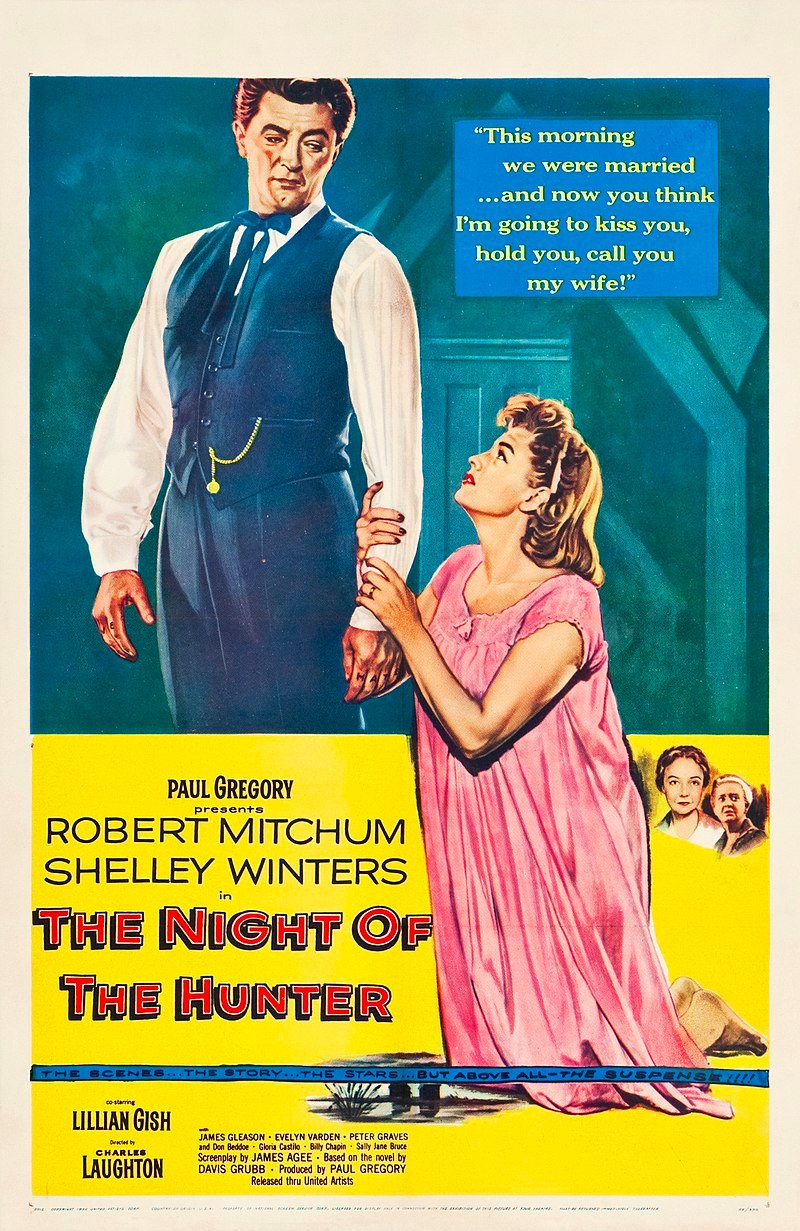
The Night of the Hunter
USA, 1955
Director: Charles Laughton
Screenplay: James Agee (based on the novel by Davis Grubb)
Genre: Thriller/Drama
Soundtrack: Walter Schumann
Main Cast:
Robert Mitchum (Harry Powell)
Shelley Winters (Willa Harper)
Lillian Gish (Rachel Cooper)
Billy Chapin (John Harper)
Sally Jane Bruce (Pearl Harper)
James Gleason (Uncle Birdie Steptoe)
Plot
Reverend Harry, accused of stealing a car, meets Ben in prison, who has been sentenced to death for killing two people during a robbery. The loot was never found, as Ben had time to hide it. His children, little John and Pearl, are the only ones who know where the money is.
Harry is released from prison after Ben’s execution and suspects that the family knows where he hid the money. So, the charismatic preacher heads to the town where the family lives and, through his sermons and songs, wins the affection of the neighbors, the widow Willa, and little Pearl. He soon marries the deceased man’s wife. But John is aware of his stepfather’s true intentions…
Comment
In this psychological thriller, structured like a fable and a fairy tale, religious symbolism, metaphysical elements, and contrasts between the characters abound: Perhaps the most important of these contrasts is the innocence and authenticity of childhood set against the hypocrisy of the false prophets, the “whitewashed tombs,” those who pose as saints while in reality being worse than demons.
Reverend Harry is one of those false prophets, a murderous psychopath (as well as a greedy one) who dons the mask of a spiritual guide and guardian of moral rectitude, but who is unscrupulous and whose true intentions are nefarious. He is a wolf in sheep’s clothing, who first infiltrates a community and then even a family, in order to use its members and get his hands on a large sum of money.
That money, as we see in one of the opening scenes, Ben stole to prevent his children from going hungry during a crisis like the one that had unfolded during the Great Depression. And he held the people he killed during his robbery responsible for that crisis. That is the initial motivation behind the event which, linked later to the appearance of Reverend Harry, will give rise to the entire story told in the film.
Harry not only engages in infiltration, but also in blurring the lines between good and evil, using mind-control techniques and instilling a guilt complex to better manipulate others: within the community (e.g., Mrs. Spoon), the widow Willa, little Pearl, and later the teenager Ruby. He has almost everyone wrapped around his finger… With the exception of John, a boy quite mature for his age, loyal to his real father; and Mrs. Cooper, a woman who is Harry’s polar opposite: She wears a mask of severity and toughness that can make her seem unfriendly, but in reality she is a wonderful person.
It is suggested that although Harry and Mrs. Cooper are polar opposites, they could also be interpreted as two sides of the same coin, as both draw on biblical imagery (he as a reverend, she with her stories of the baby Jesus and the baby Moses…). The scene where this comes out most clearly is when Harry stalks her house and she stands guard on the porch with her shotgun: He wants to take the children, and she wants to protect them… but they both end up singing the same tune!
These polar opposites, as well as the reversal of good and evil, are reflected in the words tattooed on Harry’s knuckles: “love” on one fist and “hate” on the other. In one hand he has “love” and in the other “hate”—but both hands belong to the same person, controlled by the same mind… At a somewhat superficial glance, this could be interpreted as “extremes meet.” But perhaps it could also be an allusion to the dialectic of false opposites.
And by the way, in the Bible (which carries great symbolic weight in the film), there is also a stark contrast between the punishing God of the Old Testament and the loving, forgiving God of the New Testament. Harry explicitly mentions Jehovah in one of his confrontations with Mrs. Cooper.
As for the story of Moses, Mrs. Cooper reminds us that he was found as a baby in the river by a princess who saved and raised him (she sees herself in that role, caring for orphaned or lost children).
Robert Mitchum, as Reverend Harry, plays a psychopathic role very similar to the one he portrayed in “Cape Fear” (J. Lee Thompson, 1962), another great psychological thriller set in the Deep South. The children’s trauma is evident; Pearl seems to suffer from a kind of Stockholm syndrome toward Harry—or perhaps it’s a “love-hate” dynamic (which is literally what Harry has written on his knuckles!). As for John, the scene where Harry’s arrest triggers a “déjà vu” in the boy—linking back to what happened to his father at the beginning—is significant.
It seems this is the first film to feature the “love-hate” lettering tattoos on the knuckles; something that would seep into the collective unconscious and eventually become an iconic detail of popular culture (typical of convicts, gang members, etc.).
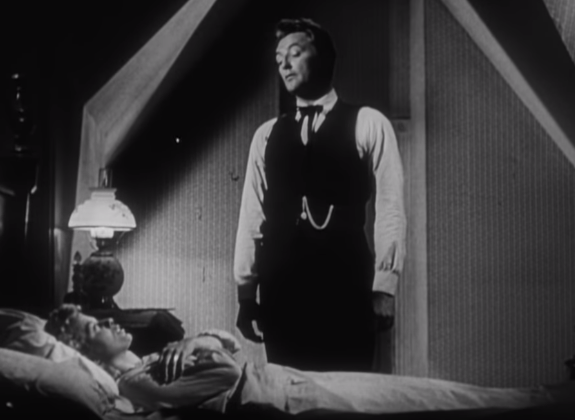
Just as in the original “Cape Fear,” this film features a highly expressionistic use of light and shadow—which helps highlight the contrasts that, as we’ve seen, are of vital importance to the story. Furthermore, a macabre fairy-tale style prevails, seasoned with dreamlike touches—both visually and narratively.
As for the locals, who had been captivated by the reverend’s charisma and his sermons, they end up wanting to lynch him. This shows us just how volatile and fickle the masses are, as Gustave Le Bon once noted…
The reverend proves seductive to the masses and also to women (of all ages, from girls to elderly women), although he does not seem to be genuinely interested in them, but only wants to use them as a tool. In this context, we are led to consider Harry’s repressed sexual drive (due to a perverted religious fanaticism), which Harry “channels” through his knife (a phallic symbol). For in addition to stealing cars (the crime that lands him in prison at the beginning of the film), he is in fact a serial killer. While the elderly Mrs. Spoon and Willa are seduced by the Reverend’s mask of “holiness,” the teenager Ruby seems more drawn to his aura of evil, which she does perceive (hibristophilia, here we go!).
The character of Uncle Birdie, the old fisherman, is also interesting. John did indeed see him as a kind of mentor or surrogate father. But Birdie proves to be a weak man, a victim of his own traumas (the premature death of his wife), his cowardice, and his alcoholism. This is frustrating for John, who from that point on has no choice but to grow up prematurely, taking responsibility for himself and his sister.
And within that rapid development, that maturation imposed by circumstances, we can place the symbolism of the clock, which John receives as a gift from Mrs. Cooper—the only person besides him who recognized from very early on the true nature of that “false prophet,” that wolf in sheep’s clothing…
Felix Hahlbrock Ponce
(Get my books HERE)