
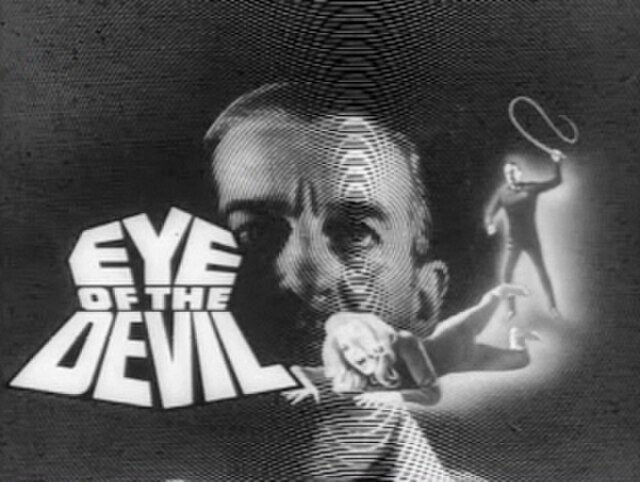
The Eye of the Devil
UK, 1966
Director: J. Lee Thompson
Screenplay: John Collier, Robin Estridge (based on the novel “Day of the Arrow” by Philip Loraine)
Genre: Horror
Soundtrack composer: Gary McFarland
Main cast:
Deborah Kerr (Catherine de Montfaucon)
David Niven (Philippe de Montfaucon)
Donald Pleasence (Father Dominic)
Sharon Tate (Odile de Caray)
David Hemmings (Christian de Caray)
Flora Robson (Countess Estelle)
Plot
During a celebration in Paris, Marquis Philippe de Montfacon receives a visit from an emissary bearing bad news. The next day, the marquis departs for his estate in the countryside. He explains to his wife Catherine that he must attend to a matter concerning the vineyards. But in reality, it involves other, more urgent and profound reasons that she would not understand…
The marquis’s aunt lives at Bellenac Castle, and nearby reside two mysterious young people, the siblings Christian and Odile. Both are adepts of the magical arts.
Sensing that something is wrong with her husband, the marquise also heads to the estate, taking her children—little Jacques and Antoinette—with her. One night at the castle, Catherine witnesses a sinister ceremony, with a large number of hooded figures dressed in robes gathered in a grand hall…

Commentary
Psychological horror and the paranormal intertwine in this film from the “folk-horror” subgenre, featuring occult themes and a distinctively gothic atmosphere.
The rapid editing in the dreamlike and trance-like scenes (such as the opening sequence) is striking. Director J. Lee Thompson had filmed the highly recommended “Cape Fear” (1962) a few years earlier, which also features a terrorized family—though on that occasion for external reasons.
The marquis, much to his regret, belongs to a lineage that carries certain “responsibilities.” His family is bound by ancestral customs, with a generational chain of pacts and sacrifices that have persisted for centuries. He therefore has contracts and obligations to entities—and those entities to which he and his ancestors have “mortgaged” themselves are not banks, but others that lie “beyond”…
The motto on their family coat of arms, pierced by an arrow like those shot by the archer Christian, reads: “God gives everything.” The question is, which “God”? The same one who gives also takes away… And the castle’s priest, Father Dominique—which God does he actually serve? Behind what appears to be an ordinary mass lies a ritual with a meaning that is not what it seems at first glance.
It is not entirely clear who the mysterious siblings Christian and Odile really are. But, as Father Dominique says, “Understanding is not always necessary, and sometimes it is even impossible.”
The fact that the young man is named “Christian” could refer to the locals using Christianity as a mask, presenting themselves as Christians to hide the true nature of their cult. And “Odile,” the girl’s name, strongly evokes “Odal”: a rune that, quite appropriately for this particular case, symbolizes family and the sense of heritage and ownership.
In Eucharistic symbolism, wine represents the blood (of Christ). Here we see that the marquis (equated by his cult to a divine figure who must be sacrificed, like Christ) is the owner of vineyards. His blood must be shed so that the “harvest” may be good; this is stipulated in his family’s contracts. And he, like his ancestors and his successors, faces a dilemma: Can his sacrifice also be a personal choice, or is it part of inescapable predestination, of the inertia of blood?
The marquise, who is not in the know, meddles in matters she cannot understand. Meanwhile, her children, the young siblings Jacques and Antoinette (who are captivated by magic and susceptible to hypnotic states), could become Christian and Odile’s successors. Catherine, once she discovers the cult’s horrific nature, wants to alert the police… but (oh, surprise!) the local inspector is also “in on it.”
Christian and Odile, for their part, are followers of the occult sect; they know how to exercise mind control and play an important role in performing the rituals. Odile is played by Sharon Tate, who would herself become the victim of a ritual sacrifice—the boundaries between cinematic fiction and reality blur once again; and in this case, in an extremely macabre way…
Sometimes movies become reality… or paintings as well: As in this film, the painting of the 12 hooded figures “dancing” around their victim, an image that catches Catherine’s eye in a portrait of Philippe’s grandfather, her predecessor in the marquisate.
Marquis Philippe belongs to a dynasty that must “renew” its pacts through human sacrifices among its own members. He knows he is trapped, but resigns himself to his fate. And although he tries to keep his wife imprisoned to prevent her from interfering, he himself is the greatest prisoner…
Memorable is the detail of little Jacques running toward the priest, supposedly to retrieve his watch (and in reality to ratify his family line’s ancestral pact with the priestly caste). The watch is the symbol of time/Cronos: Metaphorically linking to the sacrifices of the protagonist dynasty, we have Cronos/Saturn, the god who devours his own children. For time consumes everything…
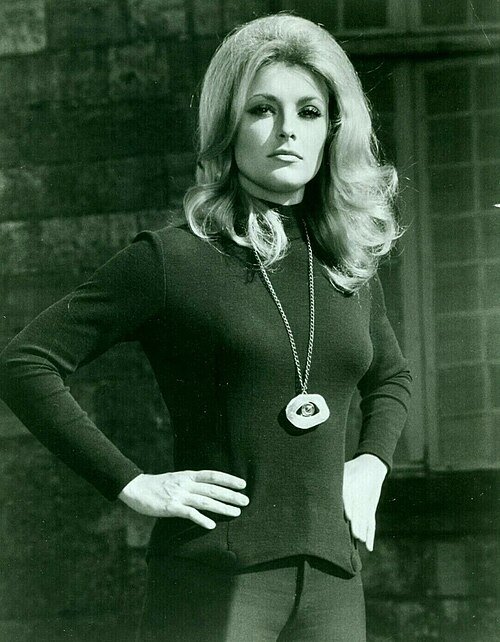
The sect’s amulet, which Odile wears as a pendant, recalls the planet Saturn, surrounded by a ring (circular time, “the eternal return”); and also an eye (“the all-seeing eye”?). The village itself also functions as a kind of collective eye, where outsiders do not go unnoticed, as they will always be under the watchful gaze of the superstitious villagers. The eye of the amulet, the one that symbolizes perpetual control and “sees all,” must be that of the demon alluded to in the film’s title.
And speaking of demons: When Catherine visits the grave in the woods, the part of the surname (“de Montfacon”) that can be read behind her in the crypt reads “de Mon…”—surely it’s just a coincidence… What do you think?
Felix Hahlbrock Ponce
(Get my books HERE)