
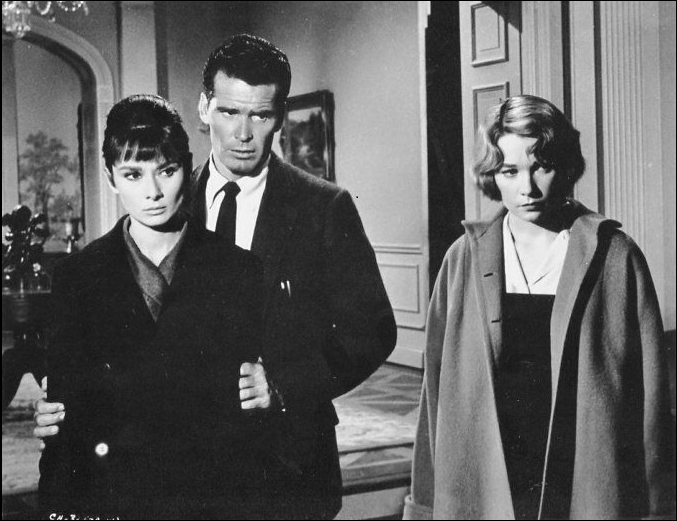
The Children’s Hour
USA, 1961
Director: William Wyler
USA, 1961
Director: William Wyler
Screenplay: John Michael Hayes (based on the play by Lillian Hellman)
Genre: Drama
Soundtrack: Alex North
Main Cast:
Audrey Hepburn (Karen Wright)
Shirley MacLaine (Martha Dobie)
James Garner (Dr. Joe Cardin)
Miriam Hopkins (Lily Mortar)
Fay Bainter (Amelia Tilford)
Karen Balkin (Mary Tilford)
Plot
Karen and Martha are two young teachers who run a boarding school for preteen girls. Lily, an aging stage actress and Martha’s aunt, helps them by teaching classes. Joe, Karen’s boyfriend, asks her to marry him. She agrees, but this does not please Martha at all, who believes that once Karen gets married, she will leave the school.
Mary, one of the girls, is aware of the entire situation because she spies on the two women.
Gossiping with her classmates, and later with her grandmother as well, certain rumors are set in motion.
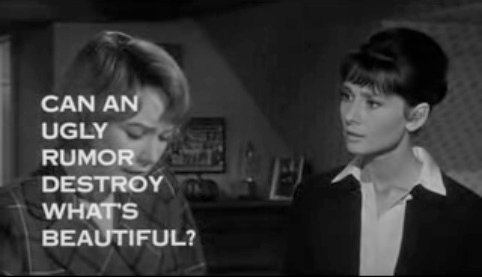
According to these rumors, the real reason for Martha’s displeasure at Karen’s upcoming wedding is jealousy… But not because both of them are in love with Joe, but because there might be something more than friendship between them…
Comment
This fascinating film is a perfect example of social engineering. It is an intense melodrama that, through effective suspense techniques and an atmosphere of intense psychological pressure, subtly erodes various aspects of family life.
It was the early 1960s, and the changing times had an impact on William Wyler’s films. While in his “Desperate Hours” (1955) the family is still presented as a bastion of resistance (there, its members unite against criminals who have taken them hostage), in “The Children’s Hour,” on the contrary, the family is broken down and mistrust reigns; it is shown to us as an outdated institution and even one with destructive potential: We have the selfish aunt, who could have testified to put an end to the rumors but did not, because she valued her acting career more; we have the grandmother who not only gives credence to the gossip but spreads it. The grandmother is an archetype of the traditional woman, the matriarch of the family, the one who should ensure harmony. But here, influenced by her granddaughter and by circumstances, she acts in the opposite way. And the aunt, a surrogate maternal figure, behaves irresponsibly and toxically. Joe, for his part, initially wants to start his own family with Karen, but he has family ties that weigh down that relationship; for he is the nephew of the slanderous grandmother and the cousin of the “demonic” girl. And here we have another peculiar detail: In the film, childlike innocence is overshadowed by Mary’s twisted cruelty and the psychological terror she unleashes. Suspicion begins to take hold among relatives and couples; the older and younger generations eye each other warily, and men and women drift apart. Insurmountable rifts emerge between the generations and between the sexes. It’s “everyone against everyone”; no one knows what’s true or who to believe anymore.
In addition to eroding the family itself, authority figures are under attack: teachers are a symbol of that authority, of education, of culture. And in the film we see that their credibility is shattered (not because of the classes they teach, but directly because of who they are as people; and by extension as authority figures)—perhaps a “taste” of what the Cultural Revolution would become a few years later? (which had its most brutal version in China, but also took hold in the West, with May ’68 and the like)
As the title itself suggests, one of the film’s aims also seems to be to discredit those who try to protect children from corrupting influences. This is the motivation behind the grandmother, who, although acting in good faith, judges others harshly and is mistaken (since she has believed Mary’s lie). Thus, these protective intentions are portrayed as a “pretext” of “old-fashioned sticklers” and as the prejudices of “backward homophobes” (prejudices that, moreover, in the case of the feature film, are dangerous because they have existential consequences for the protagonists).
In the case of Karen and Martha, everything is very innocent; there is nothing on their part to reproach. The objective facts are innocent, but NOT what is constructed from them. The sexualization present in today’s educational system (such as drag queens in schools, etc.) was something absolutely unthinkable in 1961, when the film was released. However, to reach today’s extremes, it was first necessary to familiarize the public with trends that would later begin to proliferate in the mainstream. In this way, the seeds are planted in the viewer’s mind so that the Overton window of what is “tolerable” gradually widens, in a slow process of social engineering spanning generations.
The guilt complex that develops in several of the characters involved plays a significant role in the story, contributing to the tense and oppressive atmosphere (extremely well executed) that intensifies as the plot unfolds and ultimately draws the viewer in.
Here, lies have a way of spreading far and wide; once they’ve been set in motion, there’s no turning back, and the consequences could reach tragic proportions.
We are shown the destructive potential of false rumors started by an “innocent” girl. But at the same time, the film plays with Martha’s ambiguity, suggesting from the beginning that perhaps she does feel something more for her friend. Is there, then, a grain of truth in those rumors? Or are they lies that become truths through suggestion, in the style of self-fulfilling prophecies?
Mary reminds one of Verónica from the highly recommended Mexican film “Veneno para las hadas” (Carlos Enrique Taboada, 1984). She is a troubled girl, a compulsive liar, and a schemer. In her case, innocence is conspicuously absent. She uses blackmail to enslave a weaker girl, and against adults she employs subterfuge, pitting them against one another to her advantage.
The film is faithfully based on a 1934 play written by Lillian Hellman, who held communist views—which is not surprising, given the details mentioned earlier. The screenplay adaptation was handled by John Michael Hayes, who collaborated with Hitchcock on several occasions (including “Rear Window”). Perhaps that is why the suspense is so effective.
Felix Hahlbrock Ponce
(Get my books HERE)