
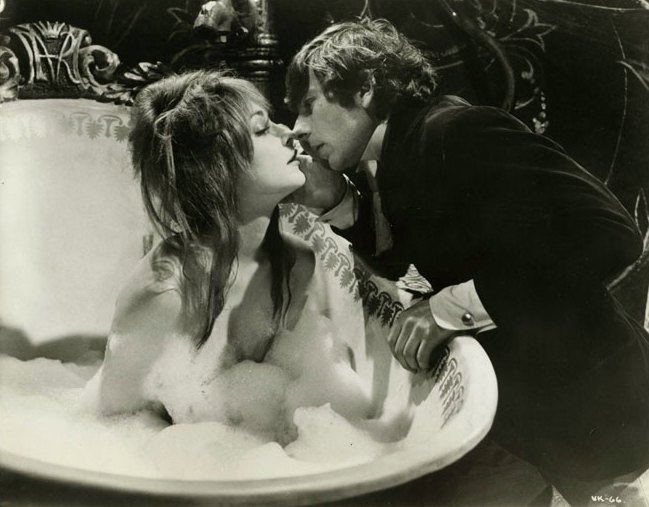
The Fearless Vampire Killers
USA/UK, 1967
Director: Roman Polanski
Screenplay: Roman Polanski, Gérard Brach
Genre: Horror comedy
Soundtrack: Krzysztof Komeda
Main cast:
Jack MacGowran (Professor Abronsius)
Roman Polanski (Alfred)
Sharon Tate (Sarah Shagal)
Alfie Bass (Shagal)
Ferdy Mayne (Count von Krolock)
Iain Quarrier (Herbert von Krolock)
Plot
Late 19th century. Professor Abronsius of Königsberg (Prussia) and his young assistant Alfred arrive in Transylvania during a harsh, snowy winter to investigate the truth behind vampire legends. They first stay at an inn, where the suspicious locals claim to know nothing of castles or counts.
But, although the inn is well-stocked with strings of garlic, a vampire soon appears one night, kidnapping Sarah, the innkeeper’s beautiful daughter.
The professor and his assistant head to the castle. The former wants to eliminate the vampires, while the latter is only interested in the girl.
The count is already waiting for them there and welcomes them as guests. That night, Alfred thinks he hears singing and imagines it might be Sarah. Has she already become a vampire, or will Alfred be in time to rescue her?
Review
A parody of gothic vampire horror directed by Roman Polanski, who also stars in the film. Presented as a satire, it features all the clichés of the subgenre pioneered by Bram Stoker’s famous novel.
Abronsius is the classic eccentric mad professor, and Alfred, played by Polanski himself, serves as his bumbling assistant. He’s actually quite cowardly when it comes to vampires (not nearly as “fearless” as the film’s original title suggests), but his desire to see Sarah (Sharon Tate) again pushes him to confront his fears.
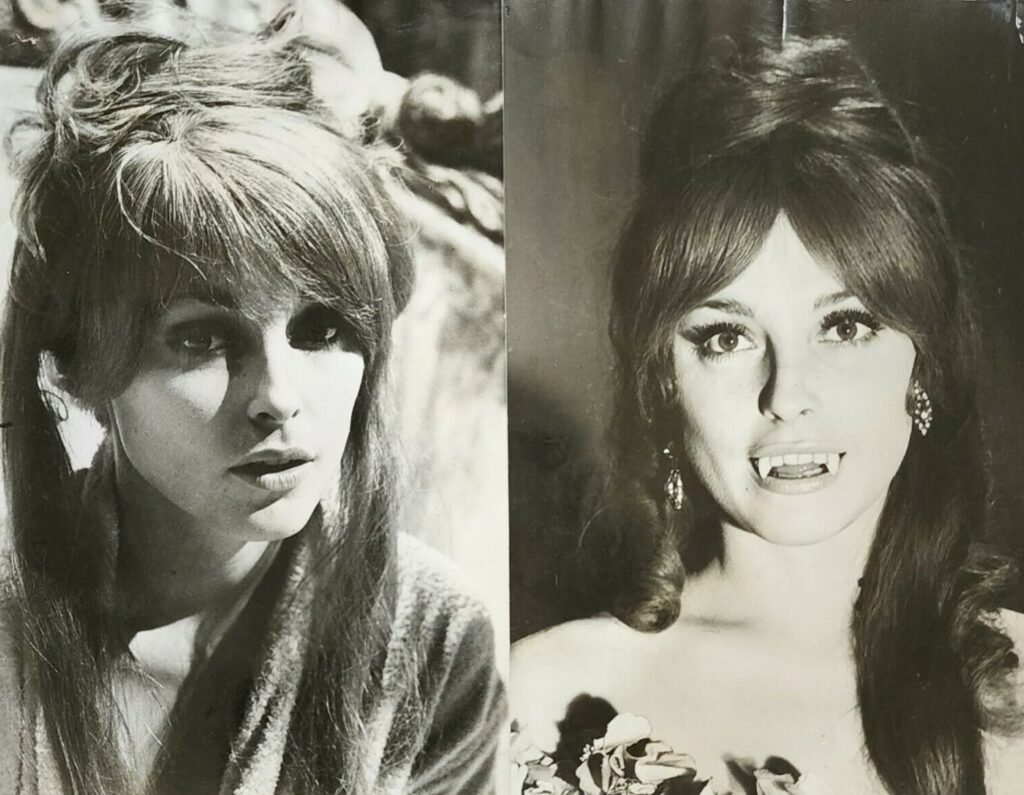
And the fact is, one of the biggest reasons to watch this charming and funny black comedy lies precisely in Sharon Tate’s appearance: an actress who didn’t get the chance to appear in too many films and who is far better known for her brutal death than for her short life (Incidentally, it’s both curious and unsettling that she appears in this film as a vampire—that is, as the “living dead”). As is well known, Sharon Tate would become Polanski’s wife (they met during the filming of this movie), and just two years later she was murdered in the infamous ritual crime perpetrated by Charles Manson’s satanic “family”—at least, that is the official version of the murky event.
Sharon plays the voluptuous redhead Sarah, whom Alfred (Polanski) wants to rescue from the vampire cult. We are, in fact, dealing with a sect of the undead, for during the opening ceremony of the ball, the count refers to himself as the “shepherd” and declares the participants to be his “flock.” The vampires of this “flock” are emaciated old men, dressed in the courtly style of the 18th century. We thus see a reference to the aristocracy of the pre-French Revolution era, portrayed as something decadent and decrepit that refuses to die. Sarah-Sharon, dressed in garish red like the “Scarlet Woman,” is presented as the evening’s main attraction, due to her youth and beauty. The elderly 18th-century vampires are eager for new blood and fresh flesh. Let us remember that vampires are the parasites par excellence. Sarah-Sharon has not yet been fully turned into a vampire, as her image can still be seen in mirrors. The leader of the vampires has a homosexual son, who has set his sights on Alfred, and also seeks to sink his fangs into him…
In the cemetery in the castle’s inner courtyard, the German surnames on the tombs, with the prefix “von,” stand out (even though the film is set in Transylvania, where people are mostly of Romanian or Hungarian origin). The count who owns the castle, for example, has the surname “von Krolock.”
In one scene, we see that the innkeeper Shagall, once he has become a vampire, is the only one unaffected by crucifixes—since he is Jewish. Interestingly, so was the actor who plays Count von Krolock, Ferdy Mayne.
There are interesting symbols, such as the reference to Saturn (in one scene, Abronsius and Alfred observe that planet through a telescope). It may seem irrelevant, but the figure of Saturn, in addition to its astronomical significance, has occult connotations and holds great importance in satanic groups (among which vampires can be counted). And precisely when Alfred begins observing that planet, he starts hearing the “siren songs” of Sarah-Sharon, which Abronsius seems not to perceive. Another curious moment is Alfred’s “circular escape,” in which he believes he has escaped the young von Krolock, but in reality he has merely gone in a circle and arrived back at the same place—it seems like just a “gag,” but it gives one pause…
Throughout the entire film, and especially in the second half, moments of dark humor are skillfully interwoven with unsettling situations. The epilogue, for example, is quite unsettling: The message ultimately is that despite having good intentions and acting correctly, the result can be the opposite of what was intended… You wish for good, but even as you fight evil, you contribute (unconsciously) to its spread… (Which ties in with the previously mentioned scene of the “cyclical flight” to nowhere).
The soundtrack by Krzysztof Komeda is memorable. This Polish-born composer, who was a friend of Polanski’s, also met a tragic end, dying young like Sharon Tate—though under far less brutal circumstances, as his death was an accident.
Felix Hahlbrock Ponce
(Get my books HERE)