
Dirty Harry
USA, 1971
Director: Don Siegel
Screenplay: Harry Julian Fink, R.M. Fink, and Dean Riesner
Genre: Action/crime
Soundtrack composer: Lalo Schifrin
Editing: Carl Pingitore
Production: Don Siegel
Main cast:
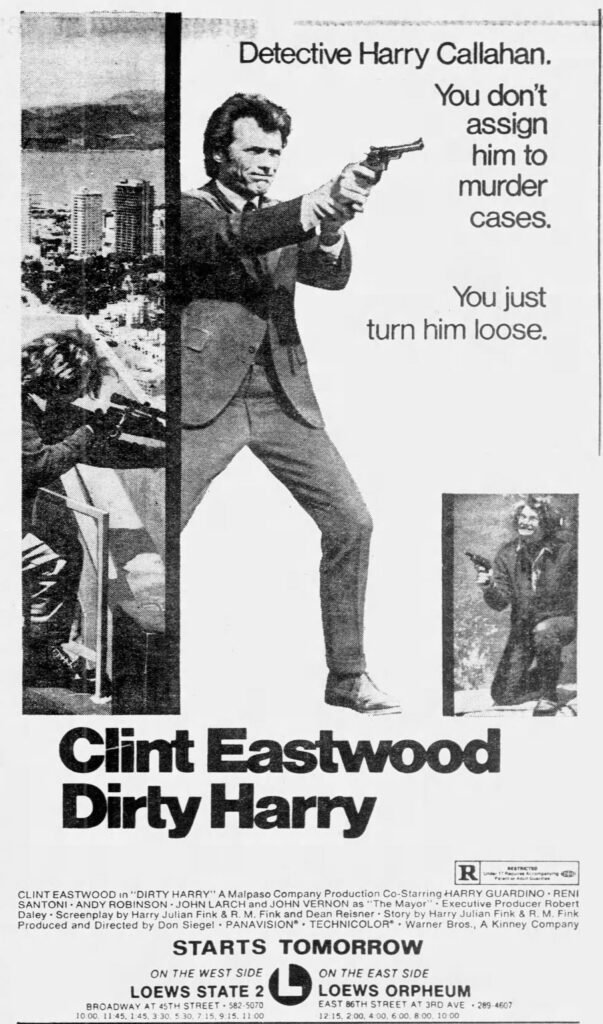
Clint Eastwood (Harry Callahan)
Andrew Robinson (Scorpio)
Harry Guardino (Lieutenant Al Bressler)
Reni Santoni (Inspector Chico Gonzalez)
Plot
A psychopathic sniper is on the loose in San Francisco. After shooting a young woman from a rooftop, the madman leaves a note threatening to kill more people if he is not paid a certain amount of money. He warns that if his demands are not met, his next victims will be a black guy or a Catholic priest. The killer, armed with a rifle with a telescopic sight, calls himself “Scorpio.”
The police prefer to prevent the media from publicizing his existence and try to communicate with him as discreetly as possible. The investigation of the case falls to Inspector Harry Callahan, known as “Dirty Harry.” Harry is assigned an assistant, the Mexican Rodríguez – Initially, Harry is unhappy about it, considering him a rookie.
Together they will try to hunt down “Scorpio” to avoid having to give in to his extortion and, above all, to prevent him from continuing to kill innocent people…
Comment
This famous production marked an era and influenced the style and themes of many films that would also become popular in the 1970s, even outside the US, as in the case of Italian “polizziesco” films.
Clint Eastwood brings to the crime genre the archetype of the lonesome antihero he had already played in several westerns (such as Sergio Leone’s Dollar Trilogy).
Taciturn, cynical, solemn, expeditious, more in line with a private detective like Humphrey Bogart in “The Maltese Falcon” than an agent integrated into a system. He is a rebel who considers the police system too bureaucratic, and therefore ineffective and soft. Harry is a man of action, but he is subject to that police-judicial system that holds him back and prevents him from decisively neutralizing criminals as dangerous as this “scorpion.”
The criminal, incredible as it may seem, plays the victim, completely subverting reality – And initially getting away with it.
Harry does not go to the extreme of a vigilante in the style of, for example, “The Punisher”. But neither does he adapt to a system he considers ineffective. Indeed, as portrayed in the film, the police and judicial system is largely ineffective. This is illustrated, among other occasions, when Harry’s boss says he has given his “word of honor” to the killer (that after the ransom is delivered, they will not follow him)… As if this psycho they are (supposedly) trying to stop was an honorable adversary!
As for the parallels with The Punisher (the Marvel comic book character created shortly afterwards, in 1974), there is a scene in which Harry tells his partner Rodríguez’s wife that his wife died in a traffic accident after being hit by a drunk driver. This tragedy can be interpreted as having influenced Harry to become a relentless vigilante, similar to Frank Castle (The Punisher), who began his anti-crime crusade after losing his family in a shootout between rival gangs.
The kidnapping of the girl and the ransom delivery, in which both the police officer and the criminal are injured, becomes the turning point; from then on, the confrontation between the two becomes not only a matter of principle, but also something personal…
Harry feels hampered by his superiors and prefers to use his own methods, considered “dirty” by many of his colleagues. But isn’t a system that allows criminals like Scorpio to roam free, killing innocent people, even dirtier? That seems to be the message of the film.
We also have the subliminal theme of police surveillance as something desirable, through control and espionage represented by tracking and binoculars, also used by Scorpio. Harry uses binoculars to locate Scorpio on the rooftops, but “in passing” he also sees other things… The story of Harry, who is effectively pursuing honorable goals (to catch a psychokiller), seems to veiledly justify greater surveillance of citizens under the pretext of “everyone’s safety.” This would give us the following dialectical trap: Thesis (Scorpio) – Antithesis (Harry) – Synthesis (more surveillance). Is that the conclusion that viewers at the time were supposed to reach? It seems that today we have become accustomed to cameras everywhere…
(Get my books HERE)