
The Misfits
USA, 1961
Director: John Huston
Screenplay: Arthur Miller
Genre: Romantic drama
Soundtrack: Alex North
Editing: Ferris Webster
Production: Miramax/Columbia Pictures
Cast:
Clark Gable (Gay Langdon)
Marilyn Monroe (Roslyn Tierney)
Eli Wallach (Guido)
Montgomery Clift (Perce)
Thelma Ritter (Alma)
Plot
Young Roslyn wants a divorce. Her mature friend Isabel, who already has experience with marital breakups, accompanies her through the process.
After finalizing the paperwork, the two women strike up a friendship with two local men who offer to show them the natural landscapes and prairies on the outskirts. They are Guido, a mechanic, and his cowboy friend Gay. Both men are drawn to the lovely Roslyn, and she agrees to stay with them at Guido’s house for a few days…
Commentary
A very interesting drama that explores couple dynamics and hints at certain patterns and behaviors that would later extend beyond the silver screen in the following decades. From the outset, it seems clear that one of the film’s aims is to normalize divorce—something that was still almost taboo at the time. Here, divorce is portrayed not as the failure of a relationship, but practically as an opening toward “new horizons,” toward “adventure and freedom”…
Roslyn herself comes from a broken home. Her friend Isabel acts as a surrogate mother and mentor. Since she is an older, divorced woman, she wants to “guide” the young, naive girl, idealizing the liberating benefits of divorce. We see, right at the beginning, how she tries to convince the girl to testify before the judge that her husband abused her, even if it’s a lie, just to speed up the process (false accusations). Isabel is a “happy and proud” divorcee who boasts about having “lost” her wedding ring as early as her honeymoon.
Both “rehearse” what Roslyn will say when she gets divorced, as if they were actresses in a movie (which is what they are; we thus have an example of meta-cinema, or rather “cinema within cinema”).
Then we learn that Guido the mechanic, one of the few characters who isn’t divorced, is a widower: His wife died from complications during pregnancy. Here the subliminal message seems to be: “Don’t have children; it can be dangerous.”
Roslyn’s yearning for freedom—she is a cabaret dancer from the big city—blends well with the free-spirited and romantic nature of the cowboys on the vast prairies. Thus, the film turns out to be an interesting cross between a contemporary revisionist western (set at the time of filming) and a melodrama that explores male-female relations—paving the way for social behavior patterns that would become widespread in the very near future.
Later on, Isabel will say goodbye to the group, leaving Roslyn alone with her new friends. They are joined by another cowboy named Perce—who, naturally, is also drawn to the sweet, angelic Roslyn.
Like the others, Perce comes from a dysfunctional family and has a conflict with his stepfather. Gay, for his part, has problems with his children, whom his wife kept and whom he hardly ever sees. We thus have a wide variety of broken family constellations. And this was in the early ’60s, when such situations were not yet so common. A sort of love triangle (or even quadrangle) forms within the main group, several years before “free love” began to become fashionable with the hippie movement at the end of the decade. Hollywood, always at the forefront of social trends…
In any case, nothing ever comes to fruition. As a result, the sexual tension is constant, and it becomes the driving force of the film.
Guido, the widowed mechanic, carries war traumas: He is a World War II veteran and mentions that he “bombed nine cities.” This contrasts with Roslyn’s great empathy (she is always concerned for her new friends, even though she has just met them; and very compassionate toward animals). Another important contrast: Roslyn seems very naive and innocent, but on several occasions there are references to her past as a dancer in a nightclub.
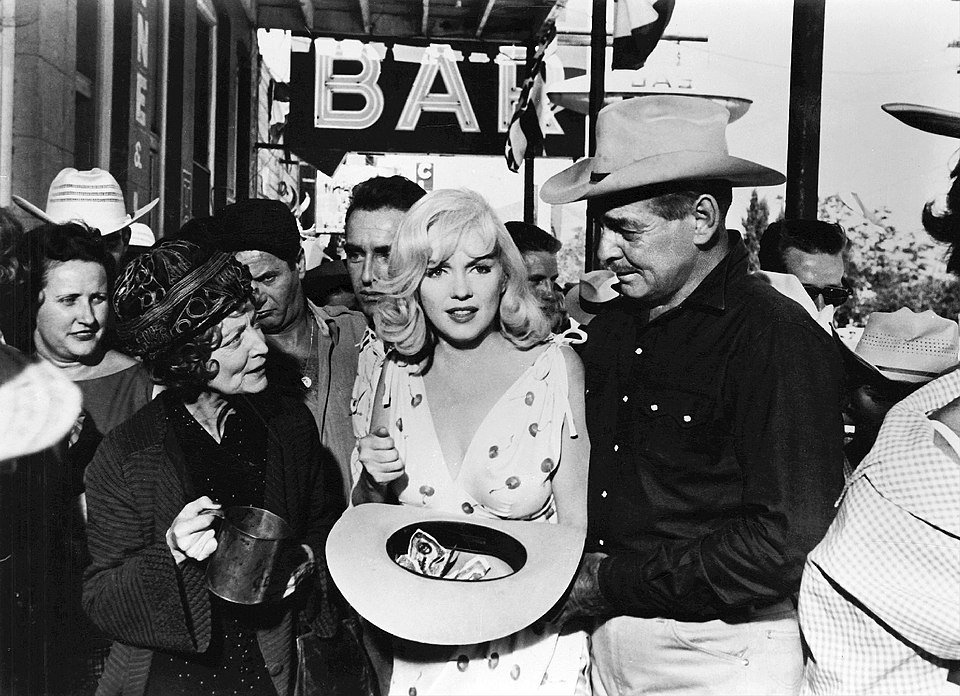
Another contrast, this one of a financial nature: In the “saloon” scene, we see two different ways of making money, which seem very different but lead to the same result—on the one hand, the voluptuous Roslyn receives a large amount of tips for her skill with the racket; at the same time, an elderly woman asks for donations for the church. In both cases, the emotions of the crowd are appealed to: Roslyn collects (though she doesn’t even set out to do so) by arousing sensual and sexual instincts; while the second woman exploits feelings of guilt.
Everyone falls in love with the sweet, angelic girl, who becomes the undisputed center of attention for the trio of seasoned cowboys (to the point that they consider leaving that “wild” life behind). The way she alters the dynamics among the three friends through her influence is remarkable.
There is also room for moral reflections, which arise from the paradoxes our protagonists face. Roslyn feels pity for the horses, wounded and captive; but Gay tries to explain to her that he captures the horses so that he himself can be free, and that “there can be no life without death.”
The contrast between the rugged, old-fashioned cowboys and the fragile, modern city girl serves to archetypically juxtapose what today is called “toxic masculinity” with women’s aspirations for “liberation,” represented by Roslyn —who, paradoxically, flees the city in search of the freedom of country life, only to find that life there wasn’t quite as “beautiful” as she had idealized it. For the wild horses also want to be free, and the “men” won’t let them…
Marilyn Monroe was already 34 years old when she played the role, though she looks much younger. She was more experienced in divorce than her character, having married and divorced three times (once again, reality surpasses fiction). Among her husbands was playwright Arthur Miller, the screenwriter of this film (!), from whom she divorced that same year, 1961.
It’s curious that the rough cowboy, a true symbol of American masculinity, is named “Gay.” It wouldn’t be until the end of the decade that this term (which in English simply means “cheerful” or “fun”) became fashionable to refer to the homosexual community.
Gay is played by Clark Gable (who was actually a fighter pilot in World War II, just like Eli Wallach’s character here). Gable died before the film’s release. Marilyn would die shortly thereafter. This was the last film for both of them. In that context, it seems almost “prophetic” that in the final scene, Roslyn and Gay are driving at night and she asks him, “How will we find our way back in this darkness?” And he replies, looking up at the sky, “The light of the stars will lead us home”…
Felix Hahlbrock Ponce
(Get my books HERE)