
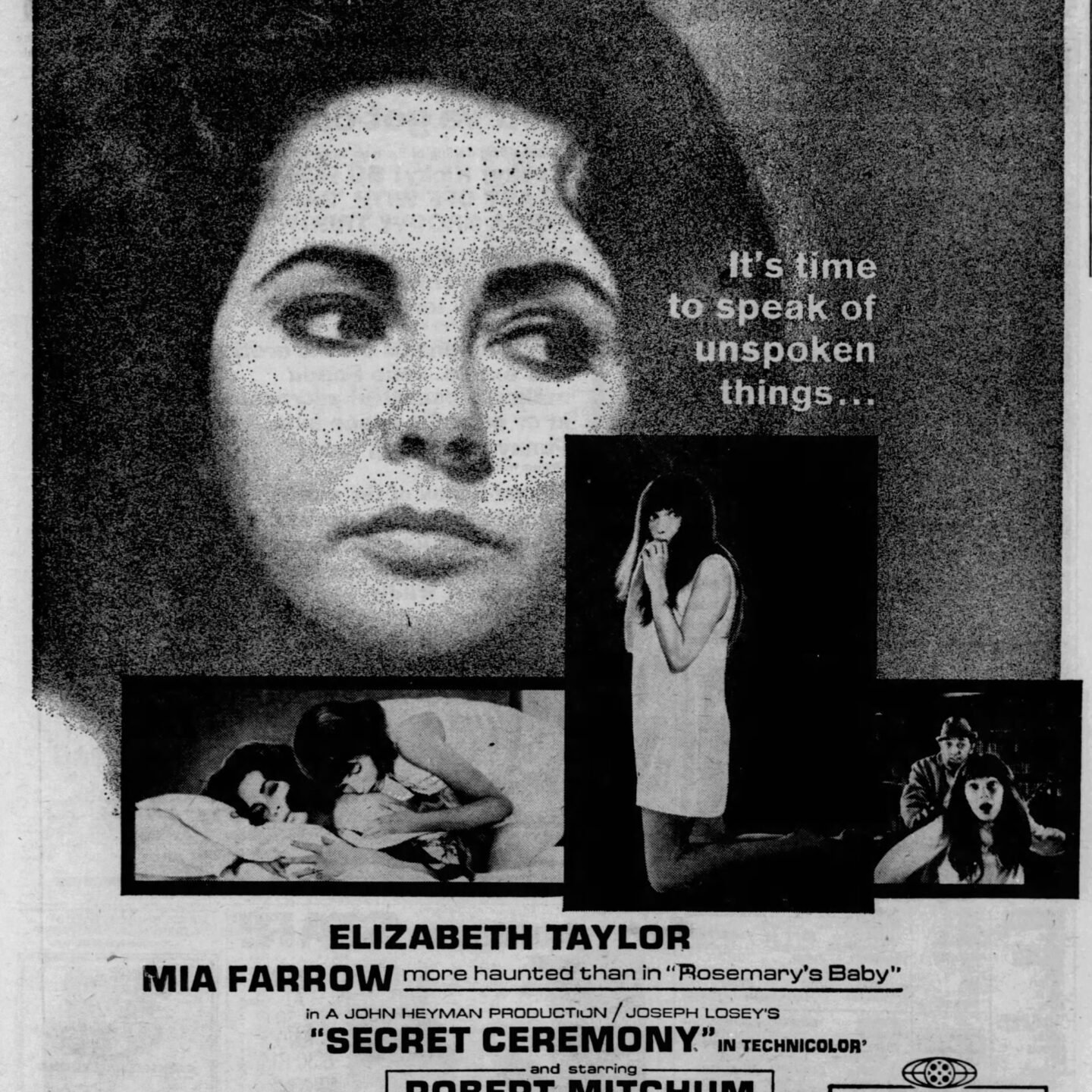
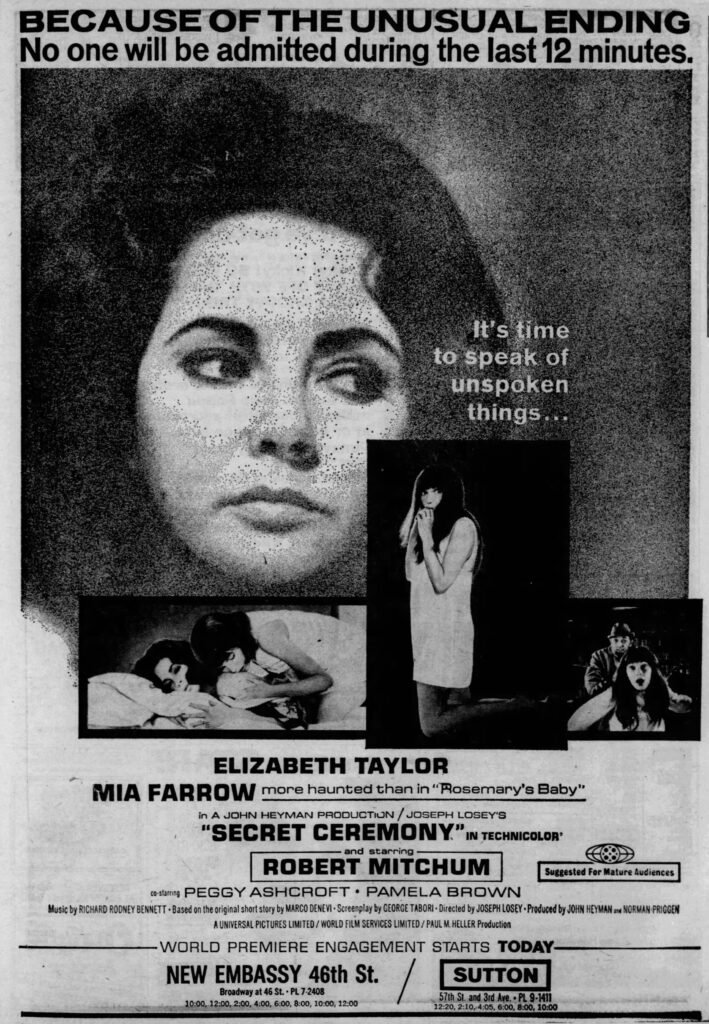
Secret Ceremony
United Kingdom, 1967
Director: Joseph Losey
Screenplay: George Tabori (based on the novel Secret Ceremony by Marco Denevi)
Genre: Thriller, psychological horror
Soundtrack composer: Richard Rodney Bennett
Editing: Reginald Beck
Production: John Heyman and Norman Priggen
Main cast:
Elizabeth Taylor (Leonora)
Mia Farrow (Cenci)
Robert Mitchum (Albert)
Peggy Ashcroft (Hannah)
Pamela Brown (Hilda)
Plot
A woman is followed to a church and then to a cemetery by a mysterious teenager. The girl believes that the woman is her mother. But the older woman is convinced that this is not the case. She seems to have had a daughter who could now be the same age as this girl. But supposedly the girl died years ago…
The enigmatic young woman, named Cenci, lives alone in a large mansion. Very happy after “the return” of the woman she considers her mother, she invites her to stay there with her.
The next day, after a visit from two aunts or relatives who are looking to take items from the huge house for their antique shop, it is discovered that Cenci’s mother, Margaret, died long ago…
So who is the woman she has invited to stay in the house?
Commentary
This psychological thriller with paranormal touches, set in England, features three big Hollywood stars of the moment: the already established Elizabeth Taylor and Robert Mitchum, and a young Mia Farrow at the beginning of her career. It is strange that, with such a cast, the film is so little known. Its release and distribution were probably overshadowed by the premiere, just one year later, of “Rosemary’s Baby” (Roman Polanski, 1968), which has a very similar premise and plot, and also stars Mia Farrow.
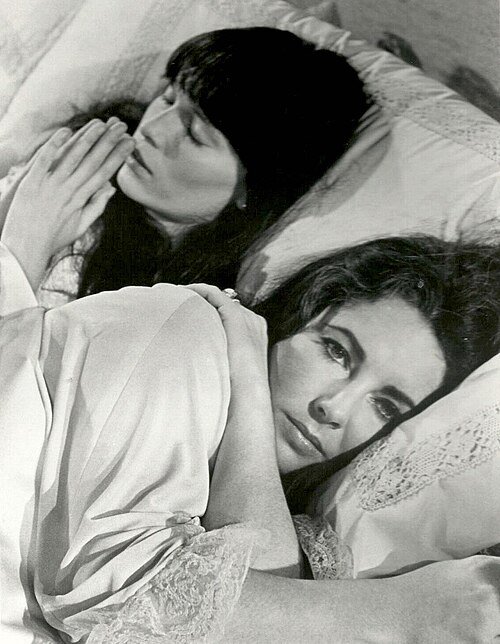
A strange and supernatural connection is established between the two female protagonists, the supposed mother and the supposed daughter. At first, it is suggested that at least one of them is actually dead… Or perhaps the one who is considered the mother is actually someone else—who also has some kind of connection to the girl. In any case, a toxic interdependence develops between the two. The older woman sees the younger woman as a substitute for her daughter, and the younger woman sees the older woman as a substitute for her mother. The “mother,” played by Elizabeth Taylor, is a very devout and practicing Catholic whose daughter drowned (due to her negligence; since then, she has been tormented by guilt and has taken refuge in religion). But we also see from the first scene that this character has several wigs, so she could just as easily be an impostor (or someone with an identity crisis), pretending to be the deceased mother of the young Cenci—a fragile and unpredictable young girl who has visions and communicates with entities from the lower astral plane. The girl is considered a poor madwoman by her aunts at the antique shop—who, like birds of prey, take advantage of her, want to steal her inheritance, and try to get their hands on everything they can in the mansion of the deceased (or not so deceased) Margaret. Among other things, a symbolic doll…
The importance of blood and sexuality as ways of making pacts is shown. The symbolism of the mirror is striking, as a reflection of parallel realities beyond the tangible world.
The figure of Albert, Margaret’s (ex-) husband and Cenci’s stepfather, also enters the scene, having just been released from prison (which is why he was an “absent father”). The two women, “mother and daughter,” are connected to Albert through a morbid sexuality—a perverse and incestuous “ménage à trois.” In this context, the Catholic imagery of virgins (in Margaret’s house, in the church, etc.) links to the theme of sexuality—Cenci’s virginity (or lack thereof). A very adorable and angelic girl, but with an extremely disturbing touch. Both because of her extrasensory abilities and her supposed traumatic past. And both things, the paranormal and the trauma, could be closely related.
Certain patterns and cycles observed in the film have interesting parallels with details of real life that would unfold later. Mia Farrow was married to Frank Sinatra when this film was shot. Sinatra was 30 years older than her (old enough to be her father). Mia Farrow would later marry Woody Allen, who later would in turn marry an adopted daughter of both of them. In this film, as we saw, Mia Farrow plays the adopted daughter seduced by her stepfather, played here by Robert Mitchum (who was practically the same age as Frank Sinatra), whose character is also very reminiscent of the shady ex-convict he played in “Cape Fear” (J. Lee Thompson, 1962).
“Secret Ceremony” is an unknown pioneer of “possession” cinema: whether we understand possession to mean an invisible entity (which is never revealed—this is probably where the ‘secret’ in the title comes from), or possession between “mother and daughter” (the toxic relationship), a possession by ghosts and traumas.
Actually, an implicit anti-maternal and anti-family message can be seen in both “Secret Ceremony” and “Rosemary’s Baby” – as motherhood and family are portrayed as something dark, oppressive, “patriarchal,” etc. This is very much in line with the “Zeitgeist” of ‘emancipation’ and “sexual revolution” of that era (the films are from 1967 and 1968, respectively).
The British production is based on the novel of the same name by Argentine author Marco Denevi. The director of this film version, Joseph Losey, gave it a more morbid and sexually ambiguous tone. Like the Hollywood trio who starred in it, Losey was American. But due to his communist sympathies, he left the US for England, as in the 1950s those of his political affiliation faced restrictions in Hollywood for promoting subversive content.
Felix Hahlbrock Ponce
(Get my books HERE)
Get Secret Ceremony HERE!
(This is an affiliate link. I may earn a commission if you purchase through these link, at no extra cost to you. As an Amazon Associate, I earn from qualifying purchases.)