
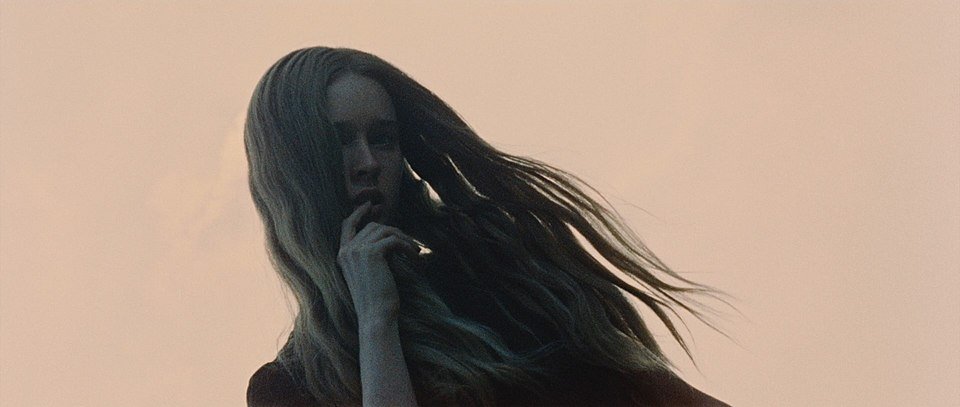
What have you done to Solange?
Italy, 1972
Director: Massimo Dallamano
Script: Bruno Di Geronimo, Massimo Dallamano, Peter M. Thouet (story by Edgar Wallace)
Cast: Fabio Testi (Enrico), Karin Baal (Herta), Cristina Galbó (Elizabeth), Joachim Fuchsberger (Inspector Barth)
Music: Ennio Morricone
Story
Enrico Rosseni is an Italian teacher in a Catholic school for young girls in London. He is married to the stern German Herta, who teaches mathematics at the same school. But the marriage is a failure. The handsome Enrico is very popular among his students, and he goes out secretly with Elizabeth, one of them.
One afternoon, when Enrico and Elizabeth are frolicking in a boat on a river by a field, the girl thinks she sees silhouettes and someone’s hand wielding a sharp knife. She tells Enrico about it, but he thinks it’s some excuse to slow down their progress.
Soon after, at home, Enrico hears on the radio that a murder has been committed in the same park where he was with Elizabeth a short time before, and he remembers what she told him. He immediately goes there. The police have cordoned off the area and the body is being removed. The victim is Hilda, another of Enrico’s students…
Inspector Barth goes to the school and begins his investigation. As Enrico was near the scene shortly after the events, and the policeman realizes he seems to want to hide something, he becomes the main suspect.
What the teacher wants to keep hidden is his relationship with Elizabeth, but that Barth does not yet know.
The schoolgirls are horrified by the macabre crime. For the murder was perpetrated with a brutal sadism: Hilda was killed by sticking the knife between her legs…
Soon it will be another girl’s turn. In the meantime, Enrico continues his adulterous relationship with Elizabeth and gets an apartment where the two can see each other without being disturbed. The girl lives with her uncle, Colonel Seccles.
Elizabeth witnessed part of Hilda’s murder, and so she is plagued by distressing nightmares. In them she sees the murder knife again. And in one of those dreams she remembers something else: The murderer seemed to be wearing a long black dress, like a cassock.
Enrico, in turn, decides to investigate on his own. He notices that the girls who were murdered had something in common. They formed a very united group dedicated to tasks that were, let’s say, not very edifying. And the key to the whole mystery seems to be found in an enigmatic girl from another school named Solange…
Commentary
This giallo by Massimo Dallamano is memorable: dramatic, lurid, moving, heartbreaking and full of good suspense; as it should be. The action, which takes place in London, is set in the environment of a school for girls, which reminds us of the excellent “La Residencia” by Chicho Ibáñez Serrador (1970). In fact, one of the main actresses in that film, the Spanish Cristina Galbó, appears here as the adorable Elizabeth. As in that other movie there is also a scene of the girls in the shower, but here they are seen completely naked (something that Chicho could not afford to shoot due to the censorship in Spain at the time).
The plot contains the usual turns of script with false suspects typical of the giallo and detective literary style that inspires the film subgenre. It could not be otherwise, since the story is based on a tale by the famous Edgar Wallace.
From a Freudian perspective it could be thought that the killer is a sexual maniac with impotence problems who attacks young girls by “penetrating” them with the knife (phallic symbol), since he cannot do it in the usual way. But not everything is what it seems, as we will see…
Enrico is characterized by Fabio Testi, a regular in Italian cinema who stood out especially in the Polizziesco subgenre: He is the protagonist of “Il grande racket” (Enzo G. Castellari, 1976) and “Revolver” (Sergio Sollima, 1973), as well as “Luca il contrabbandiere” (Lucio Fulci, 1980), among many other titles.
In addition, the German Joachim Fuchsberger (as the inspector) and Karin Baal (as Herta) stand out in the cast. The film was an Italian-German co-production. Solange is played by Camille Keaton, who stood out in the rape&revenge “I spit on your grave” (Meir Zarchi, 1978).
The director of photography was Aristide Massaccesi, better known as Joe D’Amato (who would later direct the shocking “Buio Omega” and “Antropophagous”, from 1979 and 1980 respectively). By the way, here Joe D’Amato also had a role in front of the camera: He can be seen at the police station as one of the inspector’s agents.
Unlike D’Amato, Massimo Dallamano did not have a very extensive filmography as a director; but he has real gems to his credit. Among them is undoubtedly this “Cosa avete fatto a Solange” and also the excellent “La polizia chiede aiuto” (1974), which can be considered a cross between giallo and polizziesco.
The soundtrack was composed by Maestro Morricone.
Get What have you done to Solange? HERE!
Get All the colors of murder: Guide to giallo cinema HERE!
(This are affiliate links. I may earn a commission if you purchase through these links, at no extra cost to you. As an Amazon Associate, I earn from qualifying purchases.)