
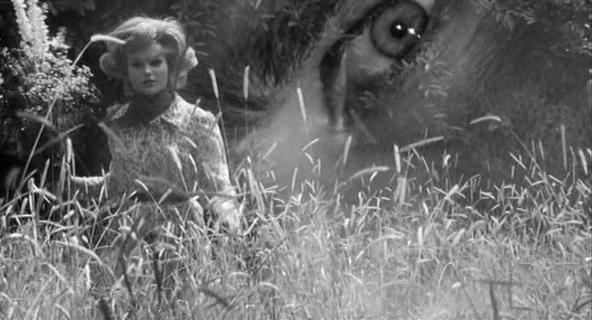
The Third Eye
Italy, 1966
Director: Mino Guerrini
Screenwriters: James Warren (Mino Guerrini) and Dean Craig (Piero Regnoli)
Genre: Thriller / Horror
Soundtrack composer: Frank Mason
Editing: Donna Christie
Production: Louis Mann (producer), Panda Società per L’Industria Cinematografica (producer)
Cinematography: Sandy Deaves
Main actors:
Franco Nero (Count Mino Alberti)
Diana Sullivan (Laura)
Olga Sunbeauty (Mother of Mino)
Plot
Mino Alberti is a young count who lives in a large country mansion with his widowed mother and a maid named Marta. Laura, Mino’s fiancée, visits him frequently, and it is only two weeks before they are to be married. After the marriage, the two plan to live together in the mansion, together with the mother and the maid…
But the old countess, possessive and tyrannical towards her son, is against Mino getting married; and in general against him having a girlfriend and seeing girls – because she wants him to take care of her exclusively. The jealous Marta is not too fond of Mino’s girlfriend either. Laura senses the constant hostility of both of them. One afternoon she comes to see Mino before leaving for a few days; she is going to meet her sister, who has just returned from Switzerland.
The old countess is bitter about her son’s engagement. “Before, he and I were so close… Everything has changed since he met that girl…” she complains to Martha. “Of course, the wedding might not take place… she might have an accident…” adds the old lady with a mischievous evil smile. Marta understands what the lady of the house is referring to, and goes to Mino’s fiancée’s car, while she is taking a bath, with the perfidious intention of sabotaging some mechanism in the vehicle. Marta has grown up in that mansion, her father was an associate of Count Alberti, Mino’s father. The two died together accidentally during a hunt in the woods. Since then the countess and her son “were like one person”….
Mino is a great fan of taxidermy. In his “laboratory” he dedicates himself to embalming small animals, especially birds. He is busy with that task when Marta comes in to tell him that dinner is ready. Mino asks about his girlfriend, but the maid replies that Laura has already left. He is surprised that she hasn’t said goodbye… The mother and the maid told the girl that he had “gone to the city”.
The young count immediately gets behind the wheel of his car to try to catch up with his beloved. The road is dangerous and full of curves. When Laura sees Mino approaching, she prepares to brake… but it is impossible. The brakes do not respond, and her car (with her inside) goes off the road and plunges into a ravine. Mino has witnessed the accident, rushes down to the river where the ravine ends, and finds to his horror that his girlfriend has died…
Meanwhile, at the Alberti mansion, the old countess is scolding the maid Marta as usual. The latter, for the first time, displays a rebellious attitude, and among other things accuses the old woman of treating her son as if he were a baby. The enraged old woman exclaims: “This is the payment for having treated you like a daughter for all these years…” “Like a daughter? Like a slave!” replies Martha. The two fight, and Marta ends up pushing the old lady down the stairs. When the lady tries to get up, she is beaten to death.
Mino returns home grieving after the tragic death of his fiancée. But fate has a new catastrophe in store for him… Entering the mansion, he finds police and doctors watching him with gloomy faces. Marta cries disconsolately (with a false and cynical sorrow) “She was like a mother to me…”. Mino understands what has happened, and falls into a deep depression over the next few weeks. Nightmares and hallucinations torture him day and night.
But Marta, the only person left by his side, will take advantage of the situation. She had always been secretly in love with him, and for years she had accumulated a great resentment for having been treated as a mere servant despite being the daughter of an important associate of the deceased count.
To try to disconnect from her anguished inner turmoil, Mino goes to a jazz club where an attractive young woman dances and performs striptease. When she has finished her number, Mino invites her to his home. Maria is a bit intimidated by the gloomy appearance of the mansion. When they go to lie together in a large double bed, the young dancer screams in terror when she sees what is on the other side of the bed: the corpse of a woman. It is Laura’s embalmed body, for Mino recovered his dead beloved from the wreckage of the car before it sank into the waters of the river, and then mummified her.
Mino then feels an irrepressible urge to strangle the dancer. When he has killed her, he weeps with remorse. But Marta arrives to console him. She assures him that she will help him get rid of the corpse, using acid. Maria is only the first of a series of victims of the growing madness of the troubled Mino… soon also a prostitute he picks up from the street has the same end.
Marta is aware that the young count is becoming increasingly dependent on her. The maid tells Mino that she will only stay with him if he agrees to take her as his wife, and the count agrees. “I will be an understanding woman, united with you in good… and above all in evil.” After the death of the old countess, it is now she who will try to manipulate Mino as she pleases.
But events take an unforeseen turn when one day Daniela, Laura’s twin sister, arrives at the villa…
Comment
This excellent psychological thriller loaded with Hitchcockian suspense and morbid elements harmoniously blends the most intriguing giallo with the darkest gothic horror – the police with the afterlife, the misdeeds of the stereotypical psychopath with the supernatural influences of the Afterlife. It would not be surprising if the reading of Edgar Alan Poe’s works had contributed to the conception and development of this unique story told by the little-known screenwriter and director Mino Guerrini.
The film made a deep impression on Joe D’Amato, whose masterpiece “Buio Omega” (1979) is obviously inspired by “Il Terzo Occhio” – to the point where it is considered by many to be a remake (the young taxidermist who mummifies his girlfriend, the sinister maid, the dead girlfriend’s twin sister who appears at the least expected moment…). It goes without saying, however, that Guerrini’s film does not even slightly approach the levels of gore that permeate the explicit “Buio Omega” (there we see in great detail how the bride is embalmed, how her viscera are removed, while we are not shown that in “Il Terzo Occhio”).
The gloomy and claustrophobic atmosphere is extremely well achieved, something that the black and white contributes to accentuate. Not having been shot in color, the film looks older than it really is; a characteristic it shares with other films of similar aesthetics and quality such as Herk Harvey’s memorable “Carnival of souls” (1962), or the interesting but slightly inferior “Dementia 13” (1963) one of F.F. Coppola’s first films.
Also “Santa sangre” (Alejandro Jodorowsky, 1989) is reminiscent, in terms of theme, of the plot of this film.
The performance of the great Franco Nero in the leading role of the young and tormented count stands out: his descent into the bottomless pit of madness is extremely disturbing.
As it used to be done in Italian cinema in those years in order to attract viewers, the names of most of the film crew are English pseudonyms or anglicized: Thus, the director Giacomo (Mino) Guerrini becomes “James Warren”, or the actress Olga Solbelli (who plays the old countess) becomes “Olga Sunbeauty” – in a hilarious attempt at literal translation. The romantic and melancholic soundtrack was composed by Francesco De Masi (who appears in the credits as “Frank Mason”).
Despite its low budget, the film was very professionally made in every aspect and is still visually very effective today. “Il Terzo Occhio” is a macabre delicacy that lovers of gothic cinema will appreciate. An unknown jewel that in my opinion has nothing to envy to the films that the master Mario Bava directed during those years.
Get “Gothic Fantastico” (Four Italian tales of terror, among them The third eye) HERE!
Get All the colors of murder: Guide to giallo cinema HERE!
(This are affiliate links. I may earn a commission if you purchase through these links, at no extra cost to you. As an Amazon Associate, I earn from qualifying purchases.)