
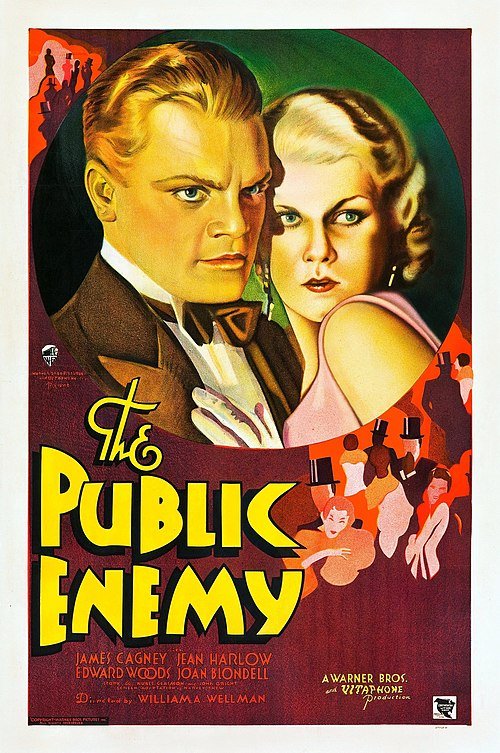
The Public Enemy
USA, 1931
Director: William A. Wellman
Screenplay: Harvey F. Thew (based on the novel by Kubec Glasmon and John Bright)
Genre: Film noir
Soundtrack composer: David Mendoza
Editing: Edward M. McDermott
Production: Darryl F. Zanuck, Warner Bros. Pictures
Main cast:
James Cagney (Tom Powers)
Jean Harlow (Gwen Allen)
Edward Woods (Matt Doyle)
Joan Blondell (Mamie)
Donald Cook (Mike Powers)
Mae Clarke (Kitty)
Beryl Mercer (Ma Powers)
Robert Emmett O’Connor (Paddy Ryan)
Plot
Tom Powers and his friend Matt Doyle are two Irish boys who grow up in Chicago in the early 20th century. Around 1909, they begin to show up in a neighborhood social club frequented by gangsters. One of them, Putty Nose, often buys stolen goods from them (paying them much less than they are worth, by the way).
One day, Tom and Matt are recruited by Putty Nose for a nighttime robbery at a warehouse. But the heist goes wrong, and one of their gang members is killed by the police. Putty Nose, who had promised to protect and support his “disciples,” abandons them to their fate…
With the 1920s comes Prohibition. Tom and Matt start working for Paddy Ryan, an alcohol smuggler. The young men quickly amass a fortune. They also find girlfriends, although the temperamental Tom soon grows bored with his.
As rivalries between gangs for control of the underground breweries increase, a conflict also arises within Tom’s own family. Although he helps his widowed mother financially, the fact that his money comes from illegal activities is viewed with suspicion by his brother Mike.
To complicate matters, Tom and Matt are reunited with an old “friend,” Putty Nose, who left them in the lurch about ten years ago…
Commentary
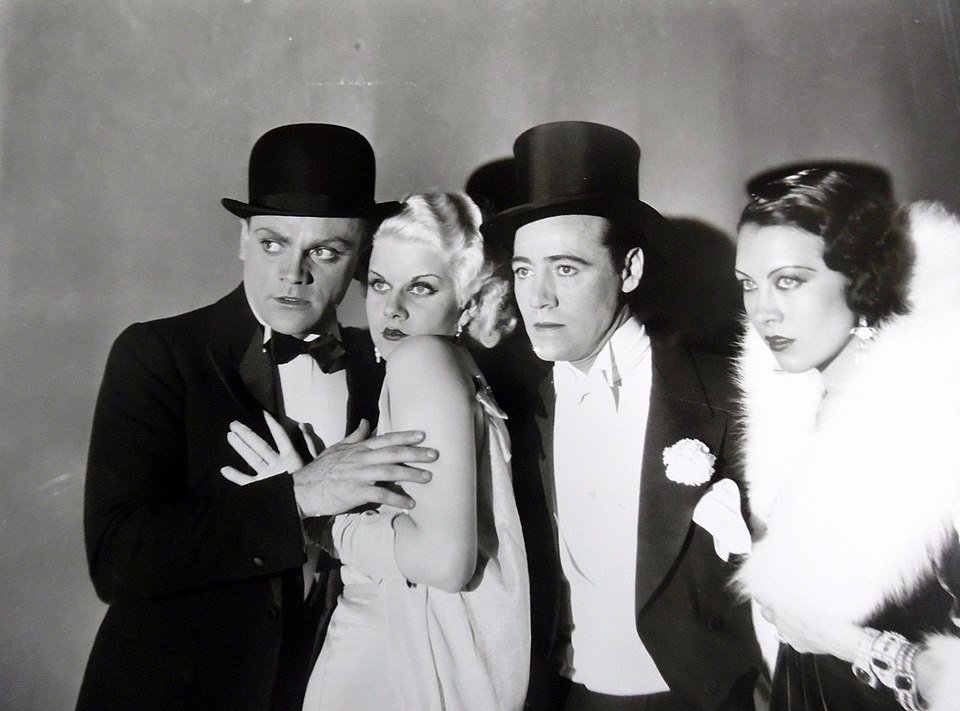
Covering the period between 1909 and 1930, the film takes us on a journey through that turbulent era in Chicago, from the perspective of the ambitious protagonist, whose rise and fall is portrayed. Events such as World War I and Prohibition serve as the backdrop for this prototypical gangster epic, one of the first of its kind to be filmed with sound. For this reason, “The Public Enemy” is of great historical interest. Shortly afterwards, other productions with very similar themes and approaches would follow, such as the first “Scarface” (Howard Hawks, 1932).
Tom is an ruthless young man with boundless ambition. He treats bar owners who refuse to buy alcohol to his gang with extreme violence. He extorts, intimidates, and is capable of cold-blooded murder. His family background is no excuse for his behavior, as his brother Mike has chosen to live an honest life. The confrontation between the two has a significant impact on the plot, to the point that Tom accuses his brother of hypocrisy, saying that he too has “blood on his hands” for having fought in World War I.
Tom also seems at times to be aware of the mistakes he has made in becoming a criminal, and he blames his first mentor, the treacherous Putty Nose, who corrupted him morally with his influence.
Tom’s relationship with women is also interesting. His first girlfriend bores him, his boss’s girlfriend flirts with him but he resists. The only one who seems capable of making him “settle down” and commit to a relationship turns out to be a very flighty femme fatale, the voluptuous blonde Gwen (played by the prematurely deceased Jean Harlow).
The first girlfriend, Kitty, whom Tom squeezes a grapefruit in the face in a famous scene, is played by Mae Clarke, who also appears in “Frankenstein” (1931).
Public Enemy, with its memorable climax and rather crude ending, marked the rise of James Cagney as an iconic actor of film noir in general and gangster films in particular.
Felix Hahlbrock Ponce
(Get my books HERE)
Get The Public Enemy HERE!
(This is an affiliate link. I may earn a commission if you purchase through these link, at no extra cost to you. As an Amazon Associate, I earn from qualifying purchases.)