
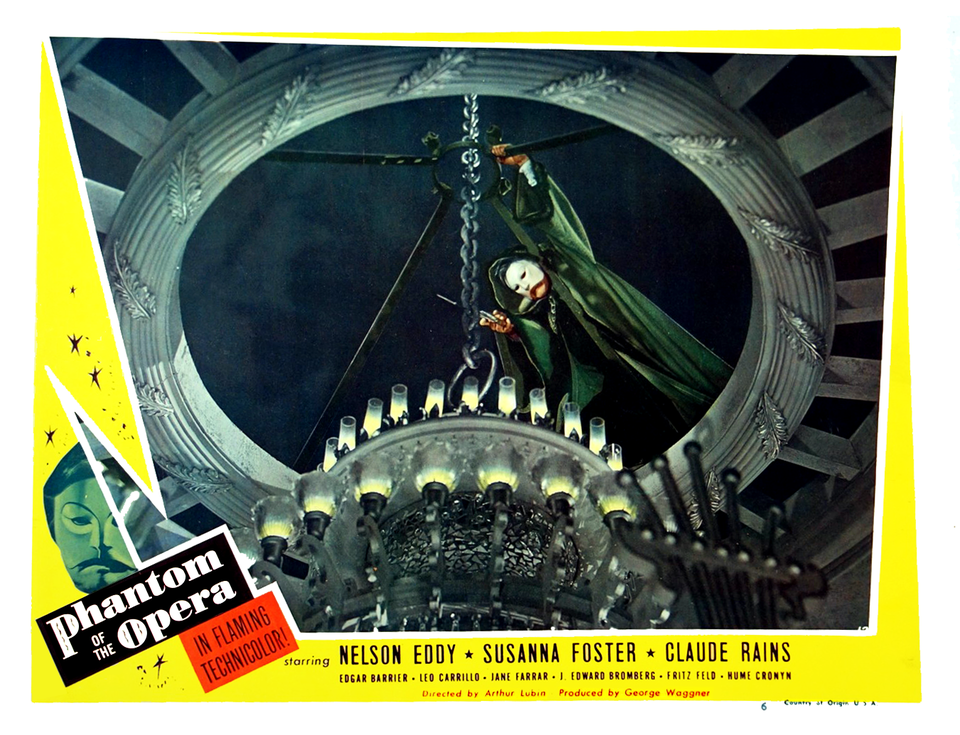
The Phantom of the Opera
USA, 1943
Director: Arthur Lubin
Screenwriter: John Jacoby (story)
Genre: Romance, horror, musical
Soundtrack composer: Edward Ward
Editor: Russell F. Schoengarth
Production company: George Waggner
Cast:
Claude Rains (Erique Claudin / Phantom of the Opera)
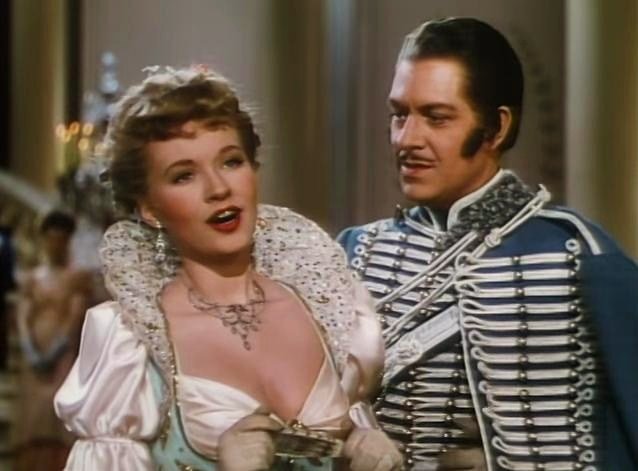
Nelson Eddy (Anatole Garron)
Susanna Foster (Christine DuBois)
Edgar Barrier (Inspector Raoul Dubert)
Jane Farrar (Biancarolli)
J. Edward Bromberg (Amiot)
Fritz Feld (Lecours)
Frank Puglia (Villeneuve)
Fritz Leiber (Franz Liszt)
Steven Geray (Vercheres)
Miles Mander (Maurice Pleyel)
Plot
Christine DuBois is a promising young soprano at the Paris Opera. The singer has two suitors: The baritone Anatole Garron and the inspector Raoul Daubert. The director of the opera calls the girl’s attention because her love affairs distract her from her artistic career. Christine also seems to have a fervent admirer in the mature violinist Erique Claudin. The latter must also appear before the conductor, who has discovered that the minor flaws in the orchestra’s performances are due to him. Claudin has worked as a violinist for the opera for twenty years, but his skill leaves something to be desired in most of the pieces. He is only able to play perfectly a melody that seems to be an old lullaby from his region. As the conductor is unwilling to tolerate imperfections in the orchestra he is forced to dismiss him…
Claudin returns to his humble apartment, and the landlady threatens to throw him out if he does not pay his rent. He is many months in arrears. He says he has no money, but the woman doesn’t believe it, after he has worked for so many years for the Parisian opera.
It turns out that all the money from Claudin’s salary was being spent on paying for Christine’s singing lessons, unbeknownst to her. The violinist has composed a concerto himself, and tries to sell it so that he can continue to support himself and Christine’s lessons. But it is with great frustration that Claudin discovers that the owner of a music company to whom he wanted to sell his piece has stolen it. In a rage, Claudin strangles the man. His mistress, in the struggle, throws a bucket of acid in Claudin’s face, disfiguring him. The violinist, his face burned, has to flee from the police and hides in the sewers.
Shortly afterwards, strange events begin to occur at the Opera House. Objects disappear from the dressing room and food from the kitchen. A rumor spreads among employees and artists that a “ghost” is in the building. This “ghost” is none other than the fugitive Claudin, who wears a mask to hide his disfigured face. The violinist hides in the basement, and his main goal is to make Christine succeed as a singer. To do so, he will not hesitate to use unorthodox methods…
The soprano Biancarolli mysteriously vanishes when she was about to sing in a performance. Christine is called to replace her, and her unexpected intervention becomes a success. The “ghost” had poured some sleeping powder into the Biancarolli’s glass to get her out of the way and pave the way for Christine. When the Biancarolli comes to her senses and discovers that someone had drugged her, she immediately suspects Anatole; for everyone at the Opera knows that he is in love with Christine. He would have had a reliable motive for wanting to get rid of Biancarolli and put Christine in her place. Inspector Raoul, despite having an understandable animosity against Anatole (they both want the same woman) is not convinced of his guilt.
The “ghost” sends anonymous threatening messages to the director, and tries to directly coerce Biancarolli to withdraw. When she refuses, she is murdered. The police, led by Inspector Raoul, search the entire Opera House for the mysterious masked criminal. Meanwhile, in Claudin’s old house, Raoul has found something that connects the missing violinist to Christine: a bust of the young singer. That is not the only link between the two; Christine frequently sings a song she remembers from her childhood, which is the same lullaby that Claudin did know how to play perfectly on his violin…
When the Opera is reopened, Raoul prepares several of his agents to guard the building. The police and those in charge of the Opera seek to provoke the “phantom” to come out of hiding and betray himself. They are more and more certain of his identity…
Comment
This film, based on the famous play by Gaston Leroux, has been erroneously classified within the horror genre, when in fact it is more of a drama with touches of musical and even some moments of comedy. Although the title refers to a ghost, no specter ever appears; for the “ghost” alluded to is Claudin himself. Since the viewer knows this from the very first moment, and the characters also discover it very early on, there is not much intrigue. With the classic Universal horror films such as “Frankenstein” (James Whale, 1931) or “The Wolf-Man” (George Waggner, 1941), this film has in common the dual character of the protagonist: The “monster” is both, the “bad guy” and the victim.
Although it is never explicitly stated, it seems to be suggested that Claudin is in fact Christine’s father. Among many other details, the nursery rhyme that is so important for both of them makes us think of it. We discover that Claudin composed it, and that Christine has known it since childhood. From the very first moment, we perceive that the fixation that the disfigured violinist has for the soprano is of a very different kind than the interest that Anatole or Raoul have for her. Claudin’s approaches are clearly paternal. His greatest desire is for the young woman to progress in her artistic career, which he secretly finances as long as he can. Later, already as the “ghost”, he is forced to commit any folly to achieve it.
The comic note is provided by the two suitors, the inspector and the baritone; when they arrive at the same time to Christine’s dressing room, when they start talking to her at the same time, each one telling her the same thing, etc. It seems that the two have a lot in common, and even physically resemble each other.
The “ghost” Claudin is played by Claude Rains, whom we already saw in “The Wolf-Man” (George Waggner, 1941) as the lycanthrope’s father. The film is already shot in color, something still unusual in the 1940s. The director Arthur Lubin would shoot in Italy with Bruno Vailati “The Thief of Baghdad” (1961); starring Steve Reeves.
Get The Phantom of the Opera HERE!
(This is an affiliate link. I may earn a commission if you purchase through these link, at no extra cost to you. As an Amazon Associate, I earn from qualifying purchases.)