
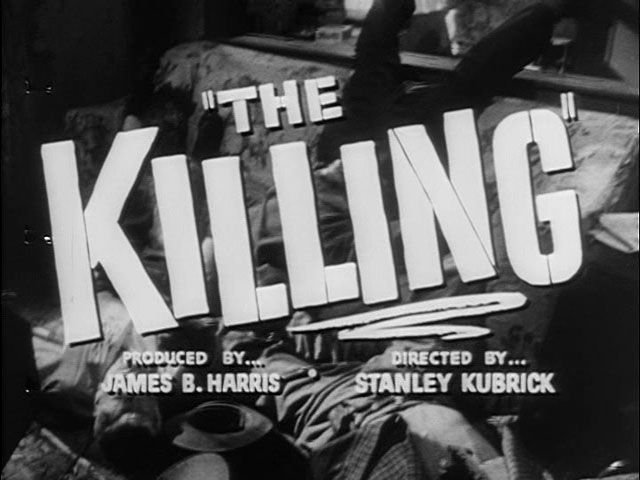
The Killing
USA, 1956
Director: Stanley Kubrick
Screenplay: Stanley Kubrick and Jim Thompson (based on the novel Clean Break by Lionel White). Genre: Noir
Soundtrack composer: Gerald Fried.
Editing: Betty Steinberg.
Production: James B. Harris (Harris-Kubrick Productions).
Main Cast
Sterling Hayden (Johnny Clay)
Coleen Gray (Fay)
Elisha Cook Jr. (George Peatty)
Marie Windsor (Sherry Peatty)
Vince Edwards (Val Cannon)
Jay C. Flippen (Marvin Unger)
Ted de Corsia (Randy Kennan)
Joe Sawyer (Mike O’Reilly)
Plot
Ex-convict Johnny Clay has organized a million-dollar heist, which involves robbing the offices of a racetrack. To do so, he has recruited five guys who, although not professional criminals, are highly motivated by this “unique” opportunity to make a lot of money without effort and without too much risk. Johnny manages to convince them that participating in this supposedly quick and easy heist will allow them to leave behind the precariousness of their mediocre lives.
One of Johnny’s accomplices is George, who works as a ticket seller at the racetrack. For that reason, he is very useful, but otherwise he is a timid man with a weak character. Sherry, his wife, finds out about the plan and begins to conspire with her lover Val to steal the gang’s loot…
Commentary
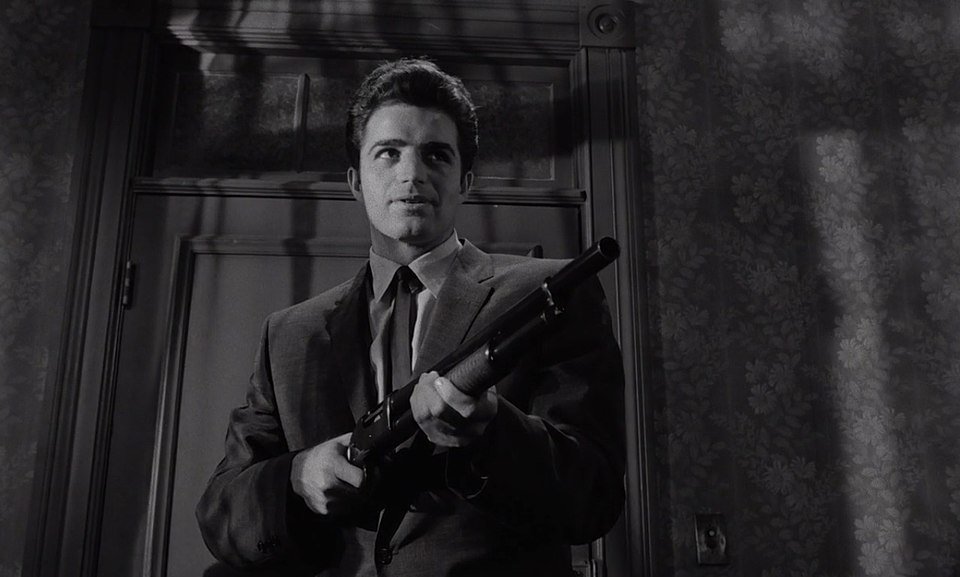
With this superb noir, one of his first contributions as a director, Kubrick shows us that you don’t need a big budget to make an excellent film. With limited resources but a lot of talent, the filmmaker brought to the big screen a story that hooks you from the start, exciting, fast-paced, and full of tension. The story, based on a novel by Lionel White, has a simple plot line, but Kubrick masterfully delves into the characters’ personalities, showing us how they react to the adverse events that hinder their plans (sometimes even from their own perspectives, using the subjective point of view).
Metaphorically, the film can be interpreted as a tragicomic ode to failure. We are led to believe that no matter how meticulously the protagonists have planned everything, there will always be something, some fortuitous circumstance, that ends up rendering all their efforts futile. It is almost as if Kubrick wanted to express that it is impossible to have everything under control. This is particularly interesting coming from him, a perfectionist who took such care with every last detail of each and every one of his scenes, shots, and frames in his films.
In this context, the fact that the robbery was organized against a racetrack to steal gambling/betting money (a symbol of chance and luck) from horse races is significant.
Among the archetypal characters we have the leader, the strategist, a man of action with nerves of steel who is willing to take on even the most extreme consequences; we have the shy one who embarks on the project longing for the reward but without being entirely convinced, and whose cold blood is conspicuous by its absence; we also have the one who acts out of more noble interests (to cure his wife); and those who operate “from within” as infiltrators (the ticket seller, the corrupt cop…); those who are “disposable”; the manipulative viper-wive…
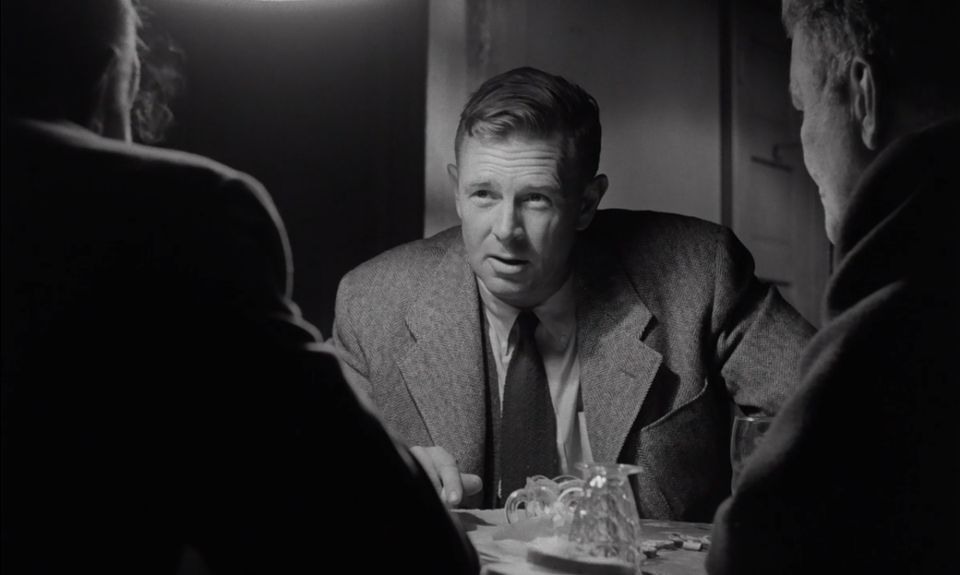
The actor who plays the protagonist Johnny is Sterling Hayden, whom we saw in “Dr. Strangelove” (1964), also by Kubrick.
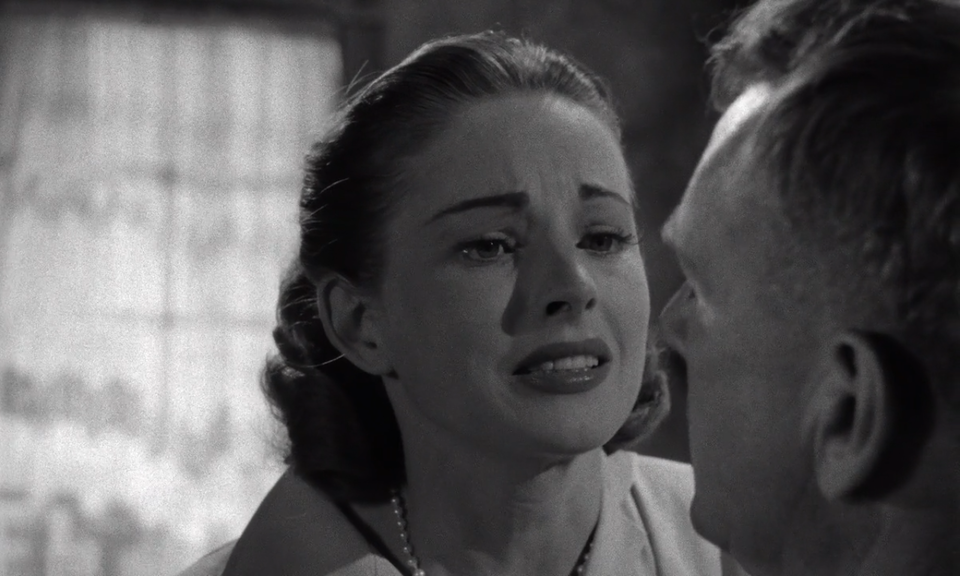
There is a stark contrast between the relationship between the stoic Johnny and his devoted girlfriend Fay, who idolizes him passionately, and that between George and his wife Sherry, who does not respect him in the slightest, to the point of plotting with her lover to “rob the robbers.”
George is played by actor Elisha Cook, whom we saw in a supporting role in The Maltese Falcon (John Huston, 1941). Fay, Johnny’s submissive girlfriend, is played by Coleen Gray, who appears in the highly recommended Kansas City Confidential (Phil Karlson, 1952).
Beyond everything related to the plot and its rich nuances, there is also a narrative tone and a particular aesthetic that is very reminiscent of that later used by directors of the Italian variant of noir (the polizziesco), such as Umberto Lenzi, Enzo G. Castellari, and especially the great Fernando Di Leo—who in turn would influence the more recent and well-known Quentin Tarantino. Tarantino stated, incidentally, that “The Killing” was one of his inspirations when shooting his debut film “Reservoir Dogs” (1993). “The Killing” also coincides with Italian genre cinema (whether polizziesco, spaghetti western, or giallo) in terms of the amorality of the characters and the prominence of antiheroes.
On a technical and structural level, the use of a voice-over narrator (in the style of a newsreader) and flashbacks to jump back in time (especially in the crucial scene of the fight that breaks out in the racetrack bar) are particularly noteworthy.
In “The Killing,” we also have a few colorful supporting characters, such as chess player and wrestler Maurice (played by Georgian actor Kola Kwariani, who was both in real life) and the volatile and disturbing sniper Nikki (Timothy Carey), who attracts bad luck after rejecting the horseshoe in a highly symbolic scene where, once again, chance plays a major role. The circumstances and vagaries of fate are crucial to the development of the film as a whole… and to its conclusion.
The fast-paced final stretch of the film (from the moment the heist is carried out to the conclusion at the airport) is simply masterful.
Felix Hahlbrock Ponce
(Get my books HERE)
Get The Killing HERE!
(This is an affiliate link. I may earn a commission if you purchase through these link, at no extra cost to you. As an Amazon Associate, I earn from qualifying purchases.)