
The iguana with the tongue of fire
Italy, 1971
Director: Riccardo Freda
Script: Riccardo Freda, Sandro Continenza, Günter Ebert, Renato Romano, André Tranché (dialogues), story by Richard Mann
Cast: Luigi Pistilli (John Norton), Dagmar Lassander (Helen Sobiesky), Anton Diffring (Ambassador Sobiesky), Dominique Boschero (Ambassador´s lover), Valentina Cortese (Mrs. Sobiesky)
Music: Stelvio Cipriani
Story
In Dublin a murderer kills a woman with a razor, after deforming her face with acid.
The body in such a pitiful state is found in the trunk of the Swiss ambassador’s car. The deceased was a Dutch citizen connected to the world of diplomacy. Soon a new and shocking crime takes place: A cabaret singer is found dead in her dressing room. Shortly before, the ambassador was there, and so was his daughter.
To investigate as discreetly as possible and avoid an international scandal, the police entrust the matter to a retired detective, John Norton. In the past, his expeditious (not to say brutal) methods have already caused him more than one problem. Norton lives with his mother and a young daughter. In order to get closer to the ambassador’s entourage, the ex-cop starts a relationship with Helen, the ambassador’s daughter.
While the ex-detective advances with his investigations (pending clues such as cigarette butts and sunglasses) the murderer will continue to play his part…
Commentary
Riccardo Freda can be considered the father of Italian-style Gothic horror. It was undoubtedly his disciple Mario Bava who developed this genre (and Bava in turn was in 1963 the director of the first official giallo, “The girl who knew too much”, with Dario Argento taking over from him in this other genre).
At the beginning of the seventies, seeing the success that the gialli were beginning to reap, Freda wanted to make a foray into that new style as well. Freda was not satisfied with this diplomatic thriller and preferred to sign the film with the pseudonym “Willy Pareto”. However, although as a whole it may turn out to be a mediocre product, the film also has interesting moments.
The title refers to a commentary by the curator, who draws an analogy between the iguanas and the murderer, since iguanas are very skilled at mimicking each other. Furthermore, “the iguanas are horrible looking but harmless”, and the commissioner intuits that in the case of the murderer it is the other way around.
There is a touch of humor, especially from the hand of Norton’s nice old mother, who also shows off some detective notions as if she were a Miss Marple.
It’s true that during much of the film there are many somewhat soporific moments, but the film has a tense and brutal climax.
The striking physical resemblance here between Luigi Pistilli (who plays the main character Norton) and James Caan as Sonny Corleone in “The Godfather” (F.F. Coppola, 1972) is curious. Dagmar Lassander, whom we saw in the highly recommended “Hatchet for the honeymoon” (Mario Bava, 1970) plays Helen.
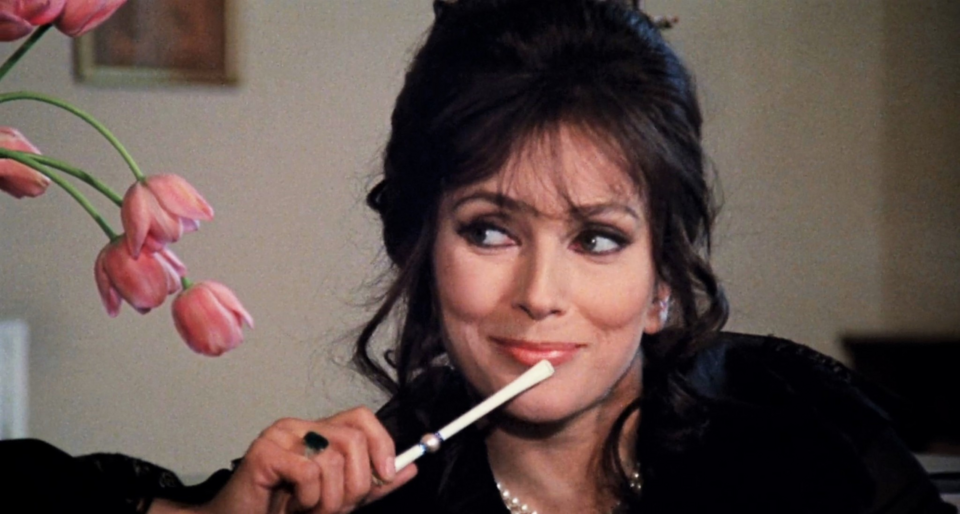
Among the other actors, Valeria Cortese is the ambassador’s wife (a histrionic lady who loves strange black cigarettes) and Dominique Boschero is the cabaret singer. The former participates in “The girl who knew too much” (Mario Bava, 1963) and the latter is part of the cast in the highly recommended “Líbido” (Ernesto Gastaldi, 1965).
Get The iguana with the tongue of fire HERE!
Get All the colors of murder: Guide to giallo cinema HERE!
(This are affiliate links. I may earn a commission if you purchase through these links, at no extra cost to you. As an Amazon Associate, I earn from qualifying purchases.)