
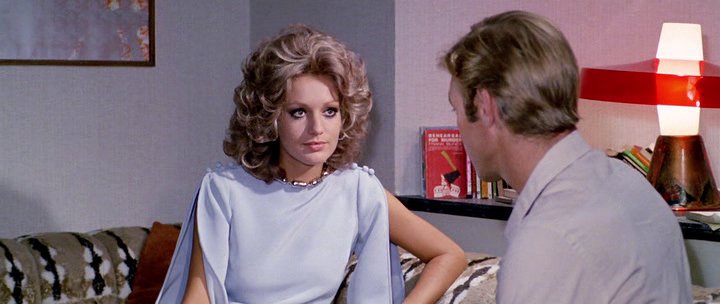
The cat o´nine tails (O.V. Il gatto a nove code)
Italy, 1971
Director: Dario Argento
Script: Dario Argento, Luigi Cozzi, Dardano Sacchetti (based in novel by Edgar Wallace)
Cast: James Franciscus (Carlo), Karl Malden (Franco), Catherine Spaak (Anna), Pier Paolo Capponi (Spini), Horst Frank (Dr. Braun), Rada Rassimov (Bianca)
Music: Ennio Morricone
Story
A middle-aged blind man and his niece of about 8 years old head home one night. In the vicinity, the blind man overhears a suspicious conversation between two individuals who are inside a parked car. He asks the girl to take a peek at them to see what they are up to.
Later, the little Lori has already gone to bed while her uncle Franco is engaged in solving a kind of crossword puzzle for the blind. Meanwhile, one of those in the car knocks out the night watchman of what appears to be a hospital and enters the building. Once inside, he searches some files until he gets the document he was looking for…
The next day, Franco collides in the street with a man who was in a great hurry: the reporter Carlo Giordani. He explains to the blind man that a robbery was committed at night at the Terzi Research Institute (what looked like a hospital), and that he arrives to find out about the case.
Carlo enters the building and meets his police friend Spini, who informs him that apparently nothing is missing. The research center is dedicated to genetic and biochemical studies. Lately they were working on the development of a secret drug. It is feared that the night raid is related to a possible case of industrial espionage. Giordani sees the center’s director, Professor Terzi, and his attractive daughter Anna. Some scientists involved in the projects are also there. Among them, a certain Calabresi, who seems to have a lot to hide. Calabresi tells his girlfriend Bianca that he knows who entered the institute that night and for what reason, but he won’t say for the moment as there are many millions at stake…
Calabresi has made an appointment with someone at the central train station. Once there, he finds the person he had arranged to meet, whom he knew beforehand, and is pushed by that person onto the train, being run over and dying on the spot. By chance, a photographer was there, who captured with his camera the exact moment when Calabresi fell to the tracks.
Lori takes the newspaper to her blind uncle, and prepares to read it to him. The girl tells him that on the first page there is a picture of a man she had seen before: He is one of the two men who were in the car the night of the assault at Terzi High School. That man, Calabresi, was run over by a train at the station, Lori explains. The authorities believe it was an accident. Franco wants to know who signed the article. A certain Carlo Giordani, answers his niece. The blind man has already heard that name; it’s the reporter he ran into the day before.
Franco and Lori visit Carlo in the newsroom of his newspaper. Franco asks if the photo printed on the first page was cropped or if it is the full image. Carlo notes that the blind man is familiar with editorial procedures. “I’m not blind since birth. I used to work as a journalist too,” Franco says. Carlo calls his fellow photographer, who checks that the photo has indeed been cropped. In the full version of the image you can see, on the left side, a hand that seems to be pushing Calabresi. This is of crucial importance, as it would indicate that the unfortunate man did not suffer an “accident” as the police believe, but was murdered. That is what Franco feared.
Carlo is left to pick up the entire photo at the photographer’s house… But he arrives too late. His partner has been strangled and the negatives have disappeared.
It seems obvious that Calabresi’s and the photographer’s deaths are linked, and both crimes have to do with what happened at the Terzi Institute. Carlo begins to investigate on his own, with the help of the blind ex-reporter who is fond of crosswords and riddles…
New crimes will take place, and the killer will notice that Carlo and Franco are after him: That is why he sends an anonymous threatening rhyme, in which he writes that “the journalist and the enigma” are on his “list”…
Commentary
This film is part of the so-called “trilogy of animals” by Dario Argento, together with “The bird with the glass feathers” (1970) and “Four flies of gray velvet” (1971). The “cat” referred to in the title does not refer to the literal feline; it is a symbolic allusion to the case and its “nine tails” the various clues that lead to its resolution.
As the investigations progressed, Carlo and Franco learned that the Terzi Institute had discovered “a chromosomal alteration on the predisposition to crime”. Someone has an interest in preventing this from coming to light. The reporter investigates Terzi’s collaborators. These scientists do not seem very interested in collaborating. Among them the British Esson, the young Cassone and the German Braun, a homosexual. Carlo will try to find out more through Terzi’s daughter Anna…
The plot, which includes industrial espionage in the area of “pharmacy”, is vaguely inspired by a story by the famous crime writer Bryan Edgar Wallace. The script was written by Dario Argento himself in collaboration with Dardano Sacchetti – one of the most prolific and brilliant screenwriters in Italian cinema, who would later work with Lucio Fulci writing the plots for “Zombi 2” (1979), “The Beyond” (1981), or “Fear in the City of the Living Dead” (1980) among others.
The murders are filmed from the killer’s point of view, using the resource of the subjective camera. As in the classic Agatha Christie crime thriller, and in its Italian variant the giallo, there is a series of possible suspects (the “whodunnit”) and also some false clues (“red herrings”) that seem to incriminate those who really have nothing to do with it.
The cemetery scene is memorable, where Franco and Carlo become grave robbers in order to solve the tricky issue and put an end to the crime wave. The two believe that one of the victims, a recently murdered woman, was buried there with a medallion around her neck in which a key clue is hidden: “He has taken the secret to the grave. But the killer has followed them to the cemetery…
The film was co-produced between Italy, Germany and France. It was shot on location in Turin, Berlin and the Cinecittà studios in Rome. The film was a considerable success in Europe, but much less so in the USA. Argento was not too satisfied with the final result, and preferred the other two films of his “animal trilogy” – whose respective plots have nothing to do with each other, the “trilogy” is only because there is a mention of animals in the titles (bird, cat and flies) and because the three films were shot almost at the same time (between 1970 and 1971).
Franco is played by Karl Malden, an American actor of Bosnian Serb origin (real name Mladen Sekulovich). Also Serbian is Rada Rassimov (born Rada Đerasimović), who plays Bianca. This actress appears in westerns as “The Good, the Ugly and the Bad” (1966) by Sergio Leone and in “Django the Bastard” (Sergio Garrone, 1969). The curator Spini is played by Pier Paolo Capponi, whom we saw in the excellent polizziesco “Il Boss” (1973) by Fernando Di Leo.
The memorable soundtrack was composed by the great Ennio Morricone.
Get The Cat O’Nine Tails HERE!
Get All the colors of murder: Guide to giallo cinema HERE!
(This are affiliate links. I may earn a commission if you purchase through these links, at no extra cost to you. As an Amazon Associate, I earn from qualifying purchases.)