
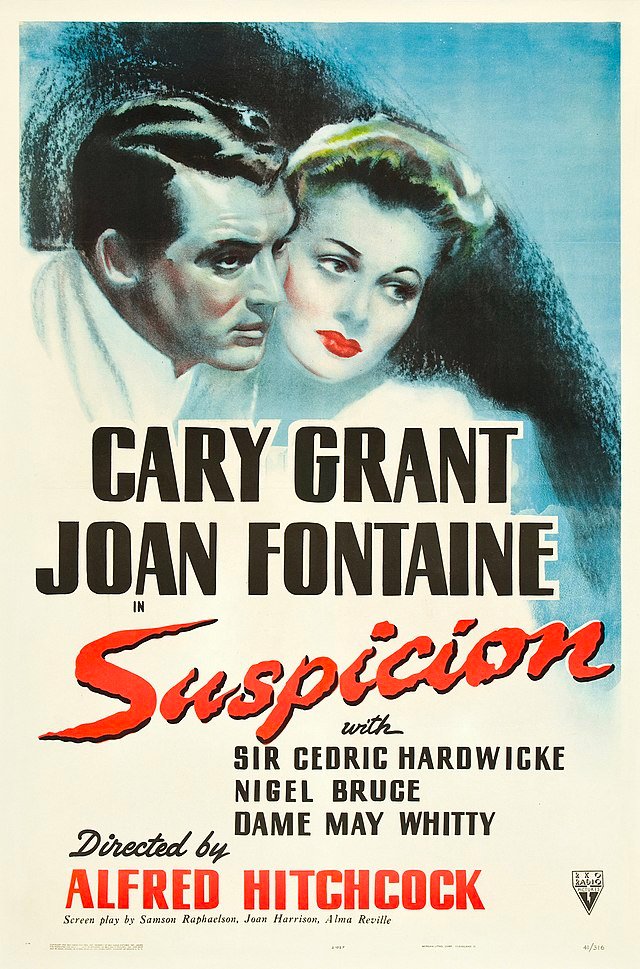
Suspicion
USA, 1941
Director: Alfred Hitchcock
Screenplay: Samson Raphaelson, Joan Harrison, Alma Reville
Genre: Psychological thriller, romance
Soundtrack composer: Franz Waxman
Editing: William Hamilton
Production: David O. Selznick (producer)
Cast
Cary Grant (Johnnie Aysgarth)
Joan Fontaine (Lina McLaidlaw Aysgarth)
Cedric Hardwicke (General McLaidlaw)
Nigel Bruce (Gordon Cochran Thwaite, alias Beaky)
May Whitty (Mrs. McLaidlaw)
Auriol Lee (Isobel Sedbusk)
Plot
Young Lina, daughter of an aristocratic and wealthy English military man, falls madly in love with a certain Johnnie, a playboy who appears in magazines. But despite his great popularity, it turns out that the guy is penniless. What he does have, however, is a lot of nerve. General McLaidlaw, the girl’s father, is not at all amused by Johnny (as is only natural). Lina, for her part, idealizes him —and she barely pays any attention to another decent suitor who wants to dance with her at a party…
It is not until after marrying the scoundrel that the young woman realizes her mistake: the character is broke; he is a bon vivant, a parasite, and does not want to lift a finger.
And in addition to having a cheeky attitude, he also has something else: debts. But not only that… He also has a great fondness for squandering money, gambling, and betting.
It could be said that the naive and long-suffering Lina has found herself with a prince who turned out to be a frog.
However, it doesn’t end there: the girl comes to fear for her life, as she notices very suspicious behavior in her handsome husband… Is he perhaps looking to get rid of her so he can keep her family’s money?
Comment
In this interesting psychological thriller, we find numerous parallels with another Hitchcock film: Rebecca (1940), filmed shortly before. To begin with, the leading actress is the same, Joan Fontaine, and her character in both films has an almost identical personality: a young, fragile, and naive woman. Lina, or “monkey face” as Johnnie mockingly calls her, swings from one emotional extreme to another without losing these traits: from her docile and gullible trust in her scoundrel of a husband, she develops an obsessive and paranoid fear of him.
And given the accumulation of clues, it’s no wonder. In addition to his fondness for horse betting, Johnnie also cultivates a keen interest in detective and murder books—perhaps these readings serve as “inspiration” for him…
The similarities between this film and Rebecca are evident in both structure and theme, as well as in the dynamics between the characters. They are also apparent in the setting and visuals: scenes of cliffs, lonely beaches, mansions…
However, the small but important difference between the protagonists of the two films (played, remember, by the same actress) is that the one in Rebecca is a humble orphan, while the one in Suspicion is the heiress to a very wealthy family. The main male character, the quarrelsome playboy Johnnie, played by Cary Grant, could very well have motives for committing one (or several) crimes.
As a master of suspense, Hitchcock manages to deceive viewers on several occasions. As the story progresses, we are manipulated through the perceptions of the protagonist, who is quite suggestible.
Paying attention to certain details can help, but it can also be a trap, as the director throws us the occasional red herring (or false clue, in detective jargon) — such as the abstract painting that one of the policemen stares at (a detail that leads nowhere); or everything surrounding the character of Isobel, the mystery writer.
The abstract painting that distracts one of the police officers could also be a meta-narrative allusion to the case they are investigating: what is seen, what is interpreted (whether or not there is a crime), depends largely on the perspective of the observer. As in an abstract painting, where what is represented is not tangible. In fact, the main protagonist of the film (above and beyond the character of Lina) is ambiguity. This is particularly true in moral terms, but also in terms of the rather open ending, which gives rise to different interpretations: justified fear and real danger… or just paranoid suspicion?
In Suspicion, May Whitty plays the mother of the protagonist. She is the same actress who plays the mysterious old lady in The Lady Vanishes (1938), one of Hitchcock’s last British productions before he made the leap across the Atlantic. That film takes place almost entirely on a train, and it is also on a train that the production we are reviewing today begins.
A more mature Cary Grant (who plays Johnnie here) would collaborate with Hitchcock again in North by Northwest (1959).
As a curiosity, the actress who plays the writer Isobel (who acts as a kind of Agatha Christie) died in a traffic accident while returning from participating in the filming of this movie.
Felix Hahlbrock Ponce
(Get my books HERE)
Get Suspicion HERE!
(This is an affiliate link. I may earn a commission if you purchase through these link, at no extra cost to you. As an Amazon Associate, I earn from qualifying purchases.)