
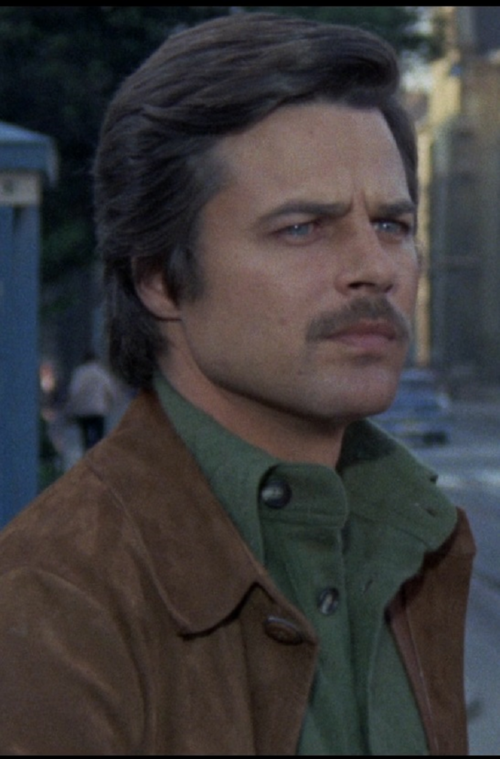
Short night of glass dolls (La corta notte delle bambole di vetro / a.k.a. “Malastrana”)
Italy, 1971
Director: Aldo Lado
Script: Aldo Lado, Rüdiger von Spies (Dialogues)
Cast: Jean Sorel (Gregory Moore), Ingrid Thulin (Jessica), Mario Adorf (Jacques), Barbara Bach (Mira), Fabijan Sovagovic (Profesor Karting), José Quaglio (Valinski)
Music: Ennio Morricone
Story
The inert body of reporter Gregory Moore is found in a park in Prague and taken to the morgue. However, Gregory is not dead, but is suffering from an episode of catalepsy that prevents him from moving and has blocked his vital signs. The employees of the morgue keep him in a cold room waiting to identify him so that they can proceed with the autopsy and establish the causes of his “death”. Meanwhile, the reporter is aware of what is going on around him; and he begins to recapitulate, as a flashback, the events that led him to his current situation…
Initially amnesiac, memories gradually come to mind. He had arrived in Czechoslovakia as a correspondent with his fellow journalists Jacques and Jessica, at the same time as a wave of kidnappings (and subsequent murders) of beautiful women was beginning in the capital. In Prague he had met a young woman named Mira, a Czech from another city, with whom he had a relationship. As part of his work as a journalist, Gregory was invited to a reception at the home of a politician named Valinski. Important personalities of the city gathered there. Gregory took Mira with him, who had come from his hometown to spend a few days with him in Prague. Later both returned to Gregory’s apartment. But the reporter had to leave once more, after receiving a call from his partner Jacques. Once he was reunited with him, everything turned out to be a false alarm. Back at his home, Gregory realized that Mira had disappeared… Although her suitcase and all her clothes were still there, and even her money and documents. The journalist immediately understood that someone had to kidnap her, and that the “false alarm” was activated to get him away from his house so that the girl would be left there alone. Gregory is convinced that Mira was kidnapped, although his partner Jessica (who, attracted by him, is jealous) tries to convince him that she simply abandoned him. But also the sullen commissioner Kierkoff tries to close the case. Thus, Gregory begins his own investigation. At first, he suspects a serial killer. But after a thorough investigation, the bold reporter gets closer and closer to the truth…
It all seems to be related to a complex and mysterious international conspiracy network that is dedicated to abducting young girls for dark rites. It is not just one individual, but a whole well-structured and branched organization.
The parents of the other missing girls are afraid to speak out. A man who had decided to tell what he knows is killed before Gregory’s eyes, when a stranger pushes him off a bridge onto the train tracks.
All the clues lead to “Club 99,” where high-profile political and financial figures attend (supposedly) classical music recitals. The owner of the club is none other than Valinski, the host of the party Gregory went to with Mira – and where the girl was last seen in public.
The hostile curator, realizing that the reporter is still investigating on his own, is looking for a way to accuse him of his girlfriend’s disappearance.
In his cataleptic state, Gregory tries to put all the pieces together to solve the case and struggles to get his body moved again. The doctors are amazed that after so many hours rigor mortis has not yet appeared, and that the body still has a warm temperature. Ivan, a doctor friend of his, will try to revive him. But some sinister individuals are very interested in Gregory never waking up…
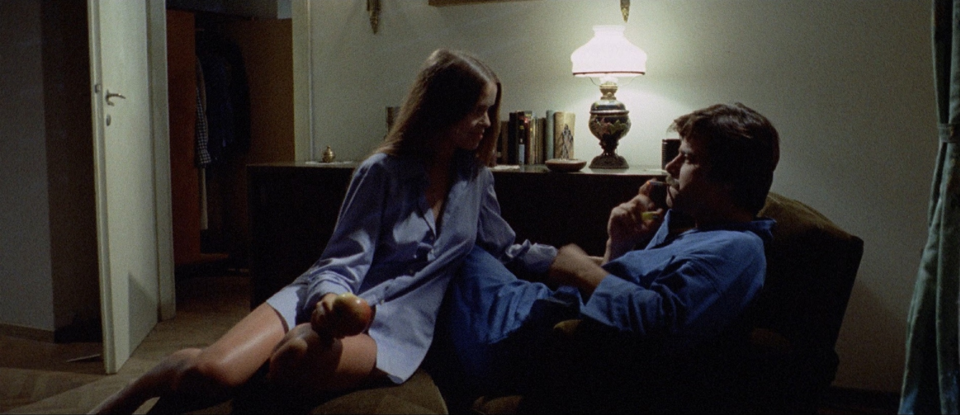
Commentary
This visionary masterpiece was several decades ahead of its time in its subject matter and in its approach to “Eyes Wide Shut” (1999), Stanley Kubrick’s latest film. “The Short Night of the Glass Dolls” (a.k.a. “Malastrana”) perfectly combines the usual stylistic canons of the Italian or Giallo thriller with a Hitchcockian suspense with dreamlike (reminiscent of “Vertigo”, 1958) and occult touches. There are also references to the most macabre Polanski, from “Rosemary’s Baby” (1968) or “The Tenant” (1976).
The legend of the Prague Golem (made literature by Gustav Meyrink’s pen) is also one of the essential influences for “The Short Night of the Glass Dolls”. The action also takes place in the enigmatic Prague, and Gregory (Jean Sorel) embodies the opposite end of the golem. The Jewish legend of the golem (which would inspire Mary Shelley to write her “Frankenstein”) is about how a rabbi brings back to life through cabalistic black magic a being composed of corpses to become his slave. The golem is an automaton, a dead person transformed into a robot, an animated (and animalistic) being although without soul or conscience; and on the other hand the cataleptic Gregory is a man reduced to the immobility of a corpse (also due to black magic?) who nevertheless is capable of feeling and reasoning.
The feeling of Kafkaesque nightmare that overwhelms Gregory during his cataleptic impotence is directly transmitted to the spectator (through the character’s internal dialogue and his memories), who anxiously wants to reconstruct with him the facts related to the disappearance of his girlfriend; facts that must have something to do with the unfortunate situation he is in (His mind does not rest at any moment, and he is always aware that he must recover his mobility as soon as possible, otherwise he will really die during the “autopsy”).
A group of sectarian and Satanist character commanded by exponents of the “elite”, international politics and high finance, performs a series of perverse rituals to maintain cohesion, satiate their vampire appetites and preserve their power. When Gregory, who has been investigating some exponents of this group, discovers that the kidnapping of his girlfriend (and other girls) is related to the sinister circle, he inevitably attracts the attention of its members, who will try at all costs to prevent the intrepid reporter from continuing to pull the strings?
Barbara Bach, who plays Mira, worked that same year in 1971 on Paolo Cavara’s giallo “Black belly of the tarantula”. She also appears in the polizziesco “Street Law” (Enzo G. Castellari, 1974). Jacques is played by Mario Adorf (Rocco in “Milano Calibro 9” by Fernando Di Leo, 1972).
Although the action takes place in Prague, most of the film was shot in Zagreb, Croatia. The soundtrack was made by maestro Ennio Morricone.
A few years later Aldo Lado would shoot the great thriller “Last stop on the night train” (1975), and also the giallo “Who has seen her die? (1972), set in Venice.
Get Short Night of Glass Dolls HERE!
Get All the colors of murder: Guide to giallo cinema HERE!
(This are affiliate links. I may earn a commission if you purchase through these links, at no extra cost to you. As an Amazon Associate, I earn from qualifying purchases.)