
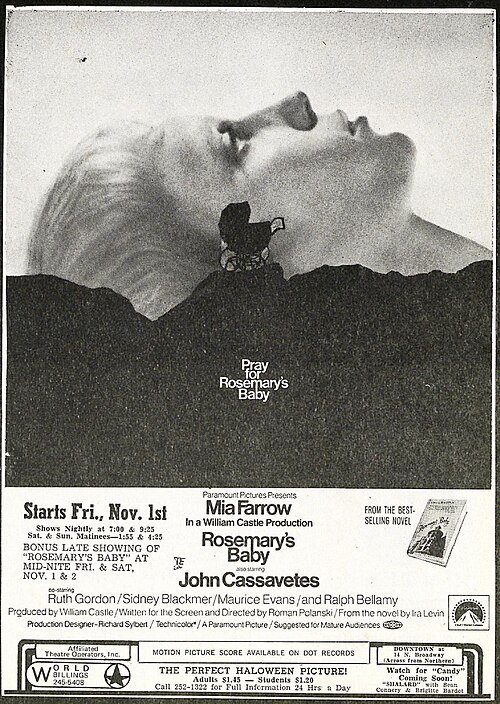
Rosemary’s Baby
USA, 1968
Director: Roman Polanski
Screenwriter: Roman Polanski (based on the novel by Ira Levin)
Genre: Gothic horror, drama, supernatural, possessions, exorcisms, psychological drama, witchcraft, motherhood
Soundtrack composer: Krzysztof Komeda
Editing: Sam O’Steen, Bob Wyman
Production company: William Castle (producer), Dona Holloway (associate producer)
Main actors:
Mia Farrow (Rosemary Woodhouse)
John Cassavetes (Guy Woodhouse)
Ruth Gordon (Minnie Castevet)
Ralph Bellamy (Dr. Sapirstein)
Sidney Blackmer (Roman Castevet)
Maurice Evans (Dr. Hill)
Victoria Vetri (Margaux Castevet)
Patsy Kelly (Mabel)
Elisha Cook Jr. (Luba)
Charles Grodin (Dr. Hill)
D’Urville Martin (Taxi Driver)
Emmaline Henry (Mrs. Byron)
Hanna Landy (Woman at the Party)
Plot
Guy Woodhouse and his wife Rosemary move into an apartment in Manhattan. He is a second-rate actor, who so far has only had minor roles in TV series. The couple wants to have their first child soon. Hutch, a friend of the young couple, shows them their new home…
In the building’s laundry Rosemary meets a young woman named Terry. She is a guest of Roman and Minnie Castevet, the Woodhouses’ elderly neighbors. Terry has no family of her own (except for a brother who is always traveling) and the Castevets (who have no children) are a sort of surrogate parents to her. Terry shows Rosemary a strange “good luck” charm, which she wears around her neck – a gift from old Minnie.
Soon after, returning one evening to their new home, Guy and Rosemary see that in front of their building the area has been cordoned off by the police. A woman’s body lies bloodied on the sidewalk. Rosemary recognizes her: it is Terry. Everything indicates that the girl has jumped from the seventh floor, from the Castevets’ house where she was staying. Roman and Minnie were outside and arrive at that moment, thus learning of the tragedy. They don’t seem too surprised, as Terry “had drug problems and was mentally very unstable”…
From that moment on, the eccentric elders seek to gain the Woodhouses’ trust, and invite them to dinner. Rosemary is struck by the fact that the Castevets seem to have removed paintings for their visit, as there are nails and empty spaces on the wall… Rosemary also hears sinister chanting coming from the neighbors’ apartment at night.
Guy, who at first was reluctant to meet the old people, ends up becoming close friends with them and visits them frequently. It is not long before he gets a call from the production company: The lead actor in the project he is working on has suddenly gone blind, and he has been chosen to take his place in the lead role. Up to now, Guy had only been involved in minor roles, and thanks to this incident, a promising career in the film industry begins for him.
The Castevets visit the young couple to bring them desserts. Rosemary becomes dizzy after taking one of those sweets, and has a disturbing nightmare, in which she is “raped by a non-human creature”. It all seems very real, but when she wakes up she forgets much of what she had dreamt – that maybe it wasn’t just a dream….
As she wished, Rosemary soon became pregnant. The Castevets are among the first to find out. Until now, the young woman had Dr. Hill as her family doctor, but the Castevets insist that Rosemary see another specialist, a friend of theirs: Dr. Abraham Sapirstein. He recommends that the pregnant woman take the concoctions that Minnie will prepare for her, based on “natural herbs”.
In addition to supplying her with these potions, Minnie also gives Rosemary a “good luck” amulet pendant: the same one worn by Terry…
Since he has been frequenting the Castevets, Guy begins to succeed as an actor. At the same time, he distances himself from his wife – who has cut her hair in a garçon style and who looks worse and worse, becoming paler and thinner (instead of gaining weight as one would expect).
Rosemary has a feeling that her “friendly neighbors” are up to something… Something to do with her future child. She tells Hutch of her concerns. Hutch calls her a few days later, as he has discovered something important and needs to talk to her urgently. Hutch doesn’t show up, and Rosemary learns that he has suffered a mishap: he is in the hospital in a coma…
Rosemary begins to believe that there is a conspiracy against her and her baby, but she cannot yet imagine the dimensions of this plot, nor its diabolical (never better said) characteristics…
Comment
This great classic of suspense and subtle horror, based on a novel by Ira Levin, has several interesting coincidences that deserve to be highlighted. The central theme, and most obvious interpretation, revolves around the archetypal theme of “selling one’s soul to the Devil”. Reality trumps fiction, and if we take into account the context surrounding the film, and especially its director Roman Polanski, it all makes even more sense.
Already at the beginning of the film, Hutch mentions that in that building took place dreadful crimes, ritual sacrifices of children. Hutch is an expert in the occult, and knows that a sorcerer named Adrian Marcato lived there. As it will be discovered later, the old Roman Castevet turns out to be his son (continuation of a dynasty of Satan worshippers). The name “Roman Castevet” is an anagram of his birth name, “Steven Marcato”. The resemblance between “Castevet” and “Cassavettes”, the real surname of the actor who plays Guy, is striking, as well as the fact that the satanic old man is called Roman, just like the director. Also striking is the resemblance between Roman Castevet (played by Sidney Blackmer) and the illuminati oligarch “philanthropist” David Rockefeller.
Guy’s sudden career success can only be explained by his friendship with the Castevets – who seem to have great influence. It is, as it is suggested to us, a “pact”: He will achieve his career goals in exchange for something… In exchange for his unborn child. Curiously, the year after the film was shot, Roman Polanski lost his wife Sharon Tate and the child she was expecting, both killed in a ritual sacrifice by members of “The Family”, Charles Manson’s cult. Some suggest that “Rosemary’s Baby” was a statement of intent, in which John Cassavettes (in his role as Guy Woodhouse) was Polanski’s own alter ego. In fact, Sharon Tate had been proposed to play the role of Rosemary; before the final decision fell on Mia Farrow.
“The Manson ‘Family’ was connected to Michael Aquino, military and NSA agent, and close associate of Anton Szandor Lavey, founder of the ”Church of Satan. The voice heard during the “black mass” in Rosemary’s nightmare is believed to be that of Lavey himself. Said black mass takes place aboard a yacht (reminiscent of “The Knife in the Water,” Polanski’s first feature film when he was still living in his native Poland). The members of the Manson cult had common contacts with Polanski, through movie stars of the time such as Marilyn Monroe or Jayne Mansfield (both dead in strange circumstances). To those circles also belonged Frank Sinatra (himself related to organized crime), ex-husband of Mia Farrow, who plays Rosemary. Mia Farrow would later marry Woody Allen (another filmmaker who, like Polanski, seems to have a predilection for pre-teen girls…).
The apartment where the story takes place is the Branford Building, outside the gates of which John Lennon was to be murdered in 1980.
Rosemary’s baby was scheduled to be born “on June 28, 1966” – 66 being “the first year of the New Age,” according to the Satanist neighbors.
Also worth noting are certain subliminal messages in the film – which among other things has been pointed out as a covert propaganda for abortion (since no one wants to have the Devil as a child…) This is not unreasonable considering that it was released in 1968, a time of hippie effervescence and the starting point of the current progressive ideologies that consider abortion as a “liberation” for women.
Other subliminal details are the Casavets’ jibes at the Pope (Rosemary is originally Catholic) and the cover of Time magazine on which one can read “Is God Dead?” – Indeed “a new era” was beginning at that time; the final stretch of the Kali yuga in which we find ourselves today.
Another memorable coincidence is the date of June 28 – That day in 1969 marked the birth of the “gay movement”, following the riots at the “Stonewall” bar (which incidentally belonged to the Genovese, one of the Five Families of the NY Mafia). As Rafapal points out, it is not unreasonable to imagine that one of the purposes of the film (besides serving as a “statement of intent” and veiled reflection of reality as far as secret societies are concerned), was to influence the collective unconscious to separate men from women, announcing the “war of the sexes” that unfortunately exists today.
“Rosemary’s Baby” has influenced not a few later films. Among them “The Short Night of the Glass Dolls” (Aldo Lado, 1971), an excellent Italian thriller that has so many parallels with Stanley Kubrick’s much later “Eyes Wide Shut” (1999). There are also obvious similarities with the interesting “The Sect” (Michele Soavi, 1991), whose screenplay was written by the master of giallo Dario Argento, director of ‘Inferno’ (1980), a film that also owes much to “Rosemary’s Baby” as far as its atmosphere is concerned.
Get Rosemary’s Baby HERE!
(This is an affiliate link. I may earn a commission if you purchase through these link, at no extra cost to you. As an Amazon Associate, I earn from qualifying purchases.)