
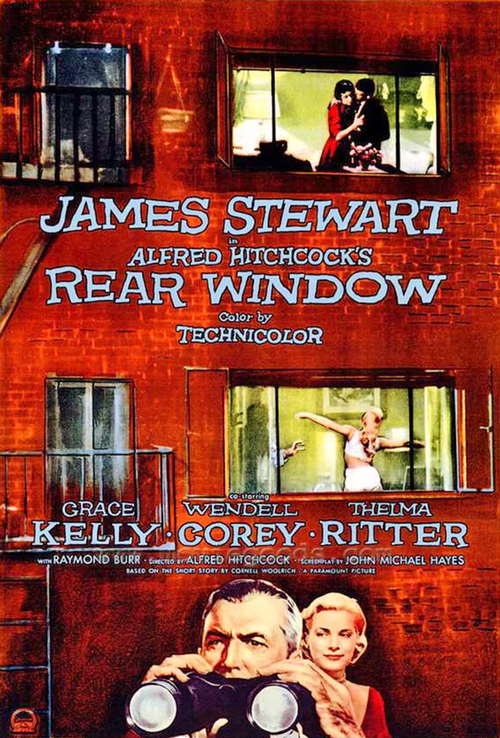
Rear Window
USA, 1955
Director: Alfred Hitchcock
Screenwriter: John Michael Hayes
Genre: Suspense, thriller, mystery
Soundtrack composer: Franz Waxman
Editor: George Tomasini
Production company: Alfred Hitchcock (producer), Paramount Pictures (studio)
Main actors:
James Stewart (L. B. “Jeff” Jefferies)
Grace Kelly (Lisa Carol Fremont)
Thelma Ritter (Stella)
Wendell Corey (Detective Doyle)
Raymond Burr (Lars Thorwald)
Georgine Darcy (Miss Torso)
Judith Evelyn (Miss Lonelyhearts)
Ross Bagdasarian (neighboring composer, musician in the film)
Plot
Fifty-year-old Jeff works as a photographer for a magazine. After an accident he is confined to his home, with one leg in a cast and in a wheelchair. He has been in a wheelchair for five weeks now, and has one more to go before he can walk again. He gets quite bored, and as a hobby he spies on the neighbors in the building across the street, watching them through their windows in their homes across the courtyard. Among others live there a beautiful ballet dancer (“Miss Torso”), a pianist, a newlywed couple, an old maid who imagines romantic encounters with non-existent beaus, and a middle-aged married couple. The married couple has certain conflicts, Jeff sees them arguing. She is bedridden…
Mature masseuse Stella warns Jeff that his voyeuristic hobbies could get him into trouble. Jeff’s girlfriend is the attractive Lisa, a young woman from a good family, always very elegant and sophisticated. Jeff is reluctant to marry her, as Lisa is “too perfect” for him. They have two completely different lifestyles that are impossible to reconcile. He, as a photographer for his magazine, must always travel to inhospitable places, shooting in jungles and deserts, while she is used to luxurious social events, fashion shows and all the comforts of the “dolce vita”. Still, she is in love with him and visits him daily in his temporary house confinement.
One night Jeff falls asleep in his wheelchair by the window. He wakes up around 2:00 a.m. because of a heavy thunderstorm. Then he sees in the apartment of the couple who were arguing how the husband goes out into the street with a suitcase. An hour later he returns, only to go out again, also with the suitcase. Jeff wonders what the guy is doing going out in the rain and carrying suitcases – not once, but up to three times during the night….
From the next day on, Jeff never sees the man’s wife again. It seems unlikely that she was out on a trip, as she was sick in bed. The photographer, who used to spy on the neighbors for entertainment, becomes obsessed. He now also uses binoculars and the lens of his camera so as not to miss any detail.
He keeps a particularly intense eye on Thorwald, the mysterious neighbor, whom he suspects of having murdered his wife. Soon, Jeff thinks he recognizes new and alarming signs that he is right: he sees Thorwald handling a large knife and a handsaw, he also sees him preparing a large trunk and tying it up with ropes…
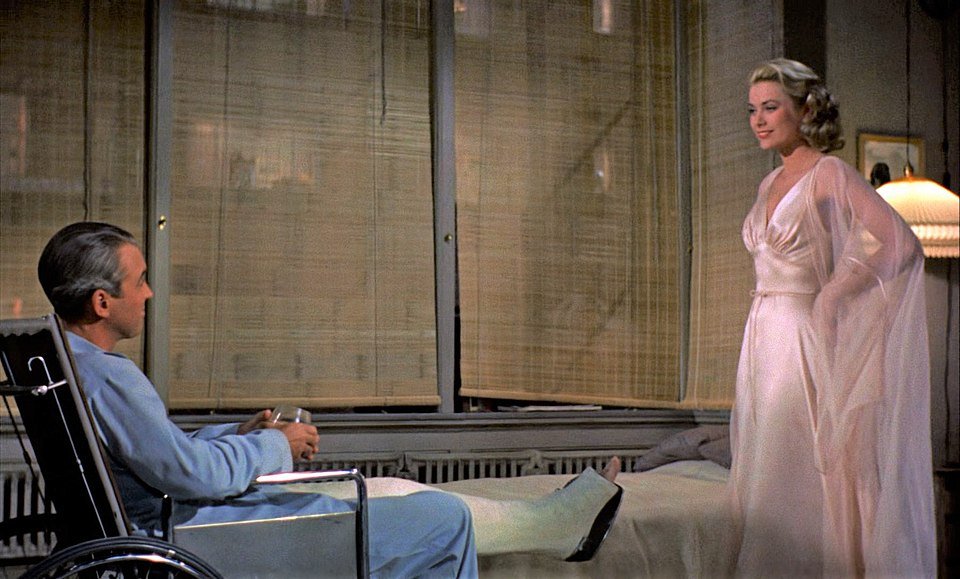
Jeff communicates his concerns to his masseuse Stella and his girlfriend Lisa. Both initially think he’s overreacting, but are soon convinced that the neighbor has at least one extremely strange attitude. Days go by and the missing woman is still nowhere to be found. Jeff calls an old police friend of his, Lieutenant Tom Doyle, whom he knows from the war. Tom agrees to investigate the matter, but finds no evidence of any wrongdoing. Everything seems to be in order, and according to his inquiries Thorwald accompanied his wife to the train station and she left for another city.
However, Jeff remains adamant that a crime has been committed on the other side of the yard, and despite his temporary handicap, he is determined to find out the truth…
Comment
Hitchcock seemed to anticipate the constant surveillance we have in cities today (cameras recording everywhere for “security” reasons). With the excuse of preventing or unveiling illegal acts, surveillance and control by the State (or worse, by nebulous supra-state agencies) sometimes invade privacy. With Big Brother Google and other cybernetic mechanisms that record everything that Internet users do online, Orwellian dystopia is very close to reality. It is possible that Hitchcock already saw this coming, as this theme can be interpreted as the deep, hidden meaning in the plot of his very interesting thriller “Rear Window”.
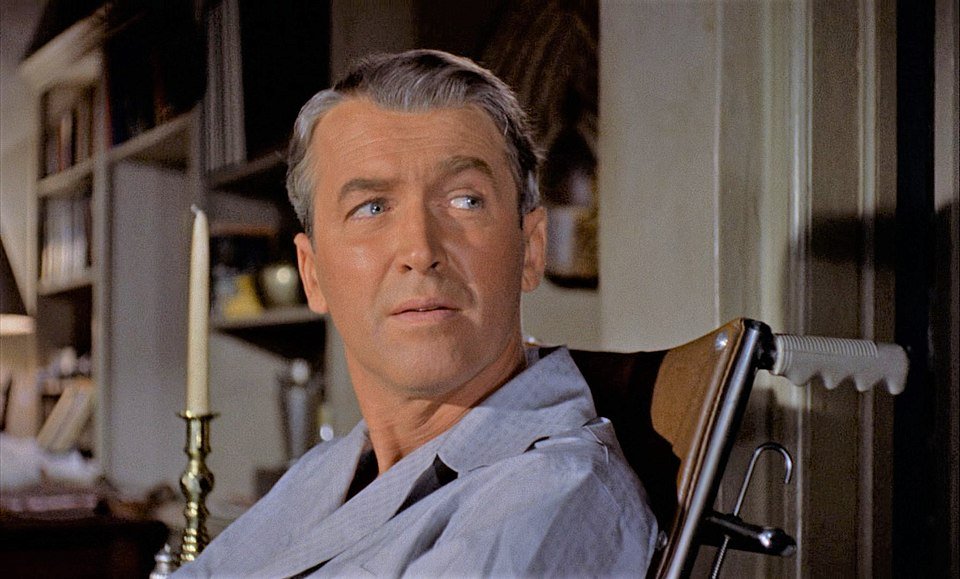
The intrigue grows for the spectator as the suspicions and obsessions of that other “spectator” increase: our protagonist Jeff, played by James Stewart. By means of sequence shots and studied camera angles from the perspective of the plastered photographer, the master of suspense manages to turn all of us who watch his film into voyeurs.
James Stewart, one of Hitchcock’s regular collaborators in that period, played the leading role in the excellent “Vertigo”, which the gruff British filmmaker would shoot three years later.
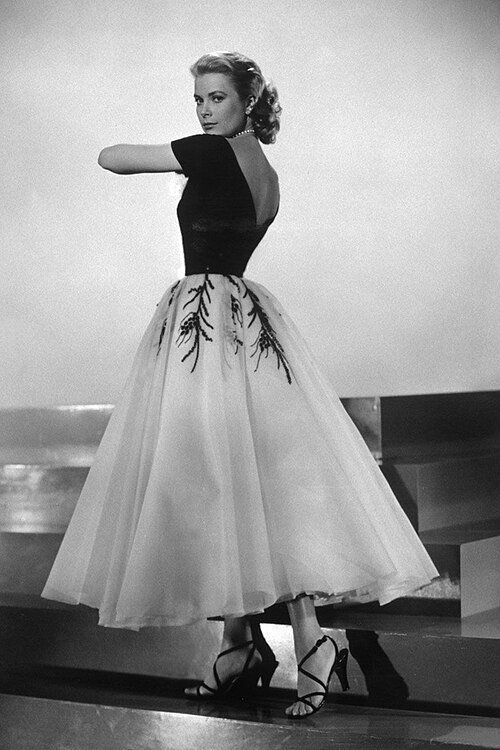
Among her co-stars was a magnificent Grace Kelly as Lisa. Shortly after, she would abandon her artistic career to become a princess, when she married Rainier of Monaco.
As it could not be otherwise, Hitchcock makes a cameo: we see him fleetingly at the pianist’s house.
The theme of urban dwellings and neighbors would deeply influence Roman Polanski: from the following decade, the Polish-Jewish director would shoot three memorable films known today as his “apartment trilogy”: ‘Repulsion’ (1965) with Catherine Deneuve, “Rosemary’s Baby” (1968) with Mia Farrow and “The Tenant” (1976), where he himself would get into the skin of the protagonist. The neighbors are conceived as hostile and threatening individuals (something contrary to what happens, for example, in the Mexican “El bruto” by Luis Buñuel, where the neighbors are “a pineapple” against the purposes of the speculator landlord).
Curiously, nowadays, few people in the apartments of the big cities have any relationship with their neighbors. Everything is much more anonymous and isolated than before. People are more distrustful and tend to isolate themselves. Have these films somehow contributed to erode the sense of community that used to exist in the neighborhoods?
Get Rear Window HERE!
(This is an affiliate link. I may earn a commission if you purchase through these link, at no extra cost to you. As an Amazon Associate, I earn from qualifying purchases.)