
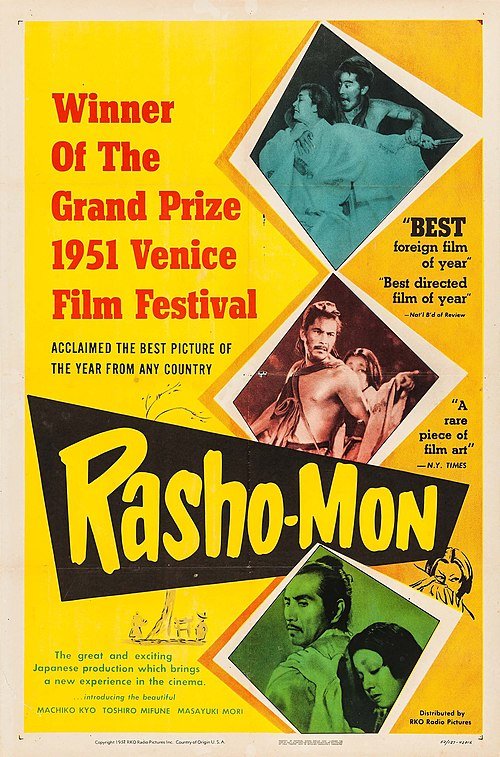
Rashomon
Japan, 1950
Director: Akira Kurosawa
Screenplay: Akira Kurosawa, Shinobu Hashimoto (based on stories by Ryūnosuke Akutagawa)
Genre: Drama / chambara
Soundtrack composer: Fumio Hayasaka
Editing: Akira Kurosawa
Production: Daiei Film
Main cast:
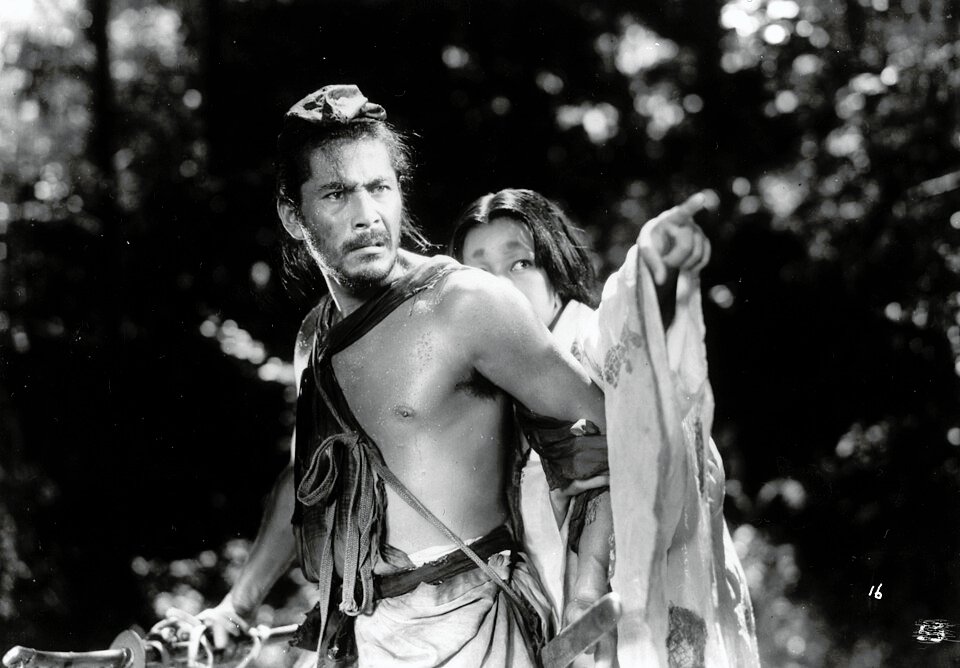
Toshirô Mifune (Tajômaru, the bandit)
Machiko Kyô (Masako Kanazawa, the wife)
Masayuki Mori (Takehiro Kanazawa, the samurai)
Takashi Shimura (the woodcutter)
Minoru Chiaki (the priest)
Kichijirô Ueda (the passerby / the common man)
Fumiko Honma (the medium)
Plot
A woodcutter, a monk, and another local take shelter from a torrential rain in the ruins of a temple. A few days earlier, the first two witnessed a strange event. In a nearby forest, the body of a man and the remains of a woman’s clothing were found.
A couple traveling through the area had been accosted by the bandit Tajomaru. He sexually assaulted the woman and tied up her husband—the man who was found dead shortly thereafter. But there are different versions of his death…
The woodcutter, the monk, and the third man who has joined them in the ruins of the Rashomon temple to shelter from the rain, recall the mysterious case from different perspectives: that of the bandit (who has been captured), that of the woman (survivor of the attack)… and that of the husband himself—who communicates with the living from the afterlife through a medium.
To everyone’s confusion and amazement, the three versions are completely different…
Commentary
Taking a criminal event and its investigation as the plot’s central theme, as well as the ramblings of the witnesses, Kurosawa shows us the very different perceptions of the same event by those involved. He explores the human tendency to hide or embellish details, whether out of a desire to look better or out of fear.
The philosophical content of this film, based on a short story by Ryunosuke Akutagawa, leads the viewer to question what truth is. There is only one objective and neutral fact, but at the same time, each of those involved in the event has a subjective view of it… which, when recounted, causes the truth to be distorted. In this way, the thin line between truth and lies becomes blurred. Just like the thin lines between reality and fiction, between the material and the imaginary, between the tangible and the ethereal—as proof of this, we even have a “testimony from beyond the grave,” that of the dead samurai who speaks from the astral plane through the mouth of the Shinto medium.
It also raises issues such as honor, how to respond to an affront, and a woman’s relationship with her husband, who has failed to protect her, and with the man who has abused her. It also questions whether she was really raped, or whether, after the initial struggle, she gave herself to the bandit, subsequently instigating the fight between the two. The dynamics between the three characters directly involved in the event are explored, and to this is added the perspective of the secondary witnesses—the woodcutter and the monk. These two characters represent morality, but also fear and mistrust. The third person who joins them in the ruins, who listens to the story in a completely detached and objective manner, serves as a kind of mirror for the monk and especially the woodcutter (who “is ashamed of not understanding his own soul”); in which their fears, cowardice, and hypocrisy are reflected, a mirror that allows them to reverse the distortion of an event that is, at heart, quite simple. Thanks to this, both the woodcutter and the monk gain clarity.
With the appearance of the baby and the end of the rain, the film ends on a hopeful note of redemption, paving the way for a new beginning.
As we can see, the content is very philosophical, and its form (the staging and atmosphere) is extremely poetic. The camera work enhances the visual power of the film, even giving it a certain hypnotic quality. To tell the story from different perspectives, Kurosawa uses flashbacks. Most of the footage is shot in the forest (representing the labyrinth and confusion of events) and in the ruins of a temple under heavy rain (a place of reflection where witnesses review the events and try to draw conclusions). As for the soundtrack, its similarity to Ravel’s famous “Bolero” is striking, and composer Fumio Hayasaka was undoubtedly inspired by it. In fact, Hayasaka would face accusations of musical plagiarism for this. This is curious considering that Kurosawa himself would later accuse Sergio Leone of plagiarism when he filmed “A Fistful of Dollars” (1964) — with a story very similar to his “Yojimbo” (1961) but in a western setting.
Another striking detail is the difference between this film and other “samurai” films in terms of clothing, hairstyles, and weapons. The story of Rashomon takes place in a much earlier period than most films of this genre. Chambara films are usually set in the Tokugawa era, around the 18th and especially the 19th centuries, while Rashomon takes place in the Heian period, some 800 years earlier.
(Get my books HERE)
Get Rashomon HERE!
(This is an affiliate link. I may earn a commission if you purchase through these link, at no extra cost to you. As an Amazon Associate, I earn from qualifying purchases.)