
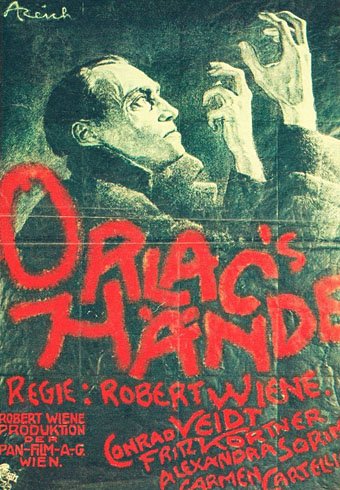
Orlac’s hands
Germany, 1924
Director: Robert Wiene
Script: Louis Nerz
Cast: Conrad Veidt, Alexandra Sorina, Fritz Kortner, Carmen Cartellieri
Genre: Drama
Plot
The famous French pianist Paul Orlac is involved in a train accident. The musician was on his way to meet his wife Yvonne. When she hears about the derailment, she runs terrified to Dr. Serral’s office, hoping that the doctor will save her beloved’s life…
In the health center where the doctor works there is also a morgue. That same morning, the corpse of a criminal who has just been executed is about to arrive there.
Serral assures Yvonne that her husband’s life is not in danger… However, he could lose his hands, which have been badly damaged. This, she believes, would be an even greater tragedy than death. Without hands, the great pianist’s life would be meaningless.
Serral promises the troubled Yvonne to do what he can. He looks out the window and sees the corpse of one of those executed on the scaffold being brought in. The ingenious doctor, an expert surgeon, comes up with a brilliant idea…
When Orlac awakens from his lethargy after the surgery, his hands are bandaged. A rather dubious individual (never better said) appears to him in disturbing visions and nightmares. As if that were not enough, an anonymous note tells the pianist what the operation really consisted of.
When he is about to be discharged, Orlac notices that his wedding ring no longer fits… His fingers and hands look very different (in fact, they are…).
Once home, the great musician seems unable to play the piano decently. Orlac senses that from that moment on, nothing will ever be the same…
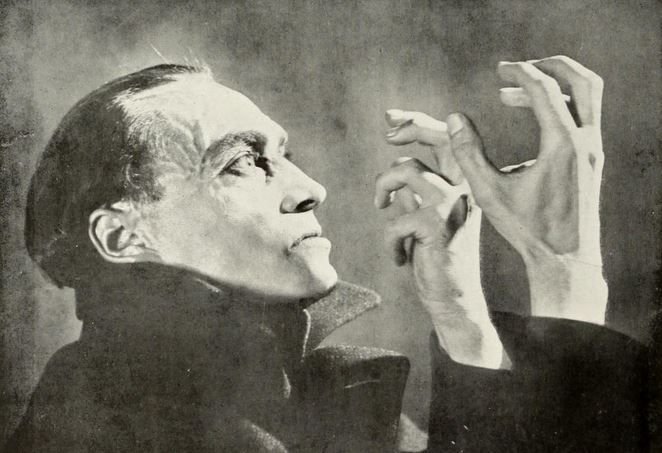
Those hands become for him an obsession, something that conflicts with his own will.
Desperate, the pianist’s wife goes to see her father-in-law, his father. The old man is a rich and powerful man who lives with a sinister butler in a kind of castle. But the old man Orlac is not willing to help his son. Later, the latter personally goes there, discovering that his father has been murdered. The weapon used to commit the crime seems quite familiar to Orlac…
Comment
This silent film, which can clearly be framed in the expressionist style so typical of its time, tells the story of a pianist who after a rather unorthodox operation will experience a drastic change (both in his personality and in his “manual” predilections).
Drama, film noir and a touch of science fiction are perfectly combined in this feature film, directed by Robert Wiene, the director of the much better known “The Cabinet of Dr. Caligari” (1920).
The subtle subtext of criticism of transhumanism and its disastrous consequences (something that was already foreseen a century ago) would be taken up decades later by the great Chicho Ibáñez Serrador, in the excellent medium-length film “El Transplante”.
“Will I be able to play the piano again?” asks Orlac to the doctor after the operation. In a philosophical tone, the doctor answers that “the spirit controls the hands”, and that “nature and a great willpower make everything possible”. It remains to be debated whether the operation performed was in accordance with the nature to which the illustrious doctor alluded.
It is also curious that Orlac knows quite well from the beginning what the operation consisted of, and perhaps this has influenced him in a psychosomatic and autosuggestive way in his new stage as an ex-pianist… The hallucinations that torment him are increasing, and Orlac is immersed in a dangerous spiral towards self-destruction. Maybe the love of his worried wife will be able to save him. Or maybe not… The couple’s maid also comes into play, hired by a mysterious individual for a devious purpose.
“Orlac’s Hands” has a very slow pace, which is not justified by the age of the film; but, far from causing tedium to the viewer, it is adequate to highlight with intensity the state of mind of the characters, giving the proposal an unreal, nightmarish atmosphere.
However, towards its final stretch, the film gains a lot in both pace and interest, as the clever plot twists will show us that not everything is what it seemed. Orlac’s story has more than one surprise in store for us as the climax approaches. It is therefore difficult to comment on the film in depth without revealing plot details that could spoil the charm of the film.
Orlac seems to be the victim of a possession, but this is (as previously mentioned) more the result of auto-suggestion. Seen as a whole, we can consider that we are in front of a primitive (cinematically speaking) psychological thriller with detective aspects; and with a plot and style undoubtedly influenced by the literature of Edgar Allan Poe. In fact, the film is based on a book written by the Frenchman Maurice Renard, who was an admirer of Poe.
In the background there is an important parallelism with the message of the slightly later “Metropolis” (Fritz Lang, 1927). The heart must be the mediator between the head and the hands.
The film has, namely, two different official soundtracks, composed and integrated into the footage many years later. One is from 1998 (by Henning Lohner) and the other from 2008 (by Paul Mercier).

The leading couple is played by Conrad Veidt (Orlac) and the Belarusian Alexandra Sorina (Yvonne). Both would participate, at the beginning of the talkies, in one of the first films about “Rasputin” (Adolf Trotz, 1932).
Get Orlac’s Hands HERE!
(This is an affiliate link. I may earn a commission if you purchase through these link, at no extra cost to you. As an Amazon Associate, I earn from qualifying purchases.)