
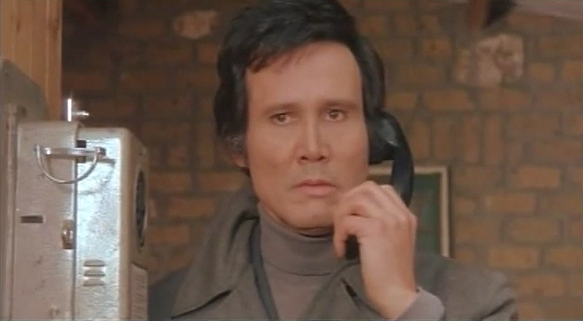
L’uomo della strada fa giustizia
Italy, 1975
Director: Umberto Lenzi
Cast:
Henry Silva (Bruno Di Luia)
Luciana Paluzzi
Silvano Tranquilli
Genre: Polizziesco
Plot
During the robbery of a jewelry store an 8 year old girl is killed, taken hostage by the assailants. The leader of the gang, pretending to be a blind old man, tricked the little girl to enter the store with her without arousing suspicion. He hoped that the employees would let their guard down and that his accomplices would then have a free hand. After shooting the girl during the escape, she still has time to repeat, before expiring, a word as a warning: “Scorpion”…
David and Vera, the victim’s parents, go disconsolate to the morgue to identify the body. While the tragic event was taking place, David was buying a doll for his daughter… A toy that will now only serve to place it next to her tombstone. David asks the sheriff to spare no effort in finding the murderers. But in any case, the grieving father does not have much confidence in the effectiveness of the police. After asking for a week’s leave, David is fired from his job and quickly replaced. He now has a lot of time on his hands and begins to consider the idea of investigating on his own. He decides to do so when he realizes that the police are not making any progress with their investigations.
One day David is visited by lawyer Mieli and his assistant Pascucci. They have formed the “Movement for Social Defense”, a para-police and clandestine citizen self-defense group. This organization seeks to apply in the streets the justice that the authorities and the established laws are incapable of implementing. As they have found out what has happened to their daughter, they try to recruit David or at least get his collaboration to clean the city of undesirables. Vera, David’s wife, convinces him not to get involved with this movement; for in her opinion Mieli and his men are only putting themselves on the same level as the criminals by fighting them with their same methods.
But the visit of the “MDS” men leaves David very thoughtful: they have privileged information from first-hand sources both in the police and in the underworld. Contact with them could prove useful in tracking down the murderers of his daughter Clara. Mieli has told him that the police hierarchy is inefficient and corrupt, that they have no real interest in putting an end to crime… and David knows he is right.
The father, anxious for justice, turns to a journalist friend who advises him to contact a private detective named Salvatore Mannino. This eccentric individual, who has connections in the underworld, sets to work with the few facts about the crime that are available to him. Among them the clue of the “scorpion” mentioned by Clara moments before her death.
Meanwhile, juvenile delinquency is on the rise. After leaving the cemetery where their daughter is buried, David and Vera are attacked by a gang of hooligans, who beat him and steal her purse. The thugs flee on their motorcycles and David chases them in his car. Arrived in the neighborhood of the criminals, they slash the tires of David’s car and begin to smash it with metal bars. When the police arrive, they escape. But what the officers do, instead of continuing after them, is to give David a speeding ticket…
Mannino seems to have discovered an important clue in a nightclub called “Zodiac”. He calls David to meet him and tell him in person what he has found out. When, after a long wait at the agreed-upon location Mannino has not shown up, David decides to go to his office… Finding him there bloodied and dead. Shortly afterwards the cleaning lady arrives, who sees David next to the corpse, believing him to be the murderer. Once before the sheriff, she must make great efforts to convince him of his innocence.
The same night he is released, David sneaks into the murdered detective’s offices to search his desk for the information Mannino didn’t have time to tell him. Finding a card that refers to the “Zodiac”, he goes to that club to continue his investigations. It’s a slum dive where all kinds of evildoers swarm.
Once there, he observes a transvestite conversing with a man he can’t see clearly… But he has a bracelet with a scorpion on it. Soon after, David interrogates the transvestite to make him confess who this mysterious character is. He discovers that he is “Mario”, the head of a dangerous gang dedicated to drug and arms trafficking.
David sets out to hunt down this Mario, convinced that he is the murderer of his daughter. This criminal is aware that David is on his heels, and will seek to liquidate him by all means, attacking him one night in his own house (where Vera is also present).
Meanwhile, the police seem more interested in dismantling Mieli’s self-defense movement than in pursuing the criminals terrorizing the city…
Commentary
Routine yet interesting polizziesco with the usual (in Italy) seventies theme of citizen insecurity and the consequent police ineptitude. David is the lone hero who is forced to take the law into his own hands, fighting a two-headed “Goliath” – One of them organized crime, and the other the corrupt cops.
There are several action scenes characteristic of the subgenre, such as shootouts and street chases, but these are not the main focus of the film. The plot invites reflection on police passivity in the face of certain types of delinquency (a very fashionable theme in Italy in those years and that today is once again topical throughout Europe; although films are no longer made about it and the media often seek to cover up or silence these facts…). ) This passivity, which some call complicity, is the ideal breeding ground for the emergence of movements in favor of a perhaps excessive heavy hand – so that one goes from one extreme to the other and the just end up paying for the sinners…
A clandestine vigilante group is the central theme in “The Police Thank You” (Steno, 1972). This “The man in the street does justice” was directed by an expert in the field, Umberto Lenzi, famous for violent films such as “Milano Odia: La polizia non può sparare” (1974), or “Roma a mano armata” (1976); both starring Tomas Milian. Later on, Lenzi would enter the exploitation field, rivaling Ruggero Deodato in the cannibal subgenre. He would also direct the underrated and little known “Incontro nel ultimo paradiso” a.k.a. “Daughter of the jungle” with the voluptuous Sabrina Siani as the main figure.
David is played by Henry Silva, a New York actor of Puerto Rican origin; with roles as an icy and taciturn hitman in the excellent “Il Boss” (Fernando Di Leo, 1973) or in the memorable “Quelli che contano” a.k.a. “Cry of a prostitute” (Andrea Bianchi, 1974). He also appears in the Italian-German co-production “Zinkssärge für die Goldjungen” a.k.a. “Battle of the godfathers” (Jürgen Roland, 1969) or in “La mala ordina” a.k.a. “The Italian Connection” (Fernando Di Leo, 1972).
His wife Vera is played by Luciana Paluzzi, who has worked in “…a tutte le auto della polizia…” (Mario Caiano, 1975) or in “Trágica ceremonia en villa Alexander” (Riccardo Freda, 1972) – also starring alongside Henry Silva, in the aforementioned “La mala ordina” (Spanish title “Our man from Milan”). As a supporting actor Claudio Nicastro, who plays detective Mannino and whom we already saw in “Il Boss” or in the prison film “The case is closed, forget it” (Damiano Damiani, 1971).
The screenplay was written by Umberto Lenzi and the prestigious Dardano Sacchetti (screenwriter of the Fulcian “Trilogy of Death” or “Zombi 2” among many others). The soundtrack was composed by the always solvent Bruno Nicolai, Morricone’s regular collaborator.
Get the VHS of Manhunt HERE!
(This is an affiliate link. I may earn a commission if you purchase through these link, at no extra cost to you. As an Amazon Associate, I earn from qualifying purchases.)