
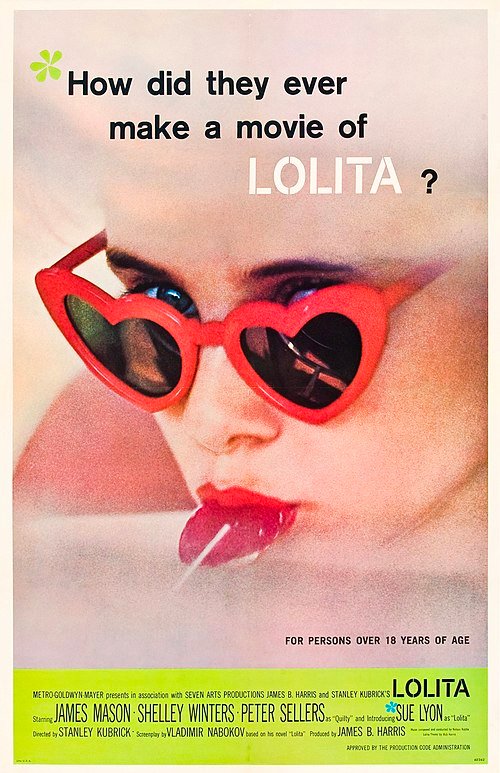
Lolita
USA, 1963
Director: Stanley Kubrick
Screenwriter: Vladimir Nabokov (novel and original screenplay), rewritten by Stanley Kubrick and James B. Harris Genre: Psychological drama Film score: Nelson Riddle Editing: (Not specified search results) Harris
Genre: Psychological drama
Soundtrack composer: Nelson Riddle
Editing: (Not specified in search results)
Production: Stanley Kubrick and James B. Harris (producers), Seven Arts Pictures, Anya Productions, Transworld (co-production)
Main Cast:
James Mason (Humbert Humbert)
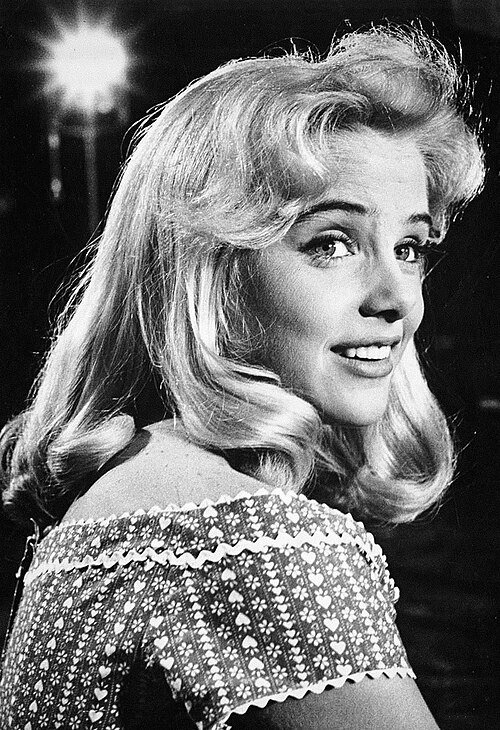
Sue Lyon (Dolores “Lolita” Haze)
Shelley Winters (Charlotte Haze)
Peter Sellers (Clare Quilty)
Gary Cockrell (Richard “Dick” Schiller)
Jerry Stovin (John Farlow)
Diana Decker (Jean Farlow)
Lois Maxwell (Nurse Mary Lore)
Cec Linder (Dr. Keegee)
Marianne Stone (Vivian Darkbloom)
William Greene (George Swine)
Plot
The first scene shows us the confrontation between two men. One of them is the successful playwright Clare Quilty, who after a night out discovers an intruder in his villa. Still under the influence of alcohol, Quilty does not think much of the stranger’s presence. Until he, a gentleman named Humbert Humbert, threatens him with a gun… Then there is a time jump to a few years earlier, and we learn about the previous events.
Humbert, a British professor of French literature, arrives in Ramsdale (New Hampshire) and rents a room in the house of Charlotte Haze, a widow who lives with her teenage daughter. The girl, named Dolores (“Lolita”), soon arouses a morbid interest in the newcomer. Humbert will become increasingly obsessed with the young girl, and she, for her part, will turn out not to be as innocent and angelic as she seems…
Charlotte, the mother, is in turn attracted to the handsome professor. The widow goes so far as to propose to Humbert that he marry her. He, despite feeling no little repulsion towards the lady, ends up agreeing just to be with Lolita (albeit in the official role of stepfather).
Humbert would like to get rid of Charlotte, as he sees her as an obstacle to his romance with the teenager…
Comment
A few years after the publication of Vladimir Nabokov’s acclaimed novel, Stanley Kubrick adapted for the big screen the story of the tormented lover of “nymphets” Humbert Humbert Humbert, and his illicit idyll with the teenager Lolita (since then, the term “lolita” has become part of the collective imagination, to designate underage girls capable of exerting a great power of sexual attraction on mature men).
It is worth noting that in both the novel and the film the protagonist is Humbert Humbert (who narrates his misadventures in the first person), and not Lolita.
The film is a very good adaptation of Nabokov’s book – and how could it not be, if Nabokov himself was the screenwriter of the film? (The few differences with the novel affected mostly the “racy” passages, due to the prevailing censorship in the USA in the ’60s).
The film is considered a drama, but there is no lack of moments full of great comedy: At first the entanglements of the love triangle between Humbert, mother and daughter (already from the garden scene, the first time Humbert sees Lolita); later the exacerbated jealousy of the “stepfather” when they are at Beardsley, and especially noteworthy are the hilarious appearances of the quirky Quilty – first at the hotel as an attendee at the police conference, and later posing as a “German psychologist” to get Lolita to participate in his theatrical play.
The British Peter Sellers played a brilliant role as Quilty. In the novel, that character does not have as much weight as in the film (and that is one of the few differences between the literary work and its first film adaptation).
Nabokov came from a wealthy and aristocratic family in St. Petersburg and had to go into exile when the Bolsheviks took power. First he went to Germany and France, then he would embark for the USA. Some have seen in “Lolita” a metaphor of the “New World” (America) seducing the “Old World” (Europe). The novel is written in an extremely exuberant style, with a very rich vocabulary, in which alliterations and puns abound. It is surprising that Nabokov wrote the work directly in English, a language that was not his mother tongue. However, this is all the more understandable when we discover that Nabokov spoke English from childhood, having had an English governess, and as one of the elite he received an exquisite education and grew up trilingual (learning French as well). His “Lolita” is full of Gallicisms and Humbert constantly uses French expressions (in the novel, but not in the film).
Nabokov never had to worry about money, and this is reflected quite well if we look at the main character of his work: Although he supposedly has the profession of a teacher, Humbert is an idle individual who lives on rents. Reading the novel I was struck by the fact that he was always traveling across the U.S., living in hotels and without a care in the world (in the film this takes a back seat).
Lolita in the feature film was played by Sue Lyon, who was 15 years old when she played the role (at the beginning of the novel, Lolita is 12 years old, and at the end, 17). This actress would later participate in “A Drop of Blood to Die Loving”, by Eloy de la Iglesia (1973), a film heavily influenced by “A Clockwork Orange” (1971) by Stanley Kubrick – director of the first film adaptation of “Lolita” that we review today: The Circle Closes.
In 1997 Adrian Lyne shot a remake, starring Jeremy Irons and Dominique Swain as the “nymphet”. It is less known that there is also a Russian version, shot in Nabokov’s original homeland – a version that is more of a porn parody and features explicit sex scenes: Russkaya Lolita (Armen Oganezov, 2007).
Get Lolita HERE!
(This is an affiliate link. I may earn a commission if you purchase through these link, at no extra cost to you. As an Amazon Associate, I earn from qualifying purchases.)