
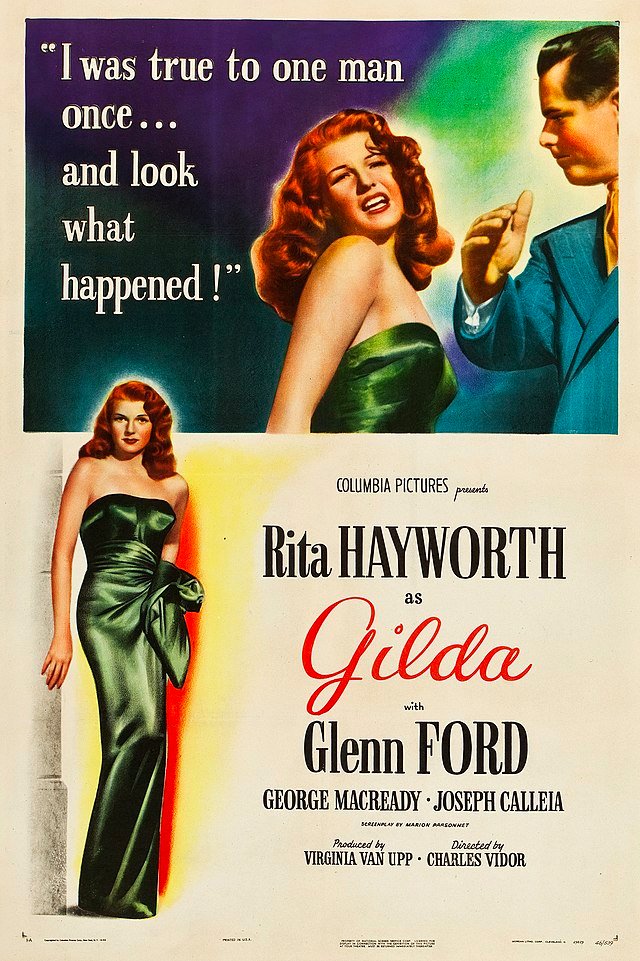
Gilda
USA, 1946
Director: Charles Vidor
Screenplay: Marion Parsonnet (with uncredited collaboration from Ben Hecht)
Genre: Film noir/drama
Soundtrack composer: Hugo Friedhofer
Editing: Charles Nelson
Production: Virginia Van Upp
Main cast:
Rita Hayworth (Gilda)
Glenn Ford (Johnny Farrell)
George Macready (Ballin Mundson)
Joseph Calleia (Det. Maurice Obregón)
Steven Geray (Uncle Pio)
Plot
Johnny Farrell is an American gambler who tries his luck in Argentina. One night, after winning a large sum at an underground card game, he is mugged. But a stranger comes to his aid. Knowing of his fondness for gambling, he invites him to an exclusive casino, which can only be accessed with a recommendation.
Once there, Johnny learns that the mysterious individual is the owner of the establishment. He is Ballin Mundson, also an American. When Johnny demonstrates his skills as a croupier and also as a bodyguard, Ballin decides to hire him. In a short time, he will become his right-hand man.
Ballin warns Johnny that women should never be involved in their business. But one day he shows up with his new wife Gilda, whom Johnny also finds very attractive…
The gambling operations, illegal in Argentina, are not Ballin’s only source of income. He is involved in a business that moves even more millions—and at the same time could also be more dangerous.
For her part, Gilda is not an easy woman at all. Her behavior will cause many headaches not only for her husband but also for her loyal employee Johnny…
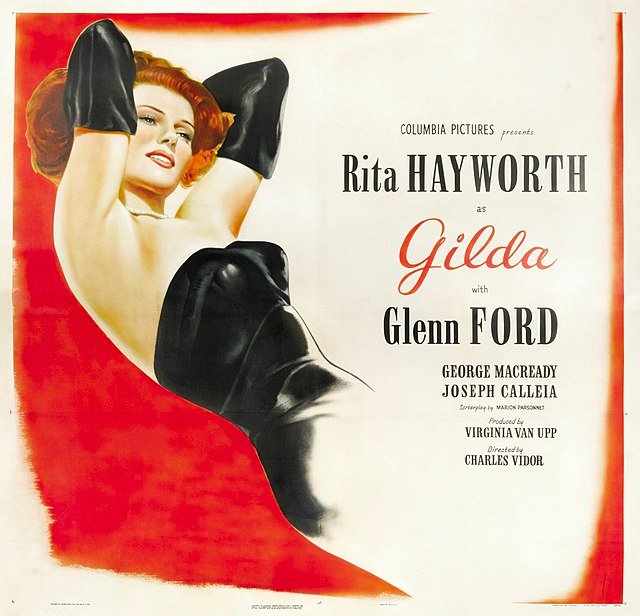
Comment
This year marks the 80th anniversary of the premiere of this great classic, a film that, halfway between melodrama and noir, shows us archetypal characters portraying their relationships in the context of casinos and show business—all set in a post-World War II atmosphere.
Gilda, a dancer and starlet with an uncertain past, is the epitome of the femme fatale. She flirts with everyone, for her this is also a kind of “gambling” (like cards or roulette for Johnny). She acts this way not because she is a nymphomaniac, but simply to make men jealous. And the person she really wants to make jealous is not her husband (whom she only married for money and whom she despises for his weak character) but Johnny, who is the one she is truly attracted to (because he does not give in immediately and maintains a stoic distance). Although Johnny tries to remain tough and impassive in the face of Gilda’s provocations, he becomes increasingly obsessed with this wild woman. Deep down, this professional gambler will be torn between loyalty to his boss (who, as we saw at the beginning, saved his life) and his most basic instincts: the temptation of the flesh.
The relationship between the two masterfully exemplifies the love-hate dynamic in couples, which, although highly toxic, always arouses passions, keeping the flame alive. “Hate is one of the most exciting emotions,” says the cabaret singer. We see that strong emotions are what matter. Her husband and other men bore her, but Johnny, who refuses to be tamed, is a challenge for her. As we shall see, Johnny turns out to be very tyrannical, very possessive of Gilda… But he himself is also possessed by her, reaching a point where he can no longer think of anything else—something that jeopardizes the smooth running of his business…
Gilda’s curves drive men crazy. She knows it. And she also knows how to take advantage of it. But at the same time, she feels a sharp dissatisfaction. She is, at heart, a fragile and tormented woman who tries to forget her frustrations through sensuality. From what she says in one scene (something like “in the past I was faithful and look what good it did me”), it is suggested that when she was very young she naively gave herself to an “alpha” who mistreated her. That trauma ended up triggering a vicious cycle, turning her into a predator of unsuspecting men—whom she manipulates at will with her voluptuous charms. But she remains a victim nonetheless.
Gilda sees Johnny as having great potential to take her husband’s place (as her new husband, but also as the casino boss), and tries to encourage him to take on that role. Ballin, for his part, has megalomaniacal aspirations that go far beyond running a casino… But Johnny and others wonder: How is he going to achieve them if he can’t even keep his wife under control?
The film is full of situations with memorable dialogue. Ballin uses a knife disguised as a cane, which he refers to as his “friend.” When Ballin mentions a “friend” (the cane-knife) who helped him and Johnny the other night (referring to the opening scene where they met during the attempted robbery), Gilda, believing they are referring to a person, asks if that ‘friend’ is a man or a woman; and Johnny replies that it is a woman: “Because at first it seems like one thing, but then it turns into another”…
In addition to being an actress, our “Gilda” Rita Hayworth was also a dancer in real life, among other things, of flamenco: Her birth name was Margarita Cansino, and her father (who was of Gypsy ethnicity) had emigrated to the US from Seville, Spain.
Rita was married five times, and her husbands included filmmaker Orson Welles and an Aga Khan (an aristocratic-religious title given to the head of one of the branches of Shia Islam). But despite her marriages, Rita had a long-term affair with Glenn Ford (the actor who plays Johnny), whom she met during the filming of Gilda. Reality surpasses fiction, and everything indicates that the actress and her character had a lot in common. They also shared a dark past of trauma, as it seems that Rita had been sexually abused by her own father, who was an alcoholic.
It is possible that in some respects the film inspired Martin Scorsese in the making of “Casino” (1995), where we see parallels in terms of the dynamics between the characters—as there is also a ménage à trois between the boss (Robert De Niro), his “right-hand man” (Joe Pesci), and the boss’s dangerous wife (Sharon Stone)—although it is true that Casino is mainly inspired by real events. Like “Casino,” “Gilda” also uses the narrative technique of voice-over. Continuing with the analogies with other productions with similar themes, it is also easy to think of the two ‘Scarface’ films (the 1932 and 1983 versions), where the boss’s “right-hand man” ends up ousting him from leadership and taking his wife. Interestingly, one of the screenwriters of “Gilda” was Ben Hecht, who had also written the screenplay for the original “Scarface.”
The film is set in Argentina, but was shot entirely in Hollywood.
(Get my books HERE)
Get Gilda HERE!
(This is an affiliate link. I may earn a commission if you purchase through these link, at no extra cost to you. As an Amazon Associate, I earn from qualifying purchases.)