
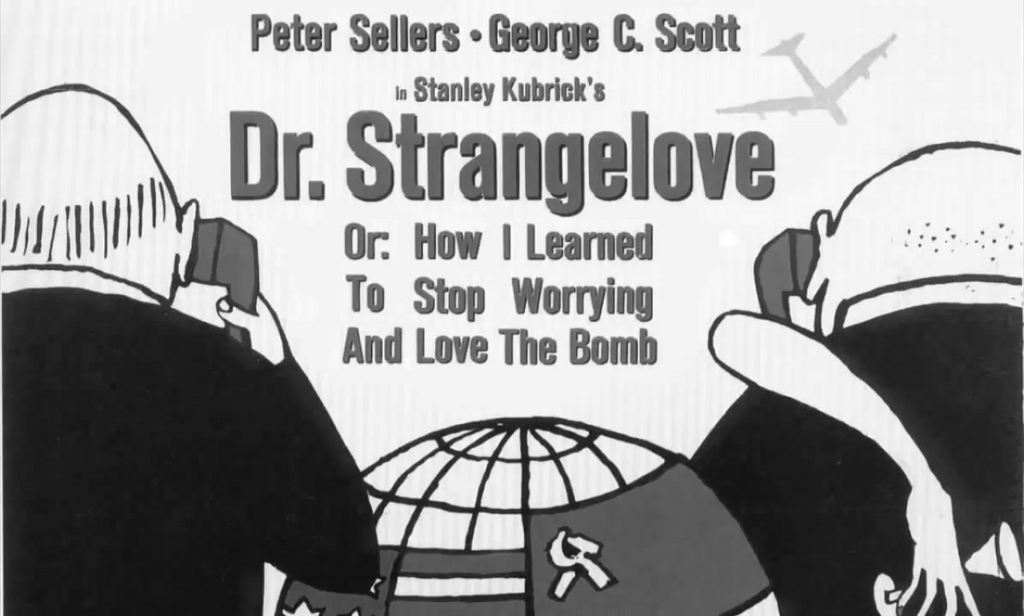
Dr. Strangelove or: How I Learned to Stop Worrying and Love the Bomb
USA/United Kingdom, 1964
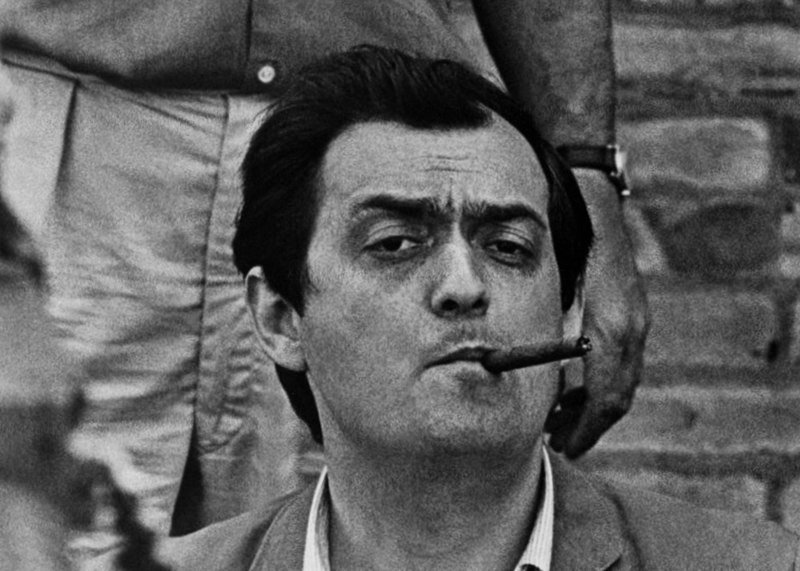
Director: Stanley Kubrick
Screenwriters: Stanley Kubrick, Peter George, Terry Southern (based on the novel “Red Alert” by Peter George)
Genre: Satire, Black comedy, War
Soundtrack composer: Laurie Johnson
Editing: Anthony Harvey
Production: Stanley Kubrick (Hawk Films; distributed by Columbia Pictures)
Cast:
Peter Sellers (Dr. Strangelove / Captain Lionel Mandrake / President Merkin Muffley)
George C. Scott (General Buck Turgidson)
Sterling Hayden (Brigadier General Jack D. Ripper)
Keenan Wynn (Colonel Bat Guano)
Slim Pickens (Major T.J. “King” Kong)
Tracy Reed (Miss Scott)
Plot
US General Jack D. Ripper has given the order, on his own initiative, to activate the top-secret “Plan R,” consisting of a nuclear attack on the USSR. American fighter planes are heading for Russia. When the US president finds out, he convenes a war council to try to stop the disaster from unfolding.
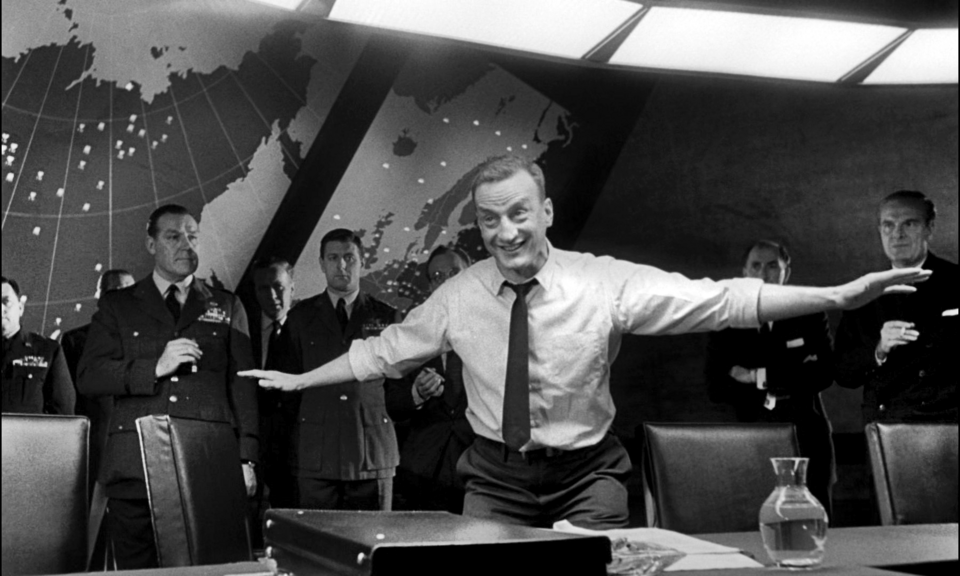
Among the participants in this extremely urgent meeting is General Turgidson, a “hawk” who supports the attack, as he believes it offers the possibility of dismantling the enemy’s weapons capabilities. Also present is the mysterious and eccentric Dr. Strangelove, an advisor of German origin who previously worked for the Nazis, and whose right arm has a rather peculiar nervous tic…
President Merkin Muffley wants to stop the attack at all costs, but Plan R is designed in such a way that the pilots responsible for dropping the bombs can no longer receive communications. Muffley invites Soviet Ambassador Alexei to the war council deliberations, who puts the US president in contact with the Soviet prime minister. Thus, the Americans discover that the USSR, for its part, has prepared an automated counterattack plan for such an eventuality, called “Doomsday”…
Meanwhile, the general who started it all, Jack D. Ripper, is holed up in his headquarters with his second-in-command, Mandrake. They are both under siege by army troops, as Ripper has also cut off communications and remains determined to carry out the attack.
In the Pentagon’s “war room,” the president continues a race against time to prevent the bombs from being launched and an apocalyptic conflict from unfolding…
Commentary
In this iconic film set against the backdrop of the Cold War and “mutually assured destruction,” Kubrick uses black humor to illustrate certain geopolitical dynamics. The Cuban missile crisis (1962) was still very recent. In this context, the director already seemed to foresee the potential threat posed by AI: The Soviet counterattack plan “Doomsday” is automated; it is activated when intruding aircraft enter its territory.
The only way to stop the catastrophe seems to be direct collaboration with the “enemy,” which involves revealing the coordinates of their own fighter jets so that they can shoot them down. This detail alone shows us in a subtle way that the so-called “Cold War” was nothing more than a farce.
“Nuclear bombs” as a mutual deterrent were and are a way of maintaining tension and perpetuating a confrontation that is only superficial (so that the respective peoples, the people of those countries, are distracted) while at the same time the upper echelons of the supposedly opposing states collaborate with each other (as we also see in the film). The common goal of both governments is to keep their respective citizens under control. Among other things, this is achieved through constant tension and, in this particular case, through fear of an imminent nuclear war.
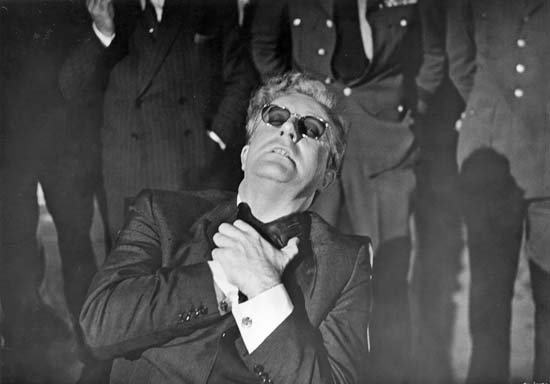
The character of Strangelove is the prototypical megalomaniac “mad scientist,” who also suggests certain eugenic ideas for repopulating the Earth, as well as glimpsing a future underground civilization (since life on the surface will not be possible for a long time if those radioactive bombs are used). Ironic, sarcastic, and somewhat cynical black humor is the predominant tone throughout the film. This is clearly evident in the names of several of the characters. There are also some Orwellian touches, such as the posters in the military zone that present the Army as “professionals of peace”… while two factions of that same Army are fighting each other! (the one loyal to the president and the one led by the mutinous Jack D. Ripper).
General “Jack D. Ripper,” whose name could not be more obvious, is the military officer who has launched the attack plan. He is presented to us as a deranged and paranoid individual, or more specifically a “conspiracy theorist,” who sees communists everywhere. Through this tactic, Kubrick seems to intend to discredit and ridicule (subtly and under the guise of comedy) those who truly feared communist infiltration. (The metaphor of “the enemy coming dressed in your own uniform,” mentioned by Ripper in one scene, can also be viewed in this context).
This process of subversive infiltration, which slowly undermines a country’s democratic institutions from within (and over the very long term), is real, part of the “entryism” strategy already outlined by Trotsky and taken from the Fabian Society. Two decades after the release of this film, Russian dissident and former KGB agent Yuri Bezmenov would speak in detail about this method, which was effectively used by the communists. One of the purposes of the film seems to be, then, to make the viewer dismiss this reality; to not even take it into consideration, by associating it with the “conspiracy theorist” delusions of the mad “Jack the Ripper” in this “comedy.” In addition, Ripper talks about the slow poisoning of water with fluoride, which also aims to ridicule the fact that “conventional” tap water is treated with substances that are potentially harmful to health in the long term—since elements such as fluoride present in it have the characteristic of making the population more docile and lethargic. In the film, this too becomes the ravings of a madman in the eyes of the average viewer.
In short: Under the guise of a satirical war comedy, Dr. Strangelove shows us a good dose of reality (as far as the dynamics of social control and geopolitics are concerned)… But these realities are presented in a distorted way, so that viewers not only fail to notice them, but come to consider them falsehoods and ridiculous.
Actor Peter Sellers plays no less than three characters here: Strangelove, the president, and Mandrake, Ripper’s assistant.
Get Dr. Strangelove HERE!
(This is an affiliate link. I may earn a commission if you purchase through these link, at no extra cost to you. As an Amazon Associate, I earn from qualifying purchases.)