
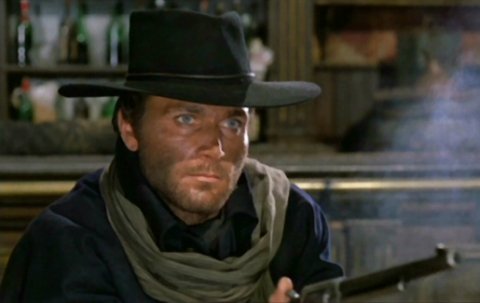
Django
Italy, 1966
Director: Sergio Corbucci
Script: Sergio Corbucci, Bruno Corbucci, Fernando Di Leo
Cast: Franco Nero (Django), José Bódalo (General Hugo Rodríguez), Loredana Nusciak (Maria), Eduardo Fajardo (Jackson)
Music: Luis Enriquez Bacalov
Plot
A man walks through the desert dragging a coffin with a rope. It’s Django, a veteran of the Northeastern army turned into a lone outlaw. Next to an old wooden bridge he sees how some Mexicans have tied up a woman and are preparing to whip her. Before he can intervene, individuals with red scarves arrive and wipe out the Mexicans. But they are not preparing to release the captive; on the contrary, they now intend to torture her. Django confronts the five of them and with the speed of lightning draws his revolver and kills them.
The woman’s name is María, and as we will see later, she is half gringa and half Mexican. That’s why both sides try to claim her for themselves. Django and María arrive at a ghost town of muddy streets, which has suffered the consequences of the constant confrontation between the Mexican bandits and the guys in the red hoods and scarves – the latter being American confederate rebels under Major Jackson. Although the civil war has ended, with the victory of the northern unionists, Jackson’s group continues to fight. The Mexican bandits, in turn, are rebels against their country’s government…
In the semi-abandoned town, Django and María arrive at Nathaniel’s posada-saloon, where they find, rather bored by the lack of customers, the chorus girls-prostitutes who are at the service of both Jackson’s rebels and the Mexican outlaws. Django continues to drag his coffin, to the amazement of Nathaniel and the girls. Through the innkeeper, we learn the reasons why the town is practically uninhabited, since it is the scene of daily shootings between Jackson’s “Reds” and the Mexicans of renegade General Hugo Rodríguez. But all this is something Django already knows in advance. He already knows both of the contending leaders. And he has a personal matter to settle with one of them…
Major Jackson and his red hoods shoot at Mexican prisoners for fun and to practice their marksmanship. When Jackson learns that a mysterious stranger with a coffin and a woman has just arrived in town, he goes to Nathaniel’s saloon to meet him. Jackson believes that it is the same man who killed five of his men by the old wooden bridge.
The group of Southern rebels collect “protection” money from Nathaniel’s business. This time, besides collecting the money as usual, Jackson also has a great interest in seeing the newly arrived guest. Thus, to the already existing confrontation between the Red Hoods and the Mexican subversives, a new element is added: Django, the lonely coffin gunman…
Commentary
There are many analogies between Western films and Japanese samurai films. In the case of Italian-style westerns (or “spaghetti-westerns”) this is more than obvious. Not only in the style, in the plot premises and in the characteristics of the main character and the other characters, but sometimes also in the plot itself. It is common knowledge that Sergio Leone was inspired by the story of Kurosawa’s “Yojimbo” (1961) for his first Western: “For a Fistful of Dollars” (1964), the film that would make the then still unknown Clint Eastwood a star. The Japanese filmmaker protested against the apocryphal Italian remake, which he considered a plagiarism – when the truth is that Kurosawa had also “borrowed” for Yojimbo certain ideas from a French film…
The story of a wandering gunman (or a ronin in the case of the chanbara) who arrives in a remote village where there is a confrontation between gangs is already a classic; a recurrent starting point in both Japanese jidaigeki and Italian-America westerns productions. This is also the case in Sergio Corbucci’s “Django”, which we are reviewing today; one of the most famous and emblematic films of the whole genre together with the “Leonese” Dollar Trilogy.
The lone gunman after whom the film is named is a mysterious individual, who seems to have something very specific in mind, but whose intentions we will gradually come to know as the film progresses. To the town besieged by Jackson’s “reds” and the Mexican bandits he does not arrive simply by chance. And inside his coffin he does not exactly carry a corpse, but something very much related to death…
Django places himself in the center of the confrontation. And there, symbolically, is also the female figure María (although not of her own free will); who, let’s remember, is half Yankee and half Mexican.
The few businesses left in the ghost town must pay “protection” taxes to Major Jackson (as if he were the Mafia). He and his hooded henchmen are in perpetual conflict with General Hugo’s Mexicans. Django will try to take advantage of the situation, but going “smart” ends up bringing him unpleasant consequences – like the “man with no name” in “For a Fistful of Dollars”.
Both Jackson’s Reds and Hugo’s gang are “rebels” who fight against the governments of their respective countries: the US and Mexico. Thus, when Jackson’s group is seriously harmed by Django’s “weapon of mass destruction,” the Southern leader will ally himself with the Mexican soldiers – sworn enemies, in turn, of the defector General Hugo. Django will join the latter in executing a coup (the gunman saved Hugo’s life in the past), but when there’s a lot of gold at stake, even the most fraternal friendships risk becoming brittle… and even more so in a place as inhospitable as the old, wild west. It is clear, as on so many other occasions, that tactical pragmatism and ephemeral alliances are basic components of any armed conflict.
Just as the character embodied by Trintignant in “Il grande Silenzio” (which Corbucci would shoot a little later) has a weapon that is unusual for the space-time context (a German semi-automatic Mauser gun), our Django also has a very special “little friend” (as Tony Montana would say): It is nothing less than a machine gun.
Just as “For a Fistful of Dollars” would make Clint Eastwood famous, “Django” catapulted Franco Nero, a young actor who was only 24 at the time, to fame – although for the role he was “aged” about a decade by make-up. María is embodied by Loredana Nusciak, an actress who also stood out in the Italian-Western genre (with titles such as Romolo Guerrieri’s “10,000 Dollars for a Massacre”).
This time the superb soundtrack is not composed by the maestro Morricone (as in Leone’s Westerns or Corbucci’s next), but by another great of film music: the Argentinian Luis Enríquez Bacalov, who a few years later would create the unforgettable score of “Milano Calibro 9” (1972), a masterful polizziesco by Fernando Di Leo – becoming the composer of this director’s headline. By the way: Although he is not accredited, the brilliant Di Leo was one of the scriptwriters both in Leone’s films and in this “Django”.
Ruggero Deodato, who later became famous with “Cannibal Holocaust”, was assistant director to Corbucci in “Django”.
Although after the success of this film dozens of westerns were shot that included the word “Django” in the title, there is only one official sequel: “Django 2: The Return” (Nello Rosatti, 1987), also starring Franco Nero.
Get Django HERE!
Get Italo-Western and more…: A filmic guide HERE!
(This are affiliate links. I may earn a commission if you purchase through these links, at no extra cost to you. As an Amazon Associate, I earn from qualifying purchases.)