
Deep Red (O.V. Profondo Rosso)
Italy, 1975
Director: Dario Argento
Script: Dario Argento, Bernardino Zapponi
Cast: David Hemmings (Marcus), Daria Nicolodi (Gianna), Gabriele Lavia (Carlo), Macha Méril (Helga), Eros Pagni (Calcabrini), Giuliana Calandra (Amanda Righetti), Glauco Mauri (Prof. Giordani), Nicoletta Elmi (Olga),
Music: Goblin, Giorgio Gaslini
Giallo/Horror
Plot
The German medium Helga Ulmann participates in a congress of parapsychology that takes place in a theater in Rome. She possesses telepathic gifts. She is not able to guess the future, but she is able to read thoughts (“sometimes thoughts solidify and are like cobwebs”), she captures the events that happen but not those that will happen.
During the event, after making a demonstration of his faculties with one of the spectators, he perceives very strong malignant vibrations among the audience, which emanate from someone he cannot yet identify. He mentions that his head hears a children’s song, sees a lot of blood and also a village.
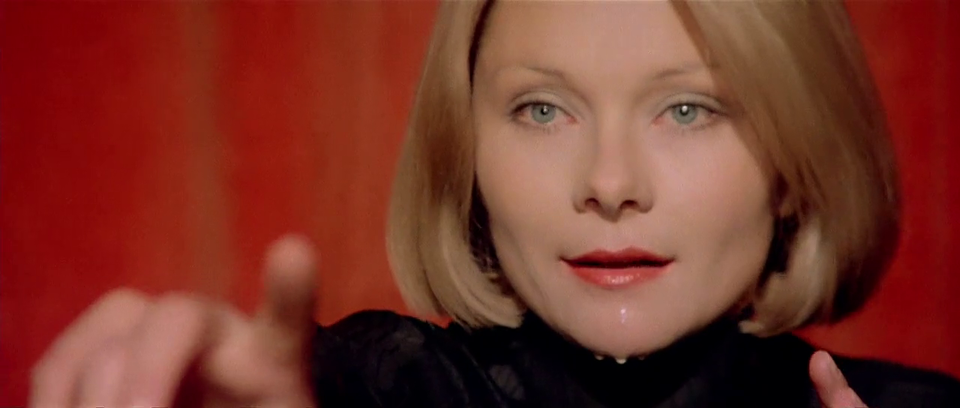
After her intervention, Helga gradually overcomes the psychic impact she has just suffered and tells her friend Giordani (one of the organizers) that she now knows who the person who has caused these vibrations is (“someone cruel and childish at the same time”), and that she is willing to write about the case. Someone has been listening to them, standing behind one of the theater columns. Shortly before, in the toilets, this person had put on some black leather gloves…
In the evening, at home, Helga is on the phone when there is a knock at her door. She goes to open the door but immediately perceives that it is an evil presence… The intruder knocks down the door and without a word begins to stab Helga with a large butcher’s knife.

At the same time, in the street, Mark meets his friend Carlo; the latter is quite drunk. They are both pianists; Mark is in a jazz orchestra and Carlo works in a nearby bar at night. At that moment he has just gone out to take one of his breaks. Suddenly the two of them hear a feminine scream of terror in the deserted square. A few moments later, when Carlo has re-entered the bar, Mark looks up and sees Helga in blood trying to look out of her window. The murderer from behind pushes her head against the glass, thus ending up killing her.
Mark knew her, because she was his neighbor. Helga lived in the same building as him. The English pianist runs to the victim’s floor finding the dead medium in the middle of a pool of blood. His attention is drawn to the macabre paintings hanging in the corridor of his house. Looking out of the same window from which Helga was trying to look, Mark sees a figure in a black raincoat fleeing the scene. When the police arrive, the commissioner begins to question Mark. The journalist Gianna, who is a friend of the pianist, also appears at the scene.
Several hours later, Mark returns home after giving a statement at the police station. In the square, next to the fountain, he meets Carlo again, now completely drunk. Mark continues to think about what happened that night, and confesses to his friend that he has the impression of having seen a painting entering the murdered woman’s apartment through the corridor, which has since disappeared… A painting that could be an important clue to the resolution of the case. Carlo is dissatisfied with his life, and gets drunk to try to escape his depressive crises.
The next day Helga’s burial takes place in a Jewish cemetery. Mark and Gianna come to see who is among the attendees. Among them is Giordani, the organizer of the congress. Mark is a little concerned because his photo now appears on the front page of the newspaper as one of the key witnesses in the case; the photo was taken by Gianna the night before at Helga’s house shortly after the crime. This could draw the killer to him.
Mark and Gianna decide to investigate the case together. They go to the theater and try to reconstruct with Giordani and other participants Helga’s intervention, who spoke during her trance of “a children’s song, a village and a lot of blood… a cruel and childish person at the same time…”.
There is no doubt that the psychopath, knowing he was discovered by the medium (“He has already killed and I feel he will do it again”), murdered her to prevent a dark secret from the past from coming to light.
Mark remembers that his friend Carlo was in the square, albeit quite drunk, when the killer in the black raincoat rushed out of the victim’s building. The pianist with a detective’s vocation goes to the house of the other less fortunate pianist. There is only his mother, a nice old lady with incipient signs of senile dementia, who had been an actress in her youth, and who after many detours informs Mark of her son’s whereabouts. Carlo is at a friend’s house, the mother gives him the address.
Mark now goes to the house of this Massimo, a friend of Carlo’s. When he gets there he finds out that this Massimo is a transvestite. Besides falling into alcoholism, the tormented Carlo also seems to have homosexual inclinations. His psychological state is becoming more and more worrying, he is drinking unrestrainedly and his depressive crises harass him more intensely than usual. In that state, there is little he can do to help Mark in clearing up the case.
Mark becomes obsessed with the memory of that painting that he is convinced he saw when he entered Helga’s apartment, and that later was no longer there. At night in his house, while he rehearses on the keyboard of his piano, he hears a little children’s song and steps inside his house… He quickly closes the door of his living room and hears a sinister voice from beyond the grave telling him that “You can’t run away, I’ll kill you sooner or later. Later, when the intruder leaves, he sees through the window the same figure in a black raincoat and hat that he saw on the night of Helga’s murder.
After telling what happened to Gianna and Giordani, another interested in parapsychological themes and friend of the second one recommends him to read a book where the strange case of a children’s song and a villa was mentioned. Mark goes to the public library, finding a compilation of legends and recent supernatural events. The story that interests him most is “The Village of the Screaming Child”. Mark tears out the page from the book where a photograph of the mansion appears and sets out to contact the author of the book, one Amanda Righetti. The pianist-detective asks Gianna to locate her.
In the meantime, Amanda Righetti receives another visit… Someone has been hanging dolls from the ceiling as if they were being executed. When the writer tries to turn on the light, she realizes that the electricity has been cut off. There is someone else inside her house… Someone wearing black leather gloves, who is getting dangerously close to the frightened woman… The same nursery rhyme starts playing again.
By the time Mark arrives it is too late: Amanda has been killed too. She has been drowned by repeatedly dipping her head into the boiling water of the bathtub. But before her death she had had time to write something on the steam on the glass wall. Mark doesn’t realize this, but the next one to arrive is the paranormal researcher Giordani. Making the bathroom steamy again, Giordani comes to read what the dead woman had written with her finger.
Mark initially fears that the police will now suspect him, as the writer was killed shortly before the date they had both agreed on. This motivates him even more to find the killer. He continues his investigations and through a very rare plant that appears in the photograph of the villa he finally manages to find the abandoned mansion…
Mark is accompanied to the villa’s doors by a disturbing redheaded girl, daughter of the caretaker of the property, who tells him to “be careful” – for the villa seems to be cursed, full of ghostly presences. Mark ignores her and goes inside to investigate…

Commentary
“Profondo Rosso” marks Dario Argento’s transition from giallo to horror, including elements of both genres. Until then, Argento’s films had been thrillers without supernatural characteristics (“The Bird with the Crystal Plumage” from 1970 or “Cat o´Nine Tails” and “Four Flies on Grey Velvet”, both from 1971). From “Deep Red” Argento would begin to include in his gialli influences from “the beyond”, such as ghost stories and various witches. This is how the so-called “Trilogy of Mothers” originated, composed by “Suspiria” (1977), “Inferno” (1980) and more recently “The Third Mother” (2007).
The way in which the murders are executed in Argento’s films would create a school, and “Profondo Rosso” (“Dark Red”) is a clear example of the violent and stylized deaths typical of the Italian-style thriller: The killer whose identity is not discovered until the end (and who is often the person least suspected), the emblematic black leather gloves, the subjective camera view from the killer’s perspective…
In the film the tension is “in crescendo”. At the beginning there are still quite a few comic touches that pretend to relax the atmosphere (the picturesque curator, the forgetful mother of Carlo, the curious relationship between Mark and Gianna…), but from the second half on (especially since Mark is dedicated to exploring the “ghost” village) the atmosphere becomes more oppressive, more distressing, and the intrigue increases intensely.
It seems obvious that the psychopath is a very unstable individual full of complexes and with a trauma that he drags from childhood. Moreover, it must be someone Mark knows personally, because every time he tries to take a step in his investigation, the killer gets ahead of him (he knew in advance, for example, about the appointment he had with the author of the book). In everyday life the killer may be a normal person, but during his crimes he is possessed by his evil side. The old nursery rhyme acts as a catalyst. When the spectators (and also the characters) become suspicious about the identity of the killer, the story takes a new turn and the origin of the bloody deaths turns out to be someone different, someone that nobody expects…
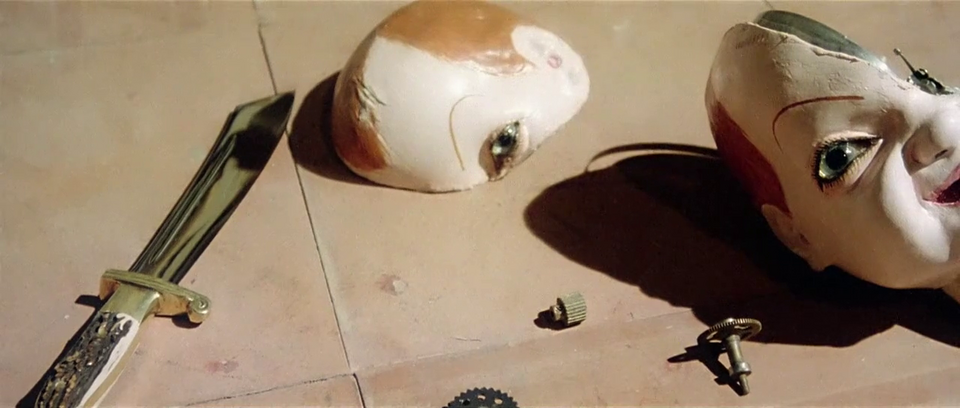
One of the most memorable scenes is undoubtedly that of the sinister dummy that appears during one of the crimes in the office of the one who will be the third victim, with the consequent murder (for whose execution the picks on the table are of great importance…)
The excellent soundtrack (which helps to highlight especially the violent moments) was composed by the Goblins (who from then on would become regular collaborators of Argento), and contains elements of progressive and psychedelic rock, so characteristic of those seventies.
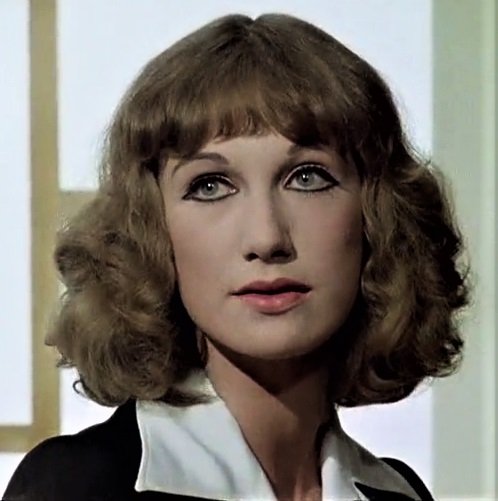
The role of Gianna is played by Daria Nicolodi, the director’s sentimental companion (and mother of his daughter Asia Argento, born the same year “Profondo Rosso” was released). Macha Méril, the actress who also in 1975 had participated in “Last stop on the night train” (by Aldo Lado) as the mysterious nymphomaniac of the train, gives life to the medium Helga Ullman. The redheaded girl Olga, with a predilection for the macabre, is played by Nicoletta Elmi, who in 1975 also appeared in “Le Orme” (by Luigi Bazzoni) and before that in “Chi l’ha vista morire” (Aldo Lado, 1972).
One of the most popular covers of “Profondo Rosso” is reminiscent of Alfred Hitchcock’s “Vertigo”.
Get Deep Red HERE!
Get All the colors of murder: Guide to giallo cinema HERE!
(This are affiliate links. I may earn a commission if you purchase through these links, at no extra cost to you. As an Amazon Associate, I earn from qualifying purchases.)