
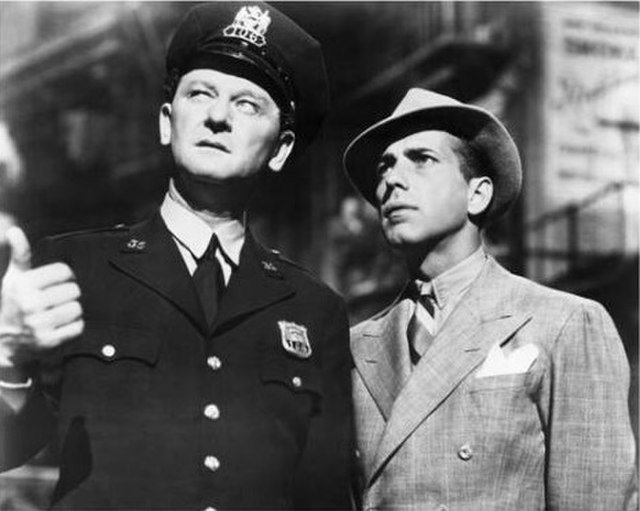
Dead End
USA, 1937
Director: William Wyler
Screenplay: Lillian Hellman, based on the play by Sidney Kingsley
Genre: Social drama, gangsters
Soundtrack composer: Alfred Newman
Editing: Daniel Mandell
Production: Samuel Goldwyn
Main cast
Sylvia Sidney (Drina Gordon)
Joel McCrea (Dave Connell)
Humphrey Bogart (Hugh “Baby Face” Martin)
Wendy Barrie (Kay Burton)
Claire Trevor (Francey)
Allen Jenkins (Hunk)
Marjorie Main (Mrs. Martin)
Charles Peck (Philip
Ward Bond (Doorman)
Dead End Kids and other cast members
Billy Halop (Tommy Gordon)
Huntz Hall (Dippy)
Bobby Jordan (Angel)
Leo B. Gorcey (Spit)
Plot
Gangster “Baby-Face” Martin and his sidekick return to New York after years away. Martin is wanted by the police, but he has had plastic surgery, and even in the neighborhood where he grew up, no one recognizes him (or better said: ALMOST no one!)…
In the neighborhood, Tommy Gordon leds a gang of street kids. Tommy’s older sister Drina is a decent girl who wants to help him become a productive member of society. Drina is in love with Dave, who was a juvenile delinquent in the past, just like her brother is now. But Dave, who left his life of crime behind and studied to become an architect, has his eye on Kay, a girl from a wealthy family.
Dave is one of the few people in the neighborhood who recognizes “Baby-Face” Martin, as they were partners in crime during their teenage years.
Martin has returned to his neighborhood to visit his mother and an old girlfriend. But he will be greatly disappointed by both of them…
Tommy’s gang, meanwhile, robs Philip, a rich kid who lives in nearby apartments. Tommy runs away, and the police start looking for him. This time, the officers are serious about finding him—Philip is not just any rich kid, but the son of an influential judge.
Drina tries to protect her brother, but she doesn’t know that a member of the gang, afraid of being sent to reform school, has snitched to the police…
Commentary
This neighborhood drama set in 1930s New York is not exactly a film noir, as one might expect given that it stars Humphrey Bogart, one of the genre’s most iconic actors. It is more of a social drama inspired by a play. And the story is, in fact, ideal for a theatrical piece, as the action takes place not only in a neighborhood, with very few locations, but practically on a single street, the one that gives the film its title, a “Dead End.”
The title is also a metaphor for the difficulty these street kids face in leaving behind their problematic lifestyle. And while it is difficult, it is not impossible, as showed by the character of Dave, who did manage to turn his life around.
We saw a similar approach in “Angels with Dirty Faces” (Michael Curtiz, 1938), which also portrays two generations from the underworld—but in that other film, a tone more characteristic of film noir is used, while here, as I mentioned, more emphasis is placed on social drama. And also on “class differences”: the rich and poor live side by side in the same neighborhood. The former in luxurious apartments with security guards, the latter crammed into dilapidated buildings infested with cockroaches; but both groups are neighbors.
This contrast is also evident in the case of the rich boy and the street thugs. The latter are played by the same young actors who would go on to play the gang in „Angels with Dirty Faces“, and who were named the “Dead End Kids,” as this film was their first contribution to the big screen.
Although both “Angels with Dirty Faces” and the film in question can in a way be considered precursors of juvenile delinquency cinema (which in Spain would lead to the quinqui subgenre), there is no evidence that the “Dead End Kids” were also a criminal gang in real life—as was the case in many later films of this kind, where the young protagonists, in the style of Vaquilla and Torete, played themselves. (Vaquilla and Torete were street kids, junkies, bank robbers and car hijackers in Spain in the 70s and 80s; who also became “actors”, playing themselves in some very succesful movies about their own lives).
There is also social criticism of a prison system that is useless in actually reforming criminals. As mentioned in one scene, the reformatory where they want to send Tommy is the same one where “Baby Face” Martin was sent in his day—who, after his time in that “corrective” center, became much worse. The implicit message seems to be that reformatories (and by extension, prisons) do not serve to turn criminals into decent citizens, but rather serve as universities of crime.
Another curious fact is the change in the protagonist’s face, which almost no one in the neighborhood recognizes (at first, not even his mother or ex-girlfriend). However, only his appearance has changed; his inclinations toward crime have become more pronounced. Returning to where he came from, in this case, will torment him more rather than appease him… “You mustn’t go back to the past, you must always move forward,” his accomplice advises him philosophically.
“Dead End” was directed by William Wyler, who would also collaborate with Humphrey Bogart later in the tense thriller “Desperate Hours” (1955) — which is, in my opinion, a far superior film.
Get Dead End HERE!
(This is an affiliate link. I may earn a commission if you purchase through these link, at no extra cost to you. As an Amazon Associate, I earn from qualifying purchases.)