
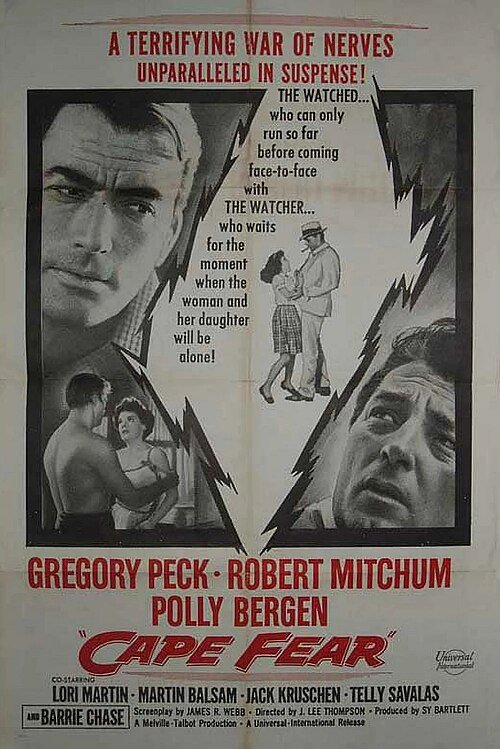
Cape Fear
USA, 1962
Director: J. Lee Thompson
Screenplay: James R. Webb (based on the novel The Executioners by John D. MacDonald)
Genre: Thriller
Soundtrack composer: Bernard Herrmann
Editing: George Tomasini
Production: Sy Bartlett
Main cast:
Gregory Peck (Sam Bowden)
Robert Mitchum (Max Cady)
Polly Bergen (Peggy Bowden)
Lori Martin (Nancy Bowden)
Martin Balsam (Chief Dutton / Mark Dutton)
Telly Savalas (Charles Sievers)
Barrie Chase (Diane Taylor)
Plot
The disturbing Max Cady has been released after spending eight years behind bars. He blames lawyer Sam Bowden, who testified against him, for his imprisonment.
Cady begins to harass Sam, following him even when he is with his family and making subtle threats.
Sam turns to his friend Mark, a police officer, but there is little he can do. Formally, Cady has not broken any laws. What’s more, when he feels he is being watched, the ex-convict hires a lawyer to reverse the roles and portray himself as a victim of police harassment.
Sam lives with his wife and daughter Nancy. He fears above all for the safety of his teenage daughter. Eight years ago, Cady was convicted of rape…
Commentary
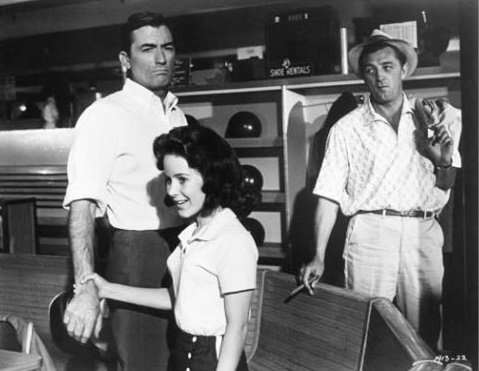
This is an archetypal example of psychological horror: a family haunted by a specific and real (yet elusive) danger, but also by their own paranoia.
Here, fear permeates the entire film, and is even present in the title.
Faced with the threat posed by the dangerous Cady, the slightest rumor, a mysterious shadow, or even a harmless silhouette is enough to trigger panic… Max Cady can appear at any moment, and he is willing to make his enemy’s life hell. His main motivation is revenge. And to carry it out, he is equipped with a cold and calculating mind, as well as a beastly sadism. Both civilized official authorities and tough private detectives are useless against him… Even port thugs. Perhaps only more forceful methods, seasoned with a good dose of cunning, will be useful in stopping him… and thus surviving. Cady does not fear death, but as we will see in the end, there is something even he is afraid of…
Based on a novel by John D. MacDonald, this film is the original that inspired the remake of the same title directed by Martin Scorsese and starring Robert DeNiro in 1991.
Paranoia and tension are masterfully conveyed, reaching right through the screen. The title is more than appropriate. It plays with confusion and the distortion of perceptions, both for the characters and the viewers. All of this recreates a nightmarish atmosphere, quite reminiscent of Gothic horror. The magnificent black-and-white photography, rich in contrasts and visually close to German expressionism, contributes to this. In addition to its symbolic and metaphorical meaning, the title also refers to a real place, as “Cape Fear” is a river (and its surrounding area) in South Carolina.
The story is set in the American South, but its director, J. Lee Thompson, was from England.
The aesthetic and thematic similarities with the films of fellow Brit Hitchcock are striking. Harassment by a psychopath is the central theme here, which gives the plot its structure. Harassment is also the main ingredient in Hitchcock’s recently reviewed Strangers on a Train (1951). In addition, for “Cape Fear,” Thompson enlisted two important regular collaborators of his (more famous) fellow filmmaker and compatriot: the composer of the soundtrack is Bernard Herrmann, who worked with Hitchcock on “Vertigo” (1958), ‘Psycho’ (1960), and “Marnie” (1964). The editing was done by George Tomasini, who, in addition to those three films, also worked on “Rear Window” (1955) and “North by Northwest” (1959).
However, it should be noted that Cape Fear lacks Hitchcock’s characteristic touch of humor and is a harsher, darker film, with a more pure psychological terror. Although Hitchcock’s humor tends toward the macabre, it serves as a mechanism for relief, lightening certain scenes of their harshness.
Other themes raised by Cape Fear include trust or distrust in the authorities (“there are too many laws or too few,” one of the characters comments at one point), the effectiveness or ineffectiveness of police surveillance, the adversary’s ability to reverse roles (making himself the victim), whether or not to take justice into one’s own hands (“you fight an animal like an animal,” says one character, referring to the predator Cady), and the phenomenon of hibristophilia is also subtly shown (with Diane, the girl who is attracted to Cady’s evil and dangerous aura… and who is then abused by him).
Robert Mitchum gives an excellent performance as the psychopath who stalks the family. His namesake DeNiro would also do so some three decades later in Scorsese’s remake.
The cast also includes Martin Balsam, who, in addition to Hitchcock’s “Psycho,” would later appear in numerous Italian polizziesco-style films. The private detective is played by Telly Savalas (when he still had hair, as he would become famous a few years later as Kojak). We also saw him in Mario Bava’s “Lisa and the Devil.”
Felix Hahlbrock Ponce
(Get my books HERE)
Get Cape fear HERE!
(This is an affiliate link. I may earn a commission if you purchase through these link, at no extra cost to you. As an Amazon Associate, I earn from qualifying purchases.)