
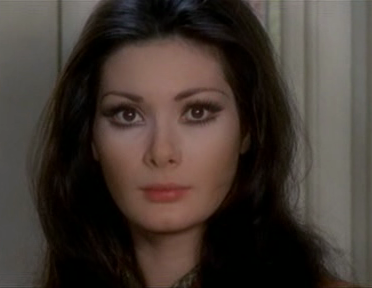
All the colors of the dark
Italy, 1972
Director: Sergio Martino
Script: Santiago Moncada, Ernesto Gastaldi, Sauro Scavolini, Lewis E. Ciannelli (English version)
Cast: George Hilton (Richard), Edwige Fenech (Jane), Ivan Rassimov (Mark), George Rigaud (Dr. Burton), Nieves Navarro (Barbara), Marina Malfatti (Mary), Luciano Pigozzi (Clay), Dominique Boschero (Jane´s mother)
Music: Bruno Nicolai
Story
Young Jane suffers from frightening nightmares and visions. She lives with her fiancé Richard, a representative of a pharmaceutical company that stuffs her with drugs (or vitamins).
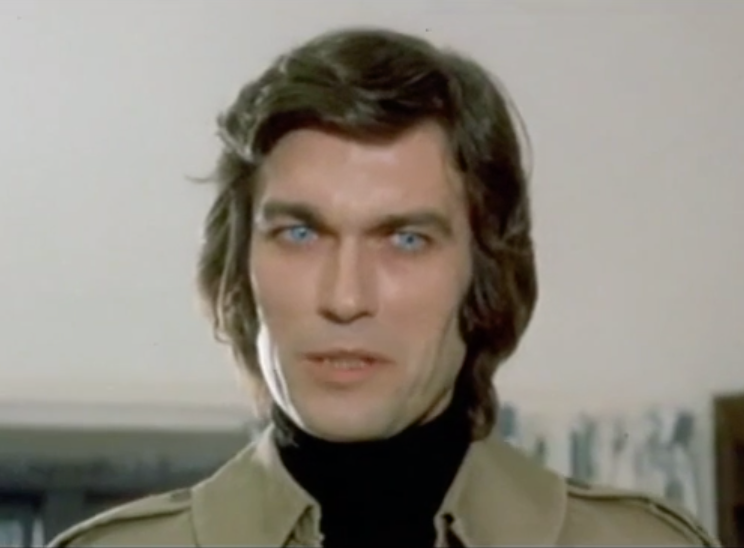
Jane has been traumatized since her childhood when she witnessed the murder of her mother (who was stabbed). As if that weren’t enough, she suffers a car accident that causes her to lose the child she was expecting. In her nightmares she sees a strange man with bright blue eyes.
Following the advice of her sister Barbara, the confused Jane goes to a psychiatrist, Dr. Burton (for whom Barbara herself works). Richard opposes this.
Jane begins to see the blue-eyed individual when she is awake as well. She feels persecuted and distressed.
Soon after, Jane meets the enigmatic Mary, a neighbor with whom she makes a certain friendship and to whom she tells her regrets. This Mary, under the pretext of helping her, invites her to participate in a “Sabbath”, a black mass, thus capturing for her sect the fragile and unwary Jane…
An attorney is also interested in contacting Jane. In the satanic ritual, Jane must overcome lascivious and sinister initiation tests. And although at first the young woman seems to have left behind her traumas, the problems will reappear in multiplicity…
Commentary
Set in a grey and cloudy autumn London, which because of its atmosphere lends itself ideally to this kind of film, the Italian-Spanish co-production “All the Colours of Darkness” is a cross between giallo and satanic horror that would become so fashionable after the success of “Rosemary´s Baby” (Roman Polanski, 1968). There are many stylistic and plot similarities between Polanski’s film and the proposal we are reviewing today. The setting, and the sensation that the film transmits to the spectator, is very similar in both productions. Perhaps Kubrick was inspired, decades later, by the “Sabbath” scene to recreate the rituals in his “Eyes Wide Shut” (1999).
The cult symbol, an eye inside a triangle, is a “Kabbalistic” symbol (according to Dr. Burton) that Jane is tattooed on one arm. Mary needed to “break free” and to do so she had to recruit a new follower. The atmosphere is extremely sinister, unsettling, and instills an atavistic fear. The cult’s mind control over its “parishioners” is complete. The annulment of their personality is sought.
Jane suffers constant nightmares related to the brutal murder of her mother as a child. In those dreamlike episodes, she always sees a sinister and threatening individual, who (of course) is also a member of the macabre cult. You don’t have to be a lynx to deduce that the crime that traumatized her so much has something to do with the murky satanic “brotherhood” into whose clutches the protagonist falls, enticed by neighboring Mary.
The film also has traces of psychological horror (in addition to paranormal horror), since the protagonist is tormented by certain parallel realities, by horrifying visions, and a déja-vu will also take place. Jane feels close to alienation and fragmentation of her personality due to trauma, a phenomenon that is highly exploited by sects. One can see here that the Satanic sect in question is “much more powerful” than one might think, and that it has well-structured ramifications in centers of power. Still, the cult leader as chief of police seems to be only part of Jane’s hallucinatory ramblings, which is a bit disappointing to those of us who were prone to imagine such a possibility; similar to what is suggested in “The Short Night of the Crystal Dolls” or “Eyes Wide Shut” (The Possibility of Conspiracies and Connections between Satanism and Political-Economic Power). Multi-generational pacts and curses are also a fundamental component of the plot here.
Jane is played by a regular Sergio Martino: The curvaceous and sensual Edwige Fenech. Masterful soundtrack by composer Bruno Nicolai. The psychiatrist is played by a regular actor of the genre, the Argentinean George Rigaud, and to reassure his patient he says an interesting phrase: “The real crazy ones are those who think they are not”.
Director Sergio Martino makes a cameo as a journalist/police officer.
Get All the colors of the dark HERE!
Get All the colors of murder: Guide to giallo cinema HERE!
(This are affiliate links. I may earn a commission if you purchase through these links, at no extra cost to you. As an Amazon Associate, I earn from qualifying purchases.)