
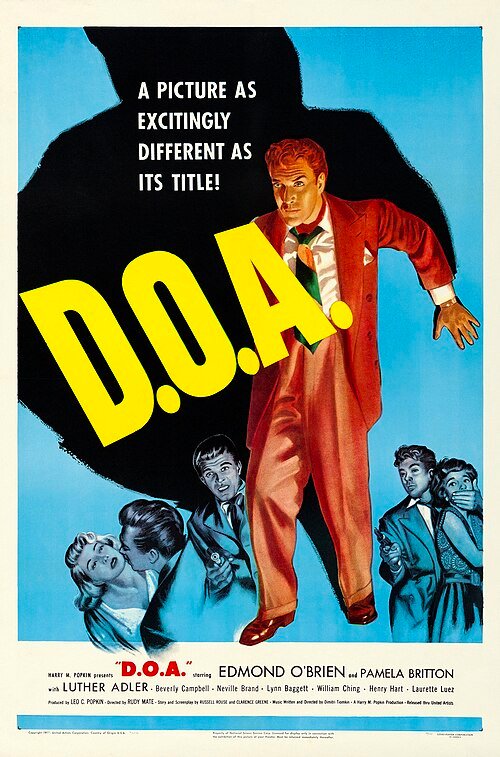
D.O.A.
USA, 1949
Director: Rudolph Maté
Screenplay: Russell Rouse, Clarence Greene
Genre: Film noir
Soundtrack: Dimitri Tiomkin
Editing: Arthur H. Nadel
Production: Cardinal Pictures / Harry Popkin Productions
Cast:
Edmond O’Brien (Frank Bigelow)
Pamela Britton (Carol Reed)
Neville Brand (Lt. Torres)
Beverly Garland (Beverly Campbell)
Laurette Luez (Nita Van Cleve)
Plot
Frank Bigelow runs an accounting office in a small California town with his secretaries, Kitty and Paula. Paula is his girlfriend. Frank decides to take a vacation and heads off alone to San Francisco. Paula protests, but eventually agrees.
Once in San Francisco, Frank meets other hotel guests and goes out partying with them. The wife of the man who invited him starts flirting with Frank—which makes her husband jealous. That same night, at a jazz bar, Frank meets another attractive young woman whom he plans to meet up with later. At the same time, a mysterious man who has been watching Frank takes the opportunity to switch his drink.
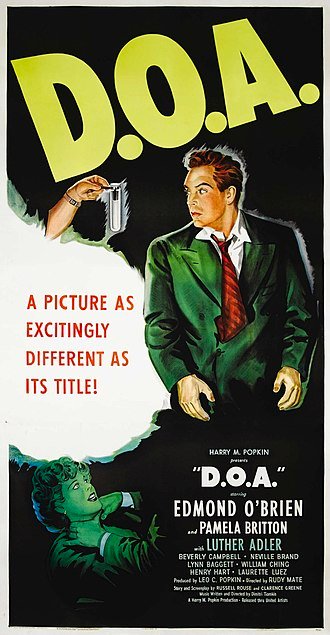
The next day, Frank wakes up with a hangover, and feeling sick, he goes to the doctor. There, he is told that he has been poisoned with a very potent toxin, and that his condition is incurable…
From that point on, what matters most to Frank is not avoiding death, but finding meaning in the rest of his life…
Comment
The opening scene shows the protagonist going to the police station to report a murder: none other than his own murder. He claims to be the victim himself… After that, we learn the context, and the entire film unfolds through a flashback.
What begins as a vacation for Frank turns into a harrowing nightmare. From the moment the doctor tells him in a somber tone, “You have been murdered,” our protagonist realizes what it means to have little time left: He has to make the most of it. For, apart from time itself, he has nothing left to lose…
After coming to terms with the fact that there is no antidote for the fluorescent poison coursing through his veins, Frank decides to become the detective investigating his own death. He wants to find out who wanted him dead and why. As a humble accountant, he had no idea he had enemies of that sort. The search for a reason and a culprit thus becomes his greatest motivation for continuing to exist.
As he follows the trail, Frank will uncover a convoluted web of industrial corruption and trafficking involving a valuable, potentially radioactive metal (iridium).
The jealous hotel roommate, whose wife flirts with Frank at the jazz club at the beginning, serves in the story merely as a “red herring,” since those truly responsible for his poisoning are not motivated by matters of passion or revenge; they are impersonal enemies—members of an abstract web of industrial corruption, in which the protagonist (who is just another interchangeable pawn) finds himself entangled simply for having “signed a piece of paper” mechanically and unconsciously; in other words, it is a purely bureaucratic murder: He must be eliminated so that evidence of the larger plot disappears.
This scheme turns out to be of international proportions, as the visible leader of the organization turns out to be a mysterious individual with a distinct foreign accent (from Eastern Europe/the Balkans, the Middle East, or the Caucasus) named Majak, who is related to one of Frank’s antagonists whom the viewer never sees; one who is involved in shady dealings and uses two names: the Anglo-Saxon Reynolds and the “exotic” Rakubian (which sounds Armenian).
Majak is played by Luther Adler, who came from a family of Yiddish theater actors in New York. His fearsome henchman Chester is portrayed by Neville Brand, whom we saw in a very similar role as a volatile psychopath in “Kansas City Confidential” (1952).
At the beginning of the film, when Frank arrives in San Francisco, the abundance of attractive women, the chaotic, festive atmosphere, and the raucous jazz club reflect the sensory overload with which the protagonist—and by extension, the modern man in big cities—is suddenly confronted. Such visual and auditory stimulation, presented so abruptly and omnipresently, confuses him and causes him to let his guard down.
But after coming to terms with his situation and decisively facing the challenges, Frank learns to value the people in his life who truly matter—such as his girlfriend Paula, whom he hadn’t taken very seriously until then.
The film features numerous memorable scenes, such as the aimless dash through the city by a desperate and cornered Frank after he discovers his poisoning following a visit to the hospital. He seems to be running away from himself. By the way: That chase was filmed spontaneously, without filming permits; and the surprised people Frank (Edmond O’Brien) crosses paths with or bumps into are actual passersby, not extras hired for the film.
Frank ends his frantic run next to a newsstand where, quite symbolically, there are many copies of “LIFE” magazine on display. Other interesting details: There’s a nightclub called “Black Magic.” On the police report at the station (at the end), the date listed is 9/11. And Frank’s age is 33. The original title D.O.A. plays on ambiguity and has two possible interpretations: “Dead Or Alive,” but also “Dead On Arrival,” which is the stamp they put on his file; and perhaps a way for the agents to try to cover up the scope of the plot—it’s suggested that, even though Frank uncovered the whole affair, the authorities won’t continue investigating, that “they didn’t find out anything” since the individual “arrived dead”…
In the end credits, it is noted that this “luminescent poison” exists in reality. It likely refers, rather than to a conventional slow-acting poison, to a biological and radioactive weapon.
In short, this is an extremely original noir film (which has since been remade several times) with touches of psychological horror and room for philosophical reflection—which is why it wouldn’t feel out of place among Ibáñez Serrador’s excellent “Historias para no dormir” (that can be translated as something like “Tales to keep you awake”) which often featured very similar themes and atmospheres.
Felix Hahlbrock Ponce
(Get my books HERE)