
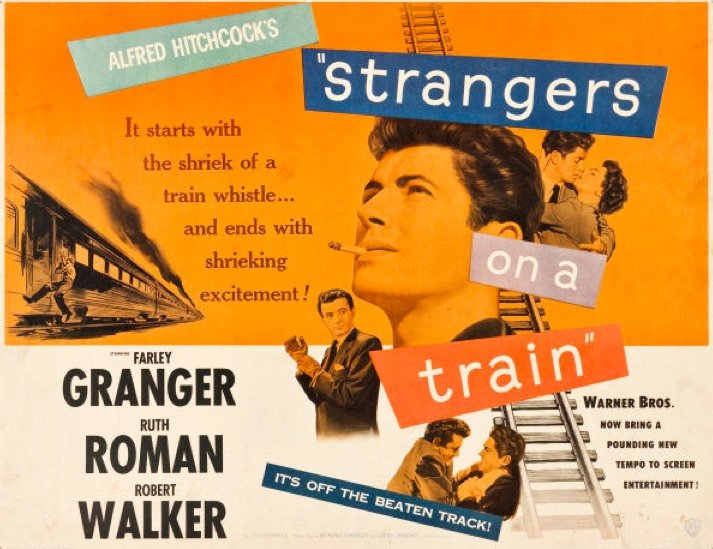
Strangers on a Train
Director: Alfred Hitchcock
USA, 1951
Screenplay: Raymond Chandler, Czenzi Ormonde, and Whitfield Cook (based on the novel by Patricia Highsmith).
Genre: Psychological thriller.
Soundtrack composer: Dimitri Tiomkin.
Editing: William H. Ziegler.
Production: Alfred Hitchcock.
Main cast
Farley Granger (Guy Haines)
Robert Walker (Bruno Antony)
Ruth Roman (Anne Morton)
Laura Elliott (Miriam Haines)
Patricia Hitchcock (Barbara Morton)
Plot
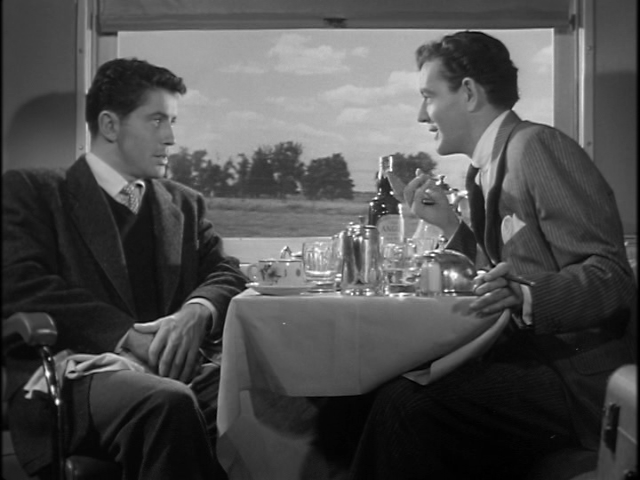
During a train journey, the extroverted Bruno Antony recognizes tennis player Guy Haines and strikes up a conversation with him. Guy is in the media and relatively famous. In addition to the sports press, he also appears in the tabloids: it is known that his relationship with his wife Miriam is not the best. There are rumors that he is getting divorced, that she is seeing other men and he is seeing the daughter of a senator in Washington.
The nosy Bruno is aware of everything. But he not only has a great fondness for gossip; he also seems to be a big fan of detective stories. During the train journey, he explains to Guy what he thinks the “perfect crime” would be like:
Two individuals who do not know each other but want to get rid of someone “exchange” murders. Bruno, who wants to get rid of his father, fantasizes about killing Guy’s wife (whom he does not know) and having Guy kill his father in return. Since there is no connection between them and their respective social circles are completely different, both would have alibis and no one would suspect them.
Guy takes his eccentric traveling companion’s proposal as a joke. But Bruno is completely serious…
Commentary
The implications and interpretations of this brilliant film go far beyond a typical suspense story, a crime and the subsequent investigation to solve it. The tension and growing interest in the story do not lie in discovering who the murderer is. We already know that in advance—and it is not, by the way, a typical psychopath…
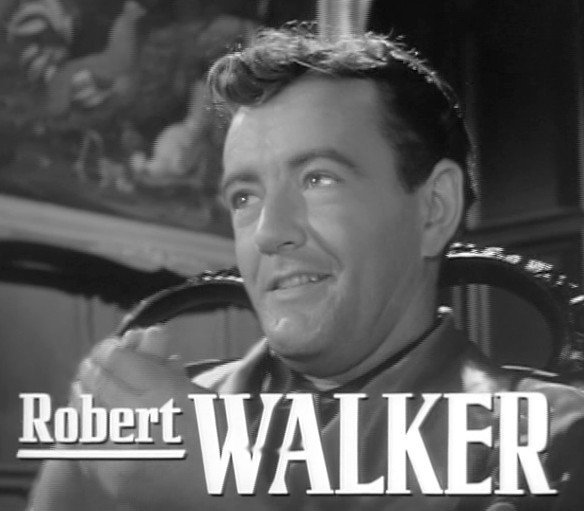
The killer in this film is a truly diabolical character, especially in the metaphysical sense of the term. The maniac boasts of having persuaded the protagonist to sign a kind of “contract” or ‘pact’ with him: “Today for you, tomorrow for me.” According to his demonic perspective, he has made Guy an offer, and since Guy did not explicitly reject it, he considers the contract valid. Bruno fulfills his part and expects to collect Guy’s “innocence” in return, pushing him to commit a crime.
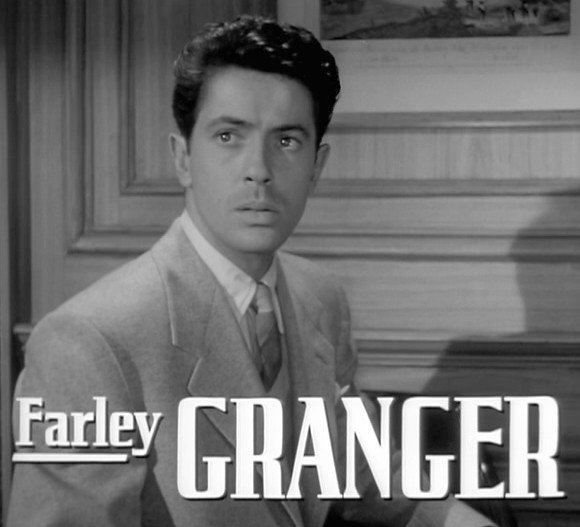
To this end, he constantly harasses the protagonist (as if he had chained his soul), who in turn is viewed with suspicion by the authorities because he had a motive to kill his wife and his alibi is not very strong. To exert pressure, the disturbing Bruno even begins to show up in Guy’s social circle.
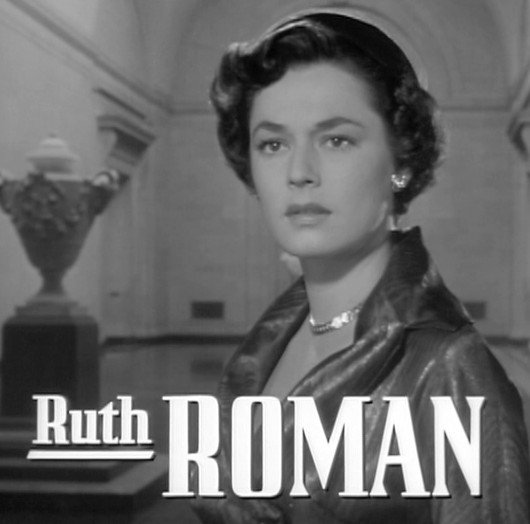
This arouses the suspicions of Anne, Guy’s girlfriend, and especially Barbara, his intellectual sister—who wears thick glasses of the same type as those worn by the strangled Miriam…
The “pact” is involuntary because it is unconscious. But Guy did indeed have a latent desire to get rid of his wife—the “devil” Bruno makes Guy’s repressed desire come true, but in exchange he wants “his soul,” that is, for Guy to also become a real murderer by killing his father (being the „father“ figure perhaps an allegory for the “creator”, and the god/devil dichotomy). The lighter becomes the material object that seals and symbolizes the “pact.”
[In Spain, the film is also called Extraños en un tren, “Strangers on a Train,” but the title in Latin America, Pacto Siniestro, “Sinister Pact,” is also very appropriate.]
Here, the lighter is used as an anchor that connects the material world with the immaterial (the fantasies of murder and the resulting “pact”), as well as being a kind of fetish for the antagonist. This object also symbolizes the importance of chance and serendipity in the development of events: Guy forgets the lighter on the train at the beginning, which Bruno uses as a means to blackmail him later. Bruno then temporarily loses the lighter in the sewer, something that delays his plans. But although chance circumstances play a key role in the film (as in Kubrick’s excellent “The Killing”), a filmmaker like Hitchcock left nothing to chance…
[Speaking of Kubrick, another visionary who told us in 1968 about “space odysseys,” we have Bruno here who, during the encounter on the train, says, “I’m going to book a ticket for the first rocket going to the moon.” Let’s remember that it’s 1951. And according to my research, that line does not appear in the original novel on which the film is based].
Thus, we find interesting references right from the opening scenes: Such as the name of the (fictional) taxi company “Diamond Dupont” and its rhombus symbol, which already suggest a relationship with duality, interchangeability (the diamond/rhombus with its angles and intersecting lines, like the two characters who „intersect“ shortly afterwards on the train), as well as the fact that ‘Dupont’ means “from the bridge” – that is, a link, a connection; between the two characters but also between two states: between the intangible and the tangible, between thought and matter (“to believe is to create”), between plans/“pacts” and their murderous crystallization.
And speaking of “crystallization,” we also find another object of great symbolic significance in the film: Miriam’s thick-lensed glasses, through which Hitchcock shows us the strangulation of the young woman. Like the lighter, these glasses also serve as an anchor object, a material seal of the pact—and then as a trigger for a traumatic flashback in the murderer when he sees Barbara, Annie’s sister, who wears very similar glasses. Specially the scene where Bruno “jokingly” strangles an old lady at the party while looking at Barbara produces a kind of mirror effect on Barbara herself, who, without knowing why, feels very disturbed by Bruno’s disturbance.
Another detail that will not go unnoticed by attentive observers is the name of the boat Bruno takes into the fairground tunnel following Miriam and her friends: “Pluto,” that is, Hades, the god of the underworld.
Another striking detail about Bruno is the tie he wears in the train scene, which is printed with drawings of lobsters with large CLASPS (maybe to “catch” Guy?).
He always wears the tie with the brooch bearing his name that his mother gave him, with whom he has a symbiotic-toxic relationship. His Oedipus complex is very pronounced, to the point that he makes no secret of his intentions to kill his father. His relationship with his mother is quite reminiscent of the character in another brilliant Hitchcockian contribution: “Psycho” (1960).
The creepy and eccentric Bruno is a born manipulator, an expert at twisting the facts. And he proves this right up to the end.
The journey that began on the train ends in the chaotic “derailed” merry-go-round, which is only stopped by an old man (who, due to his advanced age, could symbolize time) who reaches its center. The destruction of the merry-go-round, which was spinning out of control at an ever-increasing speed, can be understood as the end of the cycle. And then everything “starts again” in the next scene, back on a train, when a new stranger asks the protagonist if he is the famous tennis player from the newspapers…
And so, it practically ends as it begins: a “well-rounded” film—almost like Hitchcock’s own silhouette, and that of the double bass with which he boards the train in his cameo appearance at the 11-minute mark.
A secondary (but noteworthy) theme that is subtly included in the film is the constant surveillance of the innocent. At a time when there were not yet cameras everywhere, the idea is suggested that state or authority surveillance of “suspicious” citizens can become part of everyday life. Guy is followed around the clock by Henessy, a police detective whose mission is to keep an eye on him. And the two end up getting along, practically becoming friends!
The story is based on a novel by Patricia Highsmith (in which Bruno’s homosexual subtext is apparently more pronounced), with a screenplay by fellow mystery novelist Raymond Chandler.
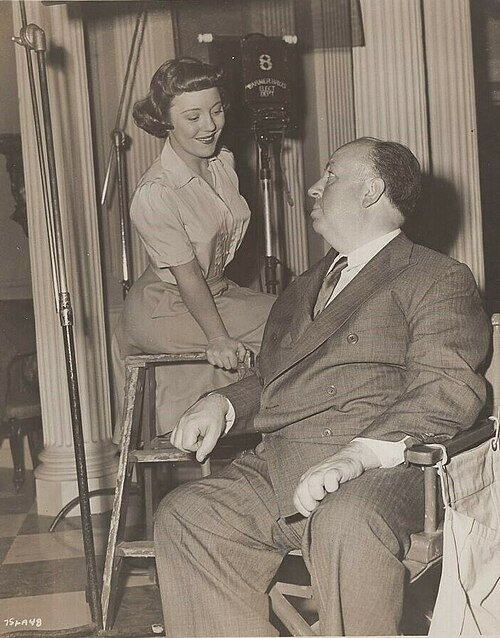
Another Patricia, Hitchcock’s daughter, plays Barbara, Annie’s sister.
And the protagonist Guy is played by Farley Granger, whom we saw in Rope (1948), another great film by the British director.
Felix Hahlbrock Ponce
(Get my books HERE)