
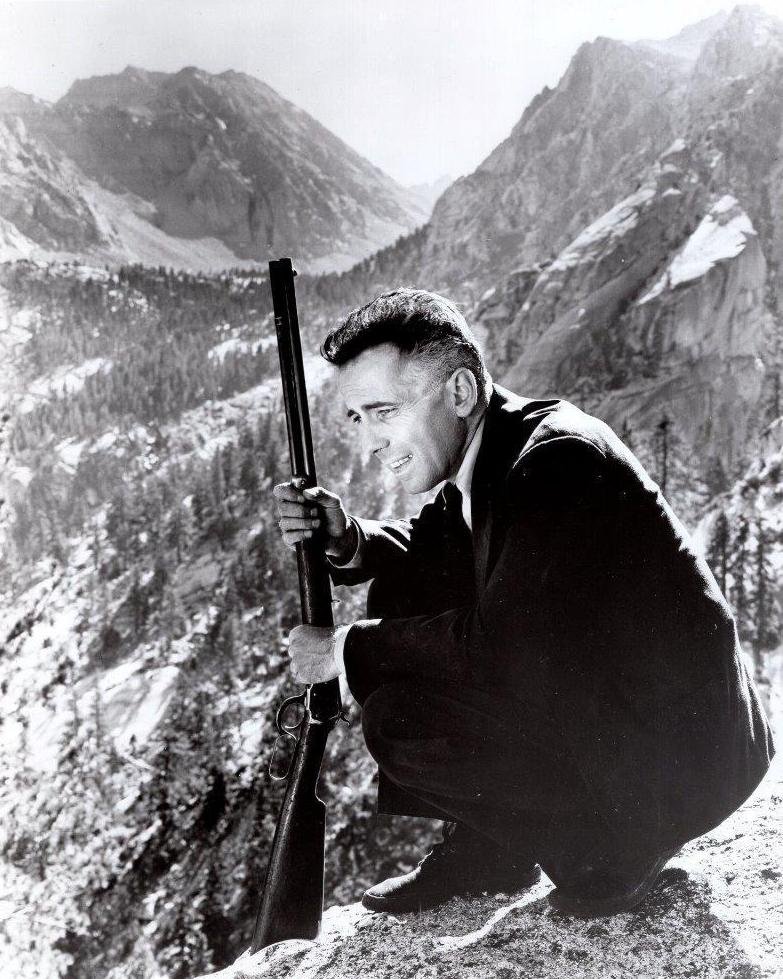
High Sierra
USA, 1941
Director: Raoul Walsh
Screenplay: John Huston and W.R. Burnett (based on the novel by Burnett)
Genre: Film noir / drama
Soundtrack composer: Adolph Deutsch
Editing: Jack Killifer
Production: Warner Bros.
Main cast:
Humphrey Bogart (Roy Earle)
Ida Lupino (Marie Garson)
Alan Curtis (Babe Kozak)
Arthur Kennedy (Red Hykes)
Joan Leslie (Velma)
Henry Travers (Pa Goodsam)
Henry Hull (Jake Kranmer)
Plot
Expert bank robber Roy Earle is granted a pardon. His old and sick boss Big Mac has planned a heist, and he expects Roy, his best man, to carry it out. They want to rob the safes of a hotel in the mountains. To do so, they enlist the help of Mendoza, one of the receptionists.
Roy accepts, thinking that this job will allow him to retire, and moves into a cabin near the hotel to prepare for the robbery with other members of the gang: the younger guys Red and Babe. The latter has brought his girlfriend Marie with him, which initially arouses Roy’s suspicions—the woman could be a distraction and jeopardize their plans. A little dog is also there with them.
On the way to the mountains, Roy befriends some elderly farmers who live nearby and notices the couple’s attractive granddaughter. Velma is a very sweet and attractive girl, but she suffers from a limp due to a malformation in her foot. Roy, idealizing her purity, falls in love with her and promises to pay for her operation. Marie, for her part, is more attracted to Roy, a mature born leader, than to the impulsive Babe.
When the time comes to carry out the robbery, not everything will go as they had planned…
Commentary
In this masterpiece, the interpersonal conflicts of those involved are memorably intertwined in a plot full of tension, drama, and tragedy.
The protagonist is a prototypical antihero, a classic and romantic outlaw who is also anachronistic, as he lives in a world that is too modern, where the code of honor by which he still lives no longer means anything. The film can be considered a classic noir with influences from revisionists westerns.
The charismatic Roy, played by Humphrey Bogart, arouses the viewer’s empathy at all times. From the very first scene, in which he slaps an insolent fellow who tried to give him orders, we see that he knows how to command respect. And also that, despite still being a bandit, he is not without principles.
He is loyal to his boss, without seeking to take advantage of his physical decline, and he also knows how to handle complex and explosive situations with the temperamental young men who are supposed to carry out the heist with him. They constantly fight among themselves over the beautiful Marie. She, for her part, comes from a troubled family; she ran away from home and worked as a dancer in establishments of dubious reputation, which catapulted her into “bad company.” Roy initially prefers the innocent and angelic Velma, who is from a humble, rural background like himself.
Roy’s greatest motivation is to live in freedom, and that goes beyond simply being out of prison. For although the film begins with his pardon, urban and “conventional” life still seems to him like an extension of prison. We are led to believe that the protagonist wants to leave crime behind (the heist for “Big Mac” is meant to be his last) and that his greatest aspiration is to retire to the countryside, to live peacefully in nature with a “decent” woman—and despite her good nature, Marie does not seem to fit into that category for Roy.
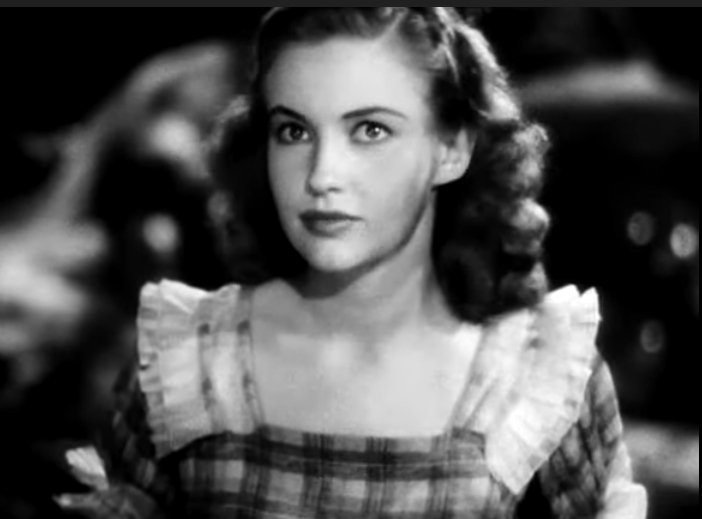
But with Velma, not everything turns out as idyllic as he had hoped… We are even led to believe that the girl was only so “sweet and innocent” because of her limp, which until then had prevented her from going out partying and “seeing the world.” The operation that Roy pays for seems to have the “side effect” of unleashing certain less pleasant latent instincts in her… We see, then, that even a tough guy from the old days, like the ones Bogart embodied, is not immune to falling into the trap of „simping“.
The psychological depth of the characters and the relationships between them is masterfully portrayed in “High Sierra.” Furthermore, unlike in “The Maltese Falcon” (John Huston, 1941), also starring Humphrey Bogart, the main characters are actually likable.
The little dog that tirelessly follows the couple is a paradigmatic example of loyalty, but at the same time, paradoxically, its presence and behavior will also serve to betray the fugitive protagonist…
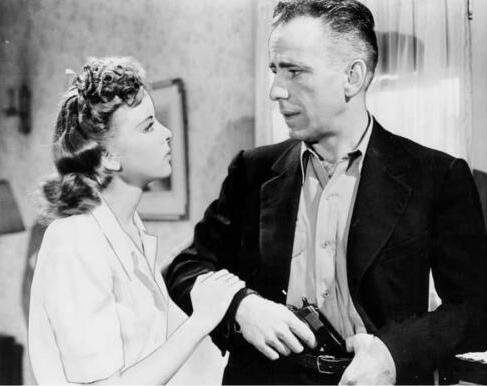
Marie is played in an extremely convincing manner by a young and beautiful Ida Lupino, who, besides an actress, would later also become a director. And she would not only direct feature films, but also some episode of the famous detective series “Columbo” (1970s) and “The Twilight Zone” (1960s), which can be considered a precursor and inspiration for Spanish series “Historias para no dormir” („Tales to keep you awake“) by Ibáñez Serrador, and for the much more recent dystopian “Black Mirror” as well.
The story of “High Sierra” is based on a novel by William R. Burnett, author of the book that inspired “Little Caesar” (Melvyn Le Roy, 1931) and co-author of the screenplay for the first “Scarface” (Howard Hawks, 1932). Filmmaker John Huston also participated in the screenplay for “High Sierra,” and would later direct, among other titles, the aforementioned “The Maltese Falcon” and “The Treasure of the Sierra Madre” (1948), also starring Bogart.
Director Raoul Walsh would later direct the highly recommended “White Heat” (1949), starring James Cagney—along with Bogart, another great icon of film noir and gangster movies of that era.
Felix Hahlbrock Ponce
(Get my books HERE)