
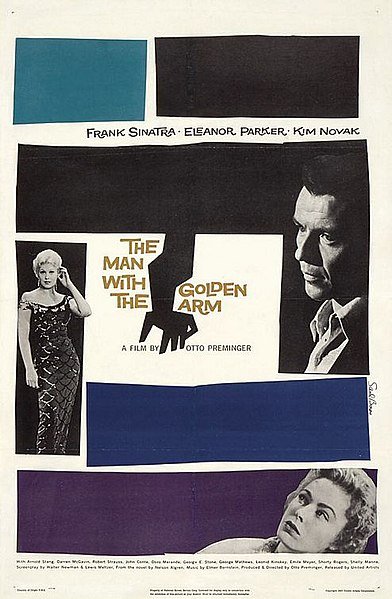
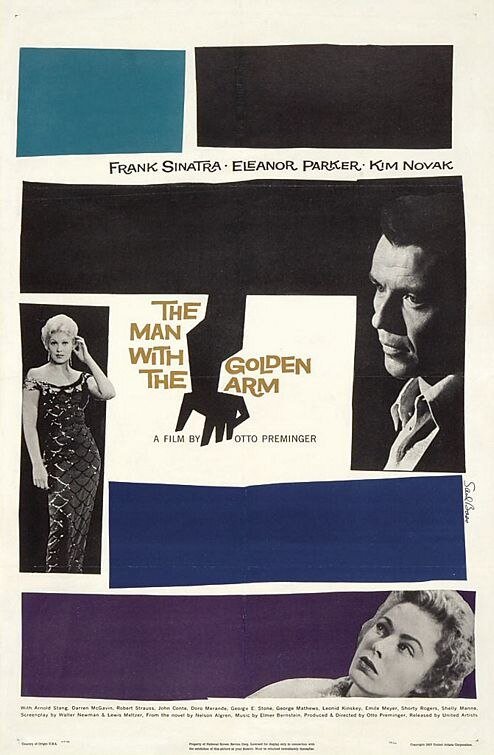
The Man with the Golden Arm
USA, 1955
Director: Otto Preminger
Screenwriters: Ben Hecht, Walter Newman, Lewis Meltzer (based on the novel by Nelson Algren)
Genre: Drama
Soundtrack composer: Elmer Bernstein
Editing: Louis R. Loeffler
Production: Otto Preminger (for Otto Preminger Films / Carlyle Productions)
Main cast
Frank Sinatra (Frankie Machine)
Eleanor Parker (Zosch)
Kim Novak (Molly)
Arnold Stang (Sparrow)
Darren McGavin (Louie Fomorowski)
Robert Strauss (Zero Schwiefka)
Doro Merande (Widow Bonsky)
George E. Stone (Sam Markette)
Plot
Frankie Machine, an aspiring musician and professional card player associated with the mob, is released from prison and returns to his neighborhood. He lives in a modest apartment with his wife Zosh, who is confined to a wheelchair. The young woman was left disabled after a car accident, and Frankie feels responsible because he was driving the car. This most likely contributed to his descent into heroin addiction. But after spending time in prison and receiving treatment from the doctors there, he has managed to rehabilitate himself… Or at least that’s what he believes.
The gangsters Schwiefka and Louie, for whom he worked in the past as a croupier in illegal gambling dens, are still very active in the neighborhood. Louie is also a heroin dealer, and he was the one who supplied Frankie with the drug.
Now, Frankie is trying to get an honest job and quit drugs for good. He is looking for work in an orchestra as a drummer. To start his life over, he will have the help of his loyal friend Sparrow and the attractive dancer Molly. She tries to encourage him to take his musical career seriously. However, the thugs Schwiefka and Louie are still on the prowl, and they know that if they reactivate his heroin addiction, Frankie will become a docile tool. Therefore, they keep pressuring him to return to his old ways…
Commentary
This film by Otto Preminger shows us the drama of a man who, after leaving prison, seeks not social reintegration, but a fresh start in life—in his particular case, the two are very different. The protagonist does not want to be “reintegrated” into the society he was part of before, that of crime and drug addiction. He wants to make a clean break with that dark past and start an artistic career. But staying in the same neighborhood, surrounded by old friends and influences, will not be easy.
Long before Trainspotting (Danny Boyle, 1996) or El Pico (Eloy de la Iglesia, 1983), this film deals with addiction to one of the most deadly drugs, heroin, an opiate that has ravaged the streets of marginal neighborhoods for many decades. Frankie’s internal struggle is the real protagonist of the film. That internal struggle, and also his willpower to succeed.
It is very interesting to see a scene at the beginning that suggests that organized crime is in cahoots with the authorities, so that the “pawns” (in this case Frankie) remain on the board: Gangster boss Schwiefka reports Frankie because the elegant suit he is wearing to a job interview (as a musician) is allegedly stolen, and when he is thrown in jail, he blackmails him by saying that he will only withdraw the complaint if he goes back to working for him—in an illegal activity (!), in this case, underground gambling.
Due to his skill with cards, Frankie is known as “the man with the golden arm” (which gives the film its title). That arm also potentially serves him well in pursuing his goal of a career as a drummer. But paradoxically, it is also into that arm that the poison is injected…
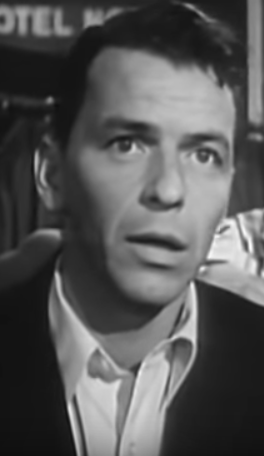
The protagonist is played by a real musician, the famous singer Frank Sinatra, whom we already saw as an actor in the highly recommended “The Manchurian Candidate” (John Frankenheimer, 1962). Although the main character in the film and the actor who plays him share the same profession and first name, the real Frank Sinatra never became addicted to drugs, unlike many of his colleagues (especially from the 1960s onwards). In any case, there are quite a few similarities between the actor/singer and his character in this brilliant work by Preminger: for example, their humble origins, their great popularity with women, and also their connections to the underworld.
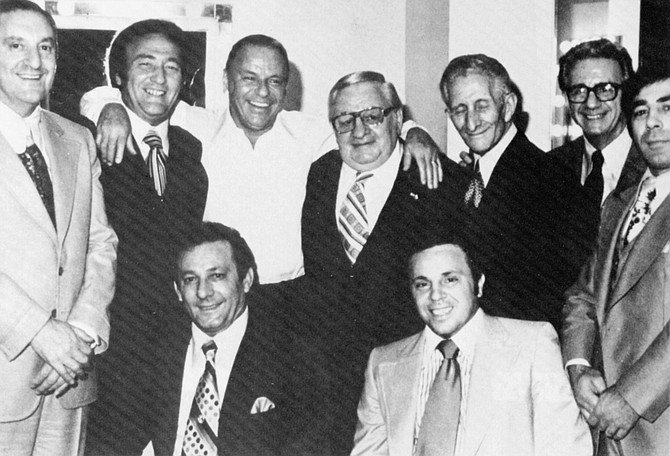
It is no secret that Sinatra knew some Mafia bosses personally, and it is said that the character of singer Johnny Fontane in The Godfather was inspired by him.
The starlet Molly is played by Kim Novak, best known for her role in Vertigo (Alfred Hitchcock, 1958).
Sinatra accurately depicts the hellish anguish that addicts go through when they are suffering from withdrawal symptoms. And he did so well before heroin became “fashionable” on the streets of the US and the rest of the Western world. This could be interpreted as a case of predictive programming or negative priming, considering that Hollywood often “announces” socio-political phenomena, trends, or events that later occur in reality.
Frankie’s relationship with women is also of great interest: the two women in this story are crazy about him, but while one of them holds him back in his development (in his struggle to leave crime and drugs behind), the other encourages him to continue on the path of self-improvement. One represents his past and the other his (potential) future.
There is a scene with considerable symbolic weight in which Frankie and Molly talk against the backdrop of a shop window displaying mannequins representing a traditional American family of the time. Perhaps the subliminal intention was to show that this prototypical 1950s family (being “paralyzed” because they are mannequins) was soon to be ‘surpassed’ by more “open” couples and relationships, as in the case of the characters in the film. Returning to the aforementioned hypothesis of predictive programming, we all know how family and relationship issues evolved from the 1960s onwards…
Among the screenwriters is Ben Hecht (who wrote the original 1932 “Scarface”, directed by Howard Hawks), and the film is based on a novel by Nelson Algren published in 1949. But Hecht and Preminger took many liberties to change important details and approaches from the original story. For example, the protagonist’s drug addiction, which in the book is a mere anecdotal detail, becomes the central plot point in the film. In the book, the protagonist became addicted to morphine when he had to take the drug to treat injuries he suffered as a soldier in World War II. In the film, on the other hand, it is mentioned that Frankie first recovered from his addiction while in prison (with the doctors who treated him there). In other words, in the book, the character becomes addicted to the drug as a result of medical therapy, while in the film it is the other way around. Furthermore, Frankie recovers while in captivity, but once released, he relapses. Note the paradox—as if subliminally suggesting: state control = good, freedom = danger.
Details such as these led the original author of the novel, Nelson Agren, to consider the film not as an adaptation of his work, but rather as a distortion of it.
Be that as it may, the truth is that, objectively speaking, “The Man with the Golden Arm” is a cinematic masterpiece. Among the best sequences, in my opinion, are the one that shows us how Frankie spends the whole night awake as a croupier (forced to do so by the gangsters), while fighting the “monkey”, and then his resounding failure in his audition as a percussionist the next morning.
Felix Hahlbrock Ponce
(Get my books HERE)