
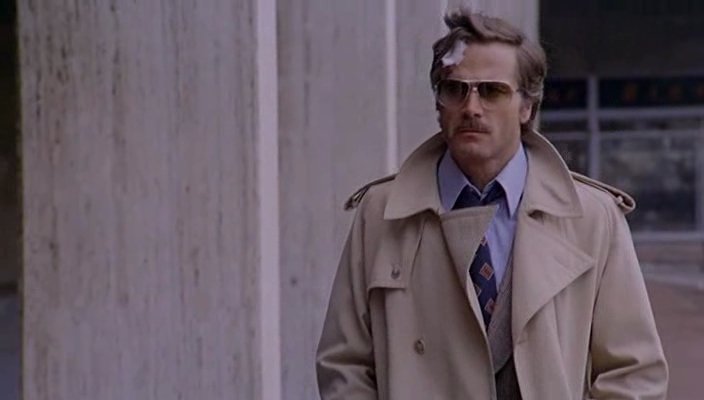
Il cittadino si ribella
Italy, 1974
Director: Enzo G. Castellari
Writer: Enzo G. Castellari
Film Genre: Thriller, Action, Police (Poliziesco)
Soundtrack composer: Guido De Angelis and Maurizio De Angelis
Production company: Capital Film
Main actors:
Franco Nero (Carlo Antonelli)
Giancarlo Prete
Barbara Bach
Renzo Palmer
Nazzareno Zamperla
Massimo Vanni
Romano Puppo
Renata Zamengo
Franco Borelli
Mauro Vestri
Luigi Antonio Guerra (Gianni Rubei)
Plot
Italy, 1970s. Muggings and violent robberies are the order of the day. Criminals roam freely, almost with impunity, committing the most heinous assaults. A trio of crime professionals pull off a brutal bank robbery. In their escape, they take Carlo (Franco Nero), an engineer, with them. It is not the first crime of which he is a victim; shortly before his house has been robbed and set on fire by unknown assailants. A fast-paced car chase through the streets ensues. During the escape, the criminals (who have taken off their ski masks exposing their faces) viciously beat Carlo, and once in the harbor, they abandon him and escape in a second car they had prepared…
Carlo is called to testify before the police. But the commissioner does not seem too interested in investigating in depth, and Carlo has the impression that the agents are not doing everything in their power to protect the citizen. Carlo feels humiliated, and abandoned by “justice”, so he decides to investigate on his own and take revenge on the three bandits once he has found them. His acquaintances and friends (including his girlfriend Barbara) try to discourage him, insisting that it is too risky, that “justice should not be taken into one’s own hands”, etc.
However, the intrepid (but very naive) Carlo is determined to venture into the city’s underworld to find out the identities of his assailants (whose faces he remembers perfectly well). But the inexperience of his methodology prevents his inquiries to bear fruit: he dedicates himself to ask (almost openly) in the locals of the malavita about the three individuals, making descriptions of them. Obviously, the questioned criminals look at him with suspicion and will try to get rid of him, they will also mock and even beat this stranger who asks too many questions. In this way, Carlo is going nowhere: he is behaving like a “nerd”.
Despite the initial difficulties, Carlo later employs a more fruitful tactic: He follows a random criminal and constantly photographs him, obtaining snapshots of him leaving a jewelry store, which prove his involvement in a crime. Thus, with the compromising photos in his possession, Carlo blackmails the gangster (named Tommy), pressuring him to reveal the names of the three assailants the police “failed” to catch. Through Tommy, Carlo also seeks access to firearms, in case he is confronted by his enemies.
Tommy is willing to help him; and as a sign of good will, Carlo gives him the reels of photos proving his authorship of the robbery (although he still does not know the identity of the three). Carlo had managed to summon them through Tommy in an industrial warehouse, and when they were there he quickly alerted the police, but the criminals knew in advance that they were wanted and escaped in time… This raised Carlo’s suspicions of collusion between the police and certain professional criminals, although the commissioner denied it, emphasizing that organized crime has the capacity to intercept calls…
Carlo and Tommy end up becoming friends. When Carlo arrives in the presence of the three criminals he is looking for, they pounce on him and massacre him, giving him a bestial beating. They then lock him in a kind of hideout, but Tommy helps him get out (it is ironic that the vigilante citizen is more helped by a criminal than by the police). One of the three criminals notices his escape and chases him by car, Carlo runs desperately in front of the vehicle, and is rammed several times, until he falls rolling down a ravine… But he manages to get away almost unharmed, and finds a shovel, which he uses to smash the windshield of his pursuer’s car… and soon after his own pursuer. However, Tommy stops him before Carlo unloads the coup de grâce… From that moment on, they both try to hunt down the other two criminals and prove to the police that the three of them were the perpetrators of the robbery who took him hostage.
Comment
Enzo Castellari’s curious polizziotesco from a somewhat different perspective: this time the story is not seen through the eyes of a policeman, nor through those of a criminal; but from the point of view of the ordinary citizen, who fed up with the crime wave and police inefficiency is willing to take the necessary risks to become a “vigilante” himself… although his amateurish procedures leave something to be desired at the beginning.
Watching especially the opening scenes of this film, it is quite obvious where directors like Martin Scorsese (the violent scenes with background music reminiscent of “Casino” -1995- or “Goodfellas” -1990) got their inspiration to shoot some of the films of his successful filmography. Castellari is undoubtedly one of the directors to whom Scorsese owes a lot. Tarantino, for his part, is not “inspired”, but rather plagiarizes and recycles on numerous occasions the Italian-Seventies style (even in the music) so characteristic of the polizzioteschi.
Very good, by the way, the soundtrack by the De Angelis brothers.
Felix Hahlbrock Ponce
(Get my books HERE)