
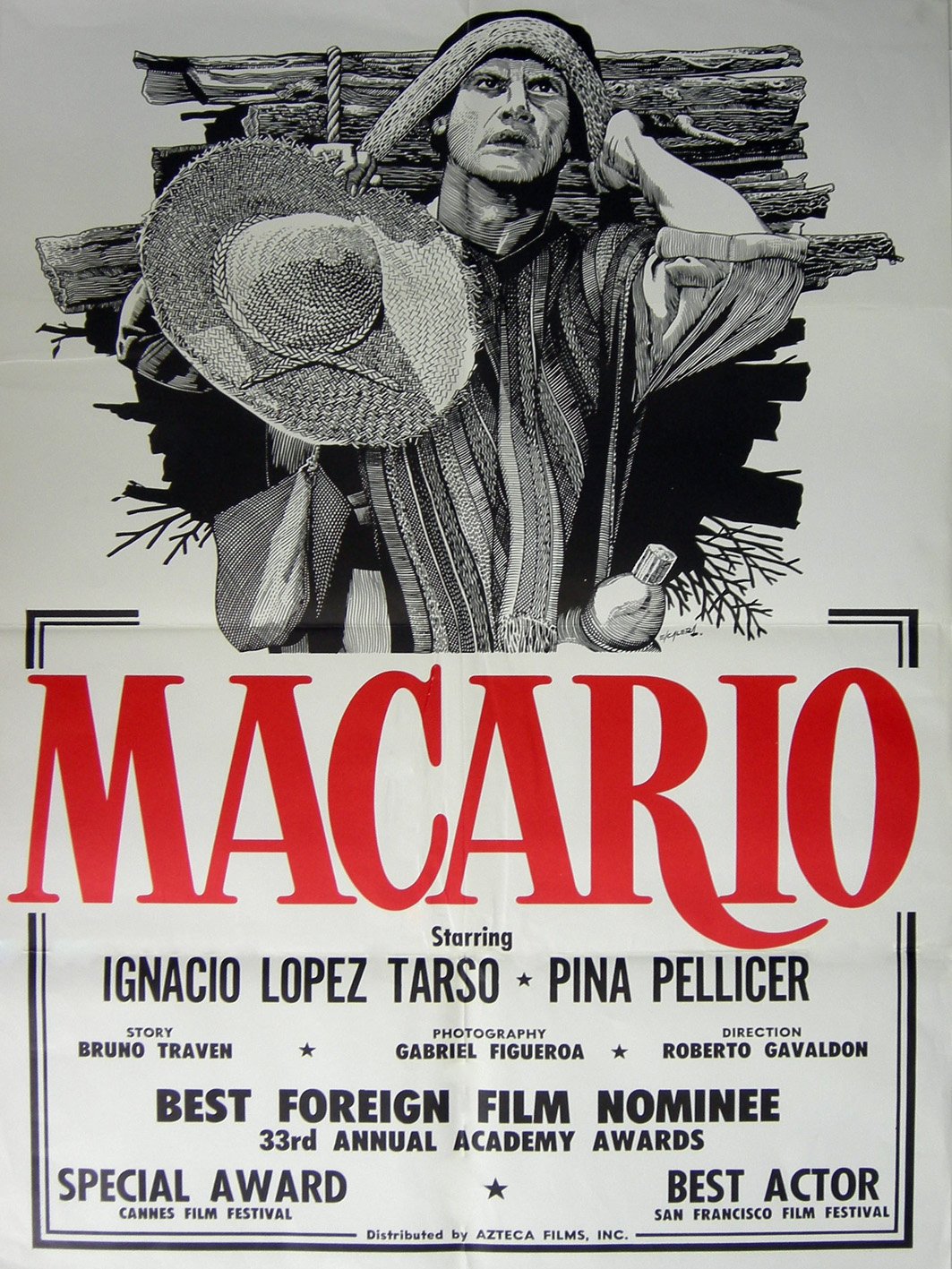
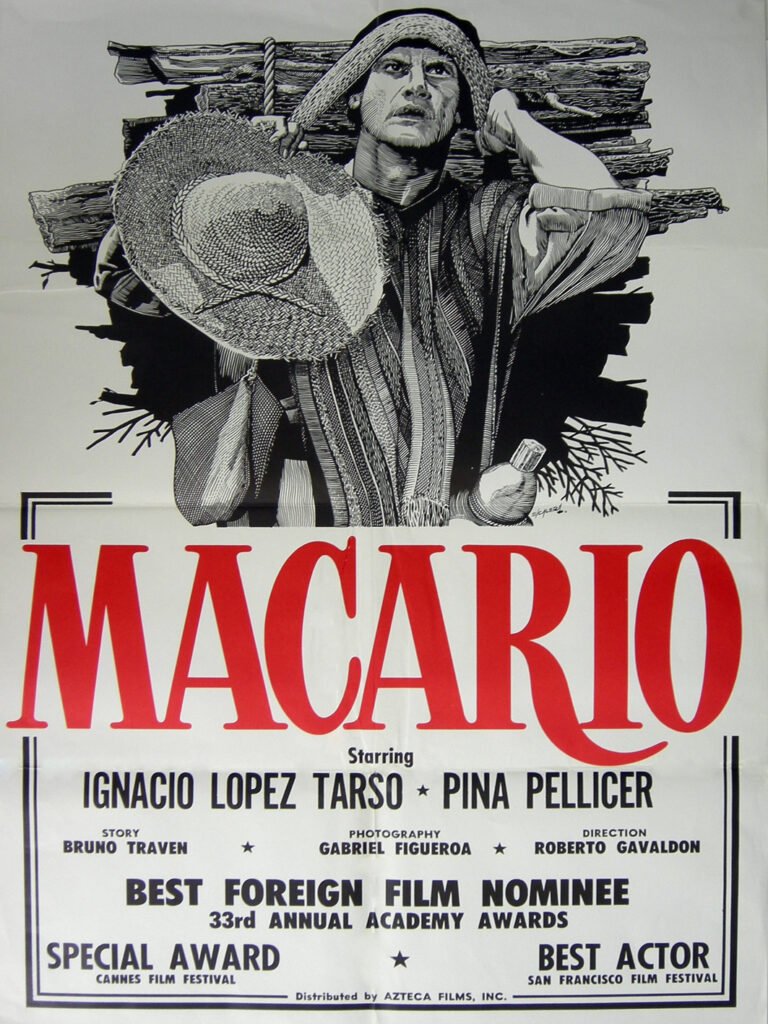
Macario
Mexico, 1960
Director: Roberto Gavaldón
Screenwriters: Roberto Gavaldón, Emilio Carballido
Soundtrack composer: Raúl Lavista
Editing: Gloria Schoemann
Production:
Executive Producer: José Luis de Celis
Producer: Armando Oribe Alba
Main actors:
Ignacio López Tarso (Macario)
Pina Pellicer (Macario’s wife)
Enrique Lucero
Mario Alberto Rodríguez
José Gálvez
José Luis Jiménez
Eduardo Fajardo
Consuelo Frank
Genre: Supernatural psychological drama
Plot
In 18th century rural Mexico, Macario is a poor peasant and indigenous woodcutter who is constantly in a state of scarcity. He barely earns enough to support his large family; his wife and seven small children. Always haunted by a voracious hunger, his greatest aspiration in life is to one day be able to have a great feast, a feast that will satiate him once and for all.
As it is the Day of the Dead, the city is full of food stalls in the streets: there are edible sweet skulls and also succulent roast turkeys (which poor Macario cannot afford to eat; he only sees them coming out of the oven in the place where he goes to deliver the firewood)…
The desperate Macario decides that he will not eat again until he gets a “guajolote” (turkey) that he can eat by himself, without the need to share it with anyone (not even his children). His wife is quite worried about his radical determination:
She: Aren’t you hungry (she asks him when one morning he refuses lunch when he goes to work in the fields)?
Macario: Hungry? I’ve never had anything else in my whole life!
The good woman is ready to help him to achieve his goal as soon as possible. So the lady takes advantage of the holidays to steal a turkey from a rich family’s farmyard.
Macario goes to the forest with the roasted turkey, to eat it secretly from his children. Once there, three mysterious characters appear in succession, trying to convince him to share his turkey with them. The first is the Devil, who, having taken the form of a rich landowner, is willing to give him something of value in exchange. The Devil offers him the silver spurs from his boots, but Macario replies that he has no horse. He then tempts him with some gold coins that he takes out of his pocket, but the peasant says that everyone would believe that he stole them and that they would cut off his hands as a thief. Then he offers him the whole forest; to which Macario replies that if they gave him the forest he would still be poor, and should continue to cut the wood. And furthermore: The forest is not his “but God’s.” Then, the Devil volatilizes.
The second character who tries to persuade Macario to share his succulent delicacy with him is none other than God Himself, in the form of a humble and decrepit old man, and the poor peasant argues that He already has everything and needs nothing, that he only wants to test him and see a gesture on his part. Then the divine old man vanishes.
The third who crosses his path is Death, transformed into an indigenous peasant in the image and likeness of Macario himself, but dressed in rigorous black. When Death tells him that he has not eaten for “thousands of years”, Macario finally agrees to share his food out of understanding (for his own situation was similar). The peasant also realizes that no one escapes Death’s inescapable design, and confesses to his interlocutor that he also agreed to invite him to the feast in order to delay his own death. After the feast, and to reward him for his generous gesture, Death makes a stream of water with healing properties gush from the ground, capable of healing seriously ill people. Macario empties his canteen and fills it with this new water. However, the use of this miraculous remedy has one condition: If Macarius sees, at the moment of providing the water to the sick person, that Death is at the foot of his bed, the person who drinks the water will be healed. But if he sees it at the bedside, there is nothing more to be done; that person is hopelessly finished.
Macario returns home and is soon presented with the opportunity to use his healing water. A single drop is enough to restore a dying man to health. The first person he is able to help is one of his sons, who was lying unconscious after falling into a well. Then, some of his neighbors in the village. Among them, the wife of the wealthy Don Ramiro. The latter intends to do business at the expense of Macario’s faculties, and prepares a list with the names of sick and rich friends and acquaintances, to charge them in exchange for their cure.
Little by little, Macario’s fame as a healer grows locally and even throughout the viceroyalty. The sick flocked to request Macario’s care, and in most cases he managed to cure them (it was only impossible when Death appeared at the patient’s bedside). The success of the once humble peasant is such that he puts the local doctor (and the undertaker) out of work. Initially he does not wish to charge people, but the locals bring him food and money on their own initiative. Thus Macario is no longer poor, and as he now lives in abundance he shares what he earns with the most disadvantaged.
However, the healing water is not unlimited, and after a while it is about to run out. To make matters worse, one day the authorities of the Inquisition show up and accuse Macario of practicing sorcery…
Comment
This wonderful classic of the “Golden Age” of Mexican cinema has all the characteristics of a parable, a metaphysical tale with a transcendent sense that invites us to reflect on life and death, on the thin line that separates both concepts, and also on predestination. “Macario” is a beautiful funeral fable, whose viewing is especially suitable for the Day of the Dead (or All Saints’ Day), November 1 – a traditional holiday that is deeply rooted in Mexican culture. The film reminds us that, like the miraculous water in Macario’s canteen, life also comes to an end someday, and that from the perspective of eternity “we spend more time dead than alive”.
The film is set in the time of the Viceroyalty of New Spain and is based on a novel by B. Traven – pseudonym of the German anarchist author Otto Feige (1882-1969), based in Mexico since the 1920s. This writer inspired the story of “The treasure of Sierra Madre” (John Huston, 1948).
Shot in black and white, it recalls Ingmar Bergman’s “Seventh Seal” (1957) in its mortuary subject matter, style and aesthetics. In my opinion, “Macario” is superior in interest to the celebrated (but sometimes somewhat tiresome) feature film by the acclaimed Swedish director, and it is a pity that this wonderful Hispanic film is so unknown outside its country of origin.
Among the best scenes should be highlighted the one in the dungeon, when Macario is urged by the inquisitorial authorities to predict the next deaths among the condemned (and to everyone’s astonishment the one about to die is the least expected individual…); as well as the sequence in the grotto towards the end, when Death shows Macario the multitude of candles that are consumed there (each one represents a life, and when the candle is extinguished the person dies). Macario realizes that his own candle is also there…).
Who gives life (never better said in this case) to Macario is the great Ignacio López Tarso, who we already know for his memorable leading roles in the masterpieces “Rapiña” and “El profeta Mimí”. At the time of writing (March 2016), the now nonagenarian López Tarso is still active in the world of cinema in his native Mexico, participating as an actor in current films.
Felix Hahlbrock Ponce
(Get my books HERE)